
Researchers in a 2021 study used SART data from the US on over 250,000 FETs and found that blastocyst-stage transfers were more likely to lead to male births compared to cleavage stage transfers.
We’ve seen plenty of data that compares the IVF outcomes of cleavage stage and blastocyst stage transfers. Overall, blastocysts tend to perform better compared to cleavage stage.
This is mostly because the embryo on Day 3 has been carried due to stored egg factors. Up to Day 3, the DNA of the sperm and egg are busy coming together, and around Day 3 the embryo’s DNA is activated. From this point on, the embryo’s development depends on the integrity of its DNA. If there’s any mistakes, then the embryo may not pull itself out from the cleavage stage and progress to blastocyst.
For a review on the data around Day 3 and Day 5 transfers, see here.
🔗 Original studies are referenced in this post or within the linked Remembryo posts.
💡 Reminder: Terms underlined with a dotted black line are linked to glossary entries. Clicking these does not count toward your paywall limit.
But besides pregnancy outcomes, another question we can ask is if there is a difference in the sex ratio between Day 3 and Day 5 embryos. Does one have a higher chance of producing a male baby?
There’s evidence that the male-to-female sex ratio is slightly skewed towards male in IVF, and that this might have to do with male embryos growing faster compared to female embryos.
Why this is isn’t clear.
So what’s the difference between boys and girls? We all have 46 chromosomes in most of the cells in our body. In males, we have a single copy of an X chromosome and a single copy of the Y chromosome. Females have two copies of X.
This second X chromosome needs to be inactivated in the embryo, which could lead to slight delays in development. Additionally, there could be genes on the Y chromosome that promote the rate of development of male embryos. And since the most developed embryo is usually transferred first, then it’s possible that male embryos may be preferentially transferred.
However, this evidence has mainly been in the context of fresh transfers, and Perlman et al. (2021) wanted to see if this applied to frozen transfers (and on a pretty big scale!).
In this retrospective study, the researchers looked at SART national IVF outcome data between 2004-2013. SART collects data from most clinics in the US and reports this data annually. They looked at over 55k blastocyst transfers and 42k cleavage stage transfers from over 256k women who had an FET.
In the cleavage stage group, 50.5% of live births were male (49.5% female), and in the blastocyst group, 51.9% of live births were male (48.1% female). Said another way, cleavage stage transfers produced 0.5% more males while blastocyst stage transfers produced 1.9% more males.
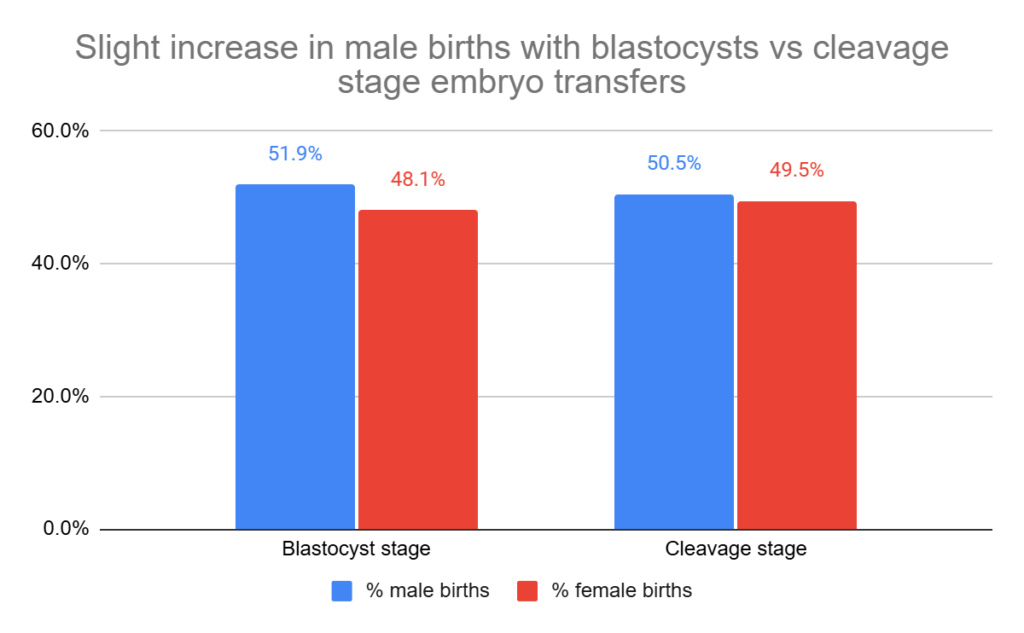
They also examined if body mass index, age, male factor infertility, and race had an impact on the sex ratio. Even when they considered these factors, there was an increased chance of having a male live birth.
Although there are differences, does this minor difference really make a difference? Probably not.
Other studies have shown a skewed male live birth rate with blastocysts:
- Bu et al. (2014) found that 54.9% of blastocyst transfers were male compared to 51.4% in cleavage stage.
- Dean et al. (2010) found 54.1% in blastocysts vs 49.9% in cleavage stage.
- Luke et al. (2008) found 51.6% with blastocysts vs 48.9% with cleavage stage.
- Supramaniam et al. (2019) found 104.8 males per 100 female births with blastocysts compared to 101.2 males per 100 females in cleavage stage.
Besides the speed of development of the embryo, other factors may contribute to the preference for males. These points were raised by Licciardi (2021).
When you look at natural conception and births, the male sex ratio is more dramatically skewed – ranging from 4.6% to 5.9% over the years in the USA. So IVF itself may not responsible for this phenomenon.
Boys die more frequently than girls. They have a higher risk of birth complications, higher infant mortality rates, and are more likely to die of infectious disease. This might be because they have a weaker immune system (because they only have one copy of the X chromosome vs two in females, and the X chromosome carries a lot of immune-related genes) (Ritchie and Roser 2019). On average, women live longer than men.
So evolution may be skewing the sex ratio in favor of males in order to compensate for these increases in male mortality, but how this is caused isn’t clear.
Reference

About Embryoman
Embryoman (Sean Lauber) is a former embryologist and the founder of Remembryo, an IVF research and fertility education website. After working in an IVF lab in the US, he returned to Canada and now focuses on making fertility research more accessible. He holds a Master’s in Immunology and launched Remembryo in 2018 to help patients and professionals make sense of IVF research. Sean shares weekly study updates on Facebook, Instagram, and Reddit regularly. He also answers questions on Reddit or in his private Facebook group.
Related posts:
 Predicting live birth rates, multiples based on 223,377 transfers
 An Italian consensus on key performance indicators for assessing IVF clinics
 Study compares outcomes after first IVF cycle, based on age
 Impact of delayed treatment on IVF outcomes
 2 embryos or 1? The risks of a double embryo transfer for women under 35
 Predicting how many day 3 embryos make it to blastocyst
 Sleep quality and its impact on IVF outcomes
 No differences in IVF outcomes when using fresh or frozen donor eggs