
Researchers in a 2023 study found that blastocysts with various degrees of hatching, including those that are completely hatched, have increased clinical pregnancy and live birth rates compared to non-hatching blastocysts.
Blastocysts that are completely hatched (a “6” by conventional grading) might be more fragile, potentially leading to reduced success rates compared to blastocysts still inside the zona.
Han et al. (2023) wanted to test this by comparing pregnancy and neonatal outcomes of embryos of varying hatching status, including hatched embryos.
Before diving in, a good post to review is my Complete guide to embryo grading and success rates, particularly the section on “expansion” in the blastocyst grading section.
🔗 Original studies are referenced in this post or within the linked Remembryo posts.
💡 Reminder: Terms underlined with a dotted black line are linked to glossary entries. Clicking these does not count toward your paywall limit.
Study details
- This is a retrospective study that took place between 2016 and 2017 at a single IVF center in South Korea.
- A single, frozen embryo was transferred. As far as I can tell, these were not assisted hatched.
- The embryo transferred was either non-hatching (a 1, 2, 3 or 4 for its expansion), hatching (a 5) or hatched (a 6).
- The primary outcome was the clinical pregnancy rate and live birth rate.
In terms of the sample size, there were 147 patients in the non-hatching blastocyst transfer group, 484 in the hatching blastocyst group and 186 in the hatched blastocyst group.
In terms of baseline characteristics, there were no differences in age (~33 years old), infertility duration, endometrial thickness, the type of FET, embryo quality, and more.
Blastocysts that are hatching/hatched have better pregnancy outcomes than non-hatching blastocysts
The clinical pregnancy and live birth rates of non-hatched, hatching and hatched blastocysts were evaluated.
Both clinical pregnancy and live birth rates were higher for hatched blastocysts compared to hatching blastocysts (53.2%, 42.5% vs 42.8%, 32.0%, p< 0.001), and hatching blastocysts had higher rates than non-hatching blastocysts (42.8%, 32.0% vs 27.9%, 23.1%, p< 0.001).
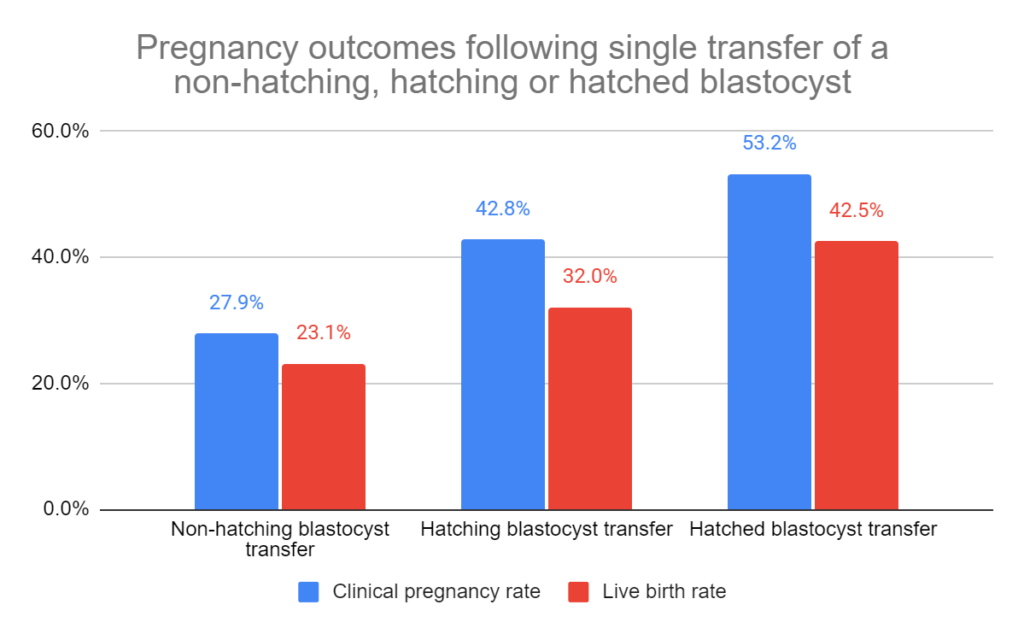
Multiple pregnancy and miscarriage rates were similar for these transfers.
The degree of hatching can affect pregnancy outcomes
They also evaluated outcomes based on how much a hatching blastocyst was hatching by measuring the volume of the hatching/non-hatching parts of the blastocyst. There were early, mid and late hatching blastocysts. An example can be seen below:

There were 484 patients in the hatching blastocyst group, with 185, 103 and 196 for early, mid and late hatching.
Clinical pregnancy rates were higher for late hatching blastocysts compared to early hatching blastocysts (50.5% vs 33.0%, p= 0.002). There was no statistical difference with both the early and late hatching groups compared to mid hatching.
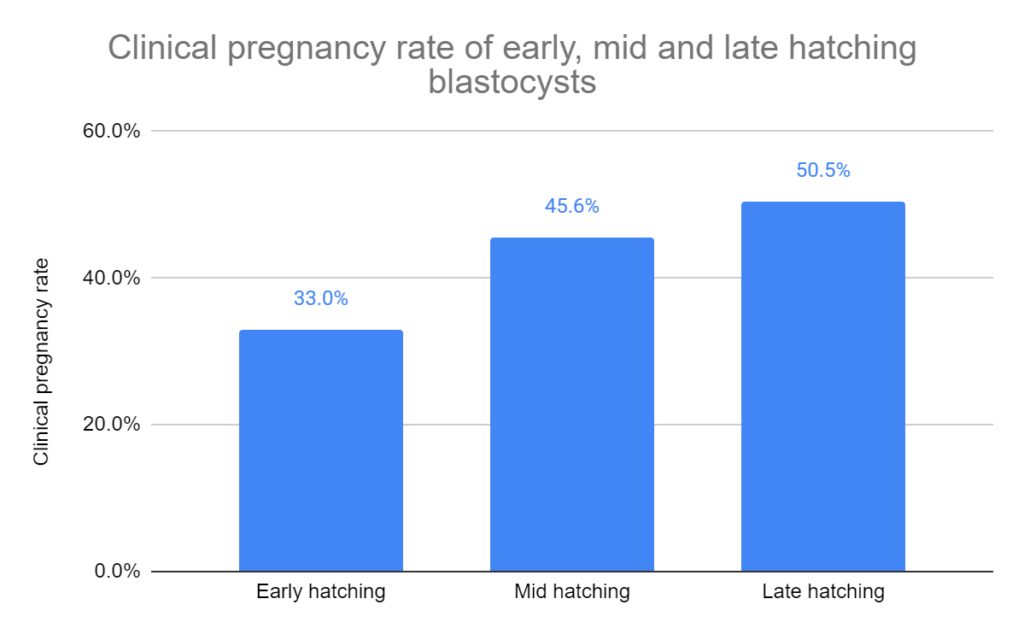
Overall, there was no difference in live birth rates, multiple pregnancies and miscarriage rates for any of these groups.
Neonatal outcomes following early, hatching or hatched blastocysts
In addition to evaluating the pregnancy outcomes, the researchers also compared neonatal outcomes.
They found that there was an increased chance of having a Cesarean delivery with non-hatching blastocysts compared to hatching or hatched blastocysts (73.5% vs 62.6%, 48.1%, p= 0.022).
Besides this, there were no differences in the gestational age of the babies born, their birthweights, or congenital malformations.
Conclusions
Clinical pregnancy and live birth rates increased as the embryo developed. So non-hatching blastocysts had lower rates than hatching blastocysts, which had lower rates than hatched blastocysts (non-hatching < hatching < hatched).
They also looked at the degree of hatching in blastocysts, based on the volume of the hatching/non-hatching parts of the blastocyst. The more the embryo was hatching, the higher the clinical pregnancy rates.
There was an increased risk of Cesarean delivery with non-hatching blastocysts compared to hatching or hatched blastocysts. It’s not clear why this is, and the authors didn’t discuss it.
This shows that the development of the embryo, and its degree of hatching, is linked to its success rate. It also shows that embryos that are completely hatched have the highest rates, which contradicts the idea that these embryos are fragile due to the absence of the zona and have reduced success rates.
A limitation is that they didn’t report on the day of the blastocyst, so it’s not clear if these were all day 5, 6, 7 or mixed.
As far as I can tell, these embryos weren’t assisted hatched, but they were collapsed before freezing. This is when a laser is used to make a hole in the blastocyst so the water in its cavity is released. This is to prevent the formation of sharp ice crystals during freezing that could damage the embryo. You can read more about embryo collapse here.
It’s possible that the single laser shot could have assisted in the hatching process to some degree. It would be interesting to see this work done with fresh blastocysts, that are never exposed to a laser.
This research is supported by another recent study on hatched embryos, although these embryos were artificially hatched and removed from the zona manually before transfer. You can check out that study here.
Related studies
Not all of the research on this topic may agree with this study. For those who are interested in learning more, here are links to 6 related studies that were referenced in the article:

Reference

About Embryoman
Embryoman (Sean Lauber) is a former embryologist and the founder of Remembryo, an IVF research and fertility education website. After working in an IVF lab in the US, he returned to Canada and now focuses on making fertility research more accessible. He holds a Master’s in Immunology and launched Remembryo in 2018 to help patients and professionals make sense of IVF research. Sean shares weekly study updates on Facebook, Instagram, and Reddit regularly. He also answers questions on Reddit or in his private Facebook group.