

Researchers in a 2026 study found that patients with only one fertilized egg (zygote) may have a higher chance of live birth with cleavage stage transfer (day 3) than blastocyst stage transfer (day 5), especially at older ages.
Growing embryos to the blastocyst stage improves the chance of selecting the best embryo for transfer. However, that strategy assumes there are multiple embryos to choose from.
For patients with only one fertilized egg (zygote), culturing to the blastocyst stage can be risky, since the embryo could stop developing before reaching the blastocyst stage and leave nothing to transfer.
In a study by Fitzgerald et al. (2026), they analyzed data from more than 11,000 IVF cycles to estimate whether transferring the embryo at the cleavage stage (day 2–4) or waiting until the blastocyst stage resulted in a higher chance of live birth for these patients. Because a randomized trial would be difficult to perform, the researchers used a statistical approach called a target trial emulation, which attempts to mimic a randomized trial using observational data.
🔗 Original studies are referenced in this post or within the linked Remembryo posts.
💡 Reminder: Terms underlined with a dotted black line are linked to glossary entries. Clicking these does not count toward your paywall limit.
Study details
- Study type: Retrospective study using a target trial emulation, conducted using data from the Australia and New Zealand Assisted Reproduction Database (ANZARD), consisting of multiple IVF clinics in these countries, between 2009 and 2022.
-
Participants: 11,163 patients undergoing their first IVF/ICSI cycle who had only one fertilized egg (zygote) and had never given birth before. No patients using PGT, donor eggs or sperm, gestational carriers, embryo donation, total fertilization failure.
- 6,505 had a cleavage stage transfer (~day 3).
- 2,216 had a blastocyst stage transfer (~day 5).
- 2,442 had no embryo available for transfer.
- Statistical modeling: The researchers knew which patients had a cleavage stage transfer, a blastocyst stage transfer, or no transfer because the embryo stopped developing. However, they didn’t know the planned transfer day for patients who didn’t have a transfer. They used a statistical model based on factors like the treatment year, clinic, age, and fertility history to estimate which transfer strategy those patients were most likely following. This allowed them to estimate the live birth rate for planned cleavage stage and planned blastocyst stage transfer.
- Primary outcome: Live birth.
Cleavage stage transfer resulted in more live births
The researchers estimated that patients with one fertilized egg (zygote) had a better chance of a live birth if they had a cleavage stage transfer instead of waiting until the blastocyst stage.
The researchers looked at live birth rates in two ways. First, they looked at live birth per patient (equivalent to per retrieval in this study because each patient only had one retrieval), which includes everyone who started treatment, even if the embryo stopped developing before transfer. They also looked at live birth per transfer, which only includes patients who actually had an embryo transferred.
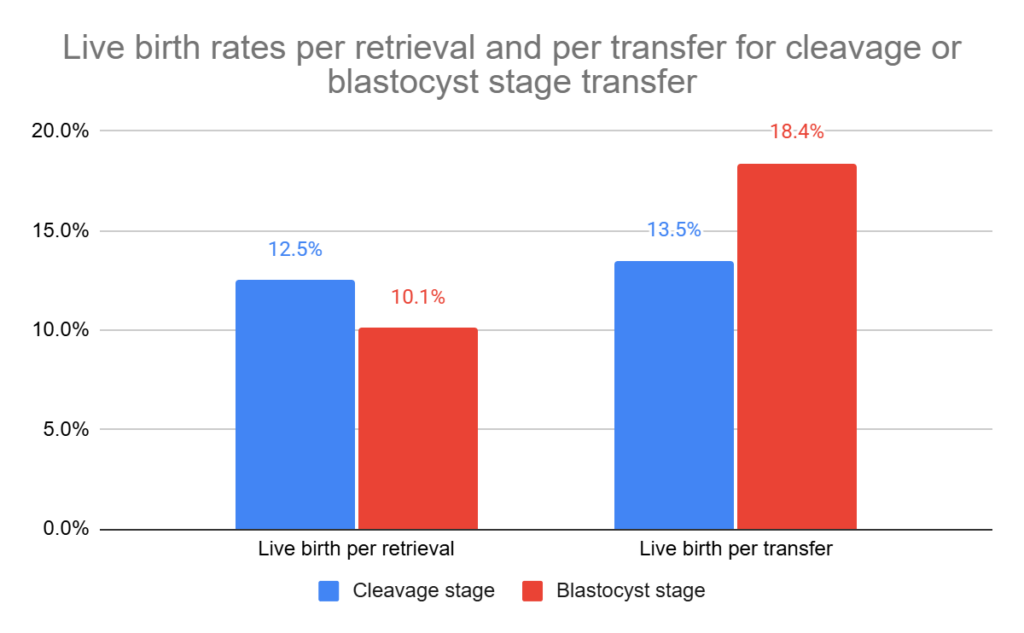
Live birth rate (per retrieval)
- Cleavage stage: 12.5%
- Blastocyst stage: 10.1%
- Adjusted relative risk [95% CI]: 1.24 [1.15–1.50]. This means that after accounting for other factors, patients who had a cleavage stage transfer had a 24% relatively higher live birth rate per retrieval than those who had a blastocyst stage transfer.
Live birth rate per transfer
- Cleavage stage: 13.5%
- Blastocyst stage: 18.4%
- Adjusted odds ratio [95% CI]: 0.74 [0.64–0.85]. This means that after accounting for other factors, patients who reached embryo transfer had a 26% relatively lower odds of live birth with cleavage stage transfer than with blastocyst stage transfer.
- These live birth rates were lower than those typically seen in the general IVF population (about 15.3% for cleavage stage transfer and 28.4% for blastocyst stage transfer). The researchers suggested this was likely because patients with only one fertilized egg generally have a poorer prognosis
Although blastocyst transfers had a higher success rate once an embryo was transferred, many embryos stopped developing before they reached the blastocyst stage (about 50-59% reached the blastocyst stage vs 92% that reached the cleavage stage). When those patients were also included, cleavage stage transfer had the higher overall live birth rate.
The researchers also identified several factors that were linked to embryo development:
- Lower chance of arrest before the cleavage stage: male factor infertility, tubal factor infertility, and unexplained infertility.
- Higher chance of arrest before the blastocyst stage: older female age (about 10% higher odds every 2 years), use of testicular sperm, and a higher number of eggs retrieved.
The benefit was greater with increasing age
The estimated benefit of planning a cleavage stage transfer became larger as female age increased.
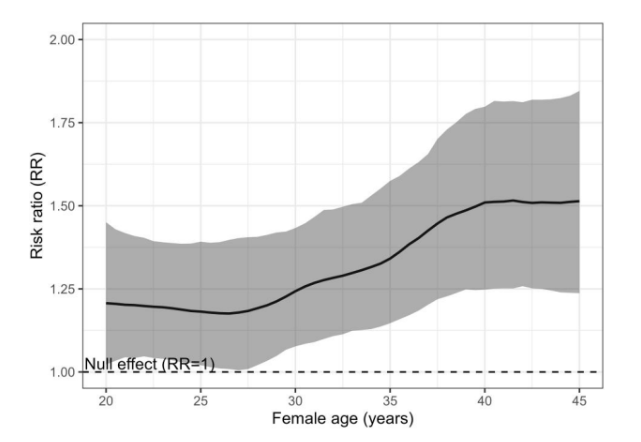
The graph shows the relative difference in live birth rates between cleavage stage and blastocyst stage transfer. A value of 1.0 means there was no difference between the two strategies. Values above 1.0 favor cleavage stage transfer.
For example:
- Age 35: About a 34% relatively higher live birth rate with cleavage stage transfer (RR 1.34).
- Age 40: About a 51% relatively higher live birth rate (RR 1.51).
Keep in mind that this is a relative difference, not an absolute one. For example, a 34% relatively higher live birth rate doesn’t mean the live birth rate increased by 34%. It means that if the live birth rate was 10% with blastocyst transfer, it would be about 13.4% with cleavage stage transfer.
The researchers estimated that this happened because fewer embryos reached the blastocyst stage with increasing female age. About 59% reached the blastocyst stage at age 35, compared with about 50% at age 40. This may make an earlier transfer more beneficial for patients with only one fertilized egg.
Conclusions
This study found that cleavage stage transfer was associated with higher estimated live birth rates than blastocyst stage transfer for patients with only one fertilized egg (12.5% vs. 10.1% per retrieval), with the benefit increasing in older patients. This may be because embryos from older patients were more likely to arrest before reaching the blastocyst stage, increasing the chance of having no embryo to transfer.
Blastocyst culture helps identify embryos with the best chance of success, but that advantage mainly applies when there are multiple embryos to choose from. When several embryos are available, one embryo arresting is less likely to prevent a transfer. With only one embryo, however, there’s a much higher chance of having nothing to transfer if it arrests during extended culture.
So does this mean embryos develop better in the uterus than in the lab?
This study can’t answer that directly, but it does suggest that transferring earlier may allow some embryos to continue developing that otherwise would have arrested during extended culture. This was especially true for older patients, whose embryos were more likely to arrest before reaching the blastocyst stage.
Still, the authors stress that these results shouldn’t be applied to patients with multiple embryos. Previous randomized trials have mostly included good prognosis patients with multiple embryos, and generally found that blastocyst transfer improves outcomes. For these patients, culturing to the blastocyst stage can be more practical because it helps identify the embryo with the best chance of success and may reduce the number of embryo transfers needed to achieve a live birth.
However, it’s not really clear what strategy is best for patients with a small number of fertilized eggs. These patients may benefit more from a strategy that maximizes every opportunity for pregnancy rather than reducing the number of transfers. This study suggests that transferring earlier could help achieve that, but it doesn’t prove it. It’s possible that some embryos develop better in the uterus than in the lab, since culture media can’t perfectly recreate the natural environment.
Limitations include that this was not a randomized trial, so the researchers had to use a statistical model to estimate which patients had a cleavage stage or blastocyst stage transfer. The study also didn’t have information on embryo quality, which could have affected both transfer decisions and outcomes.
Want to read more about cleavage vs blastocyst stage outcomes?
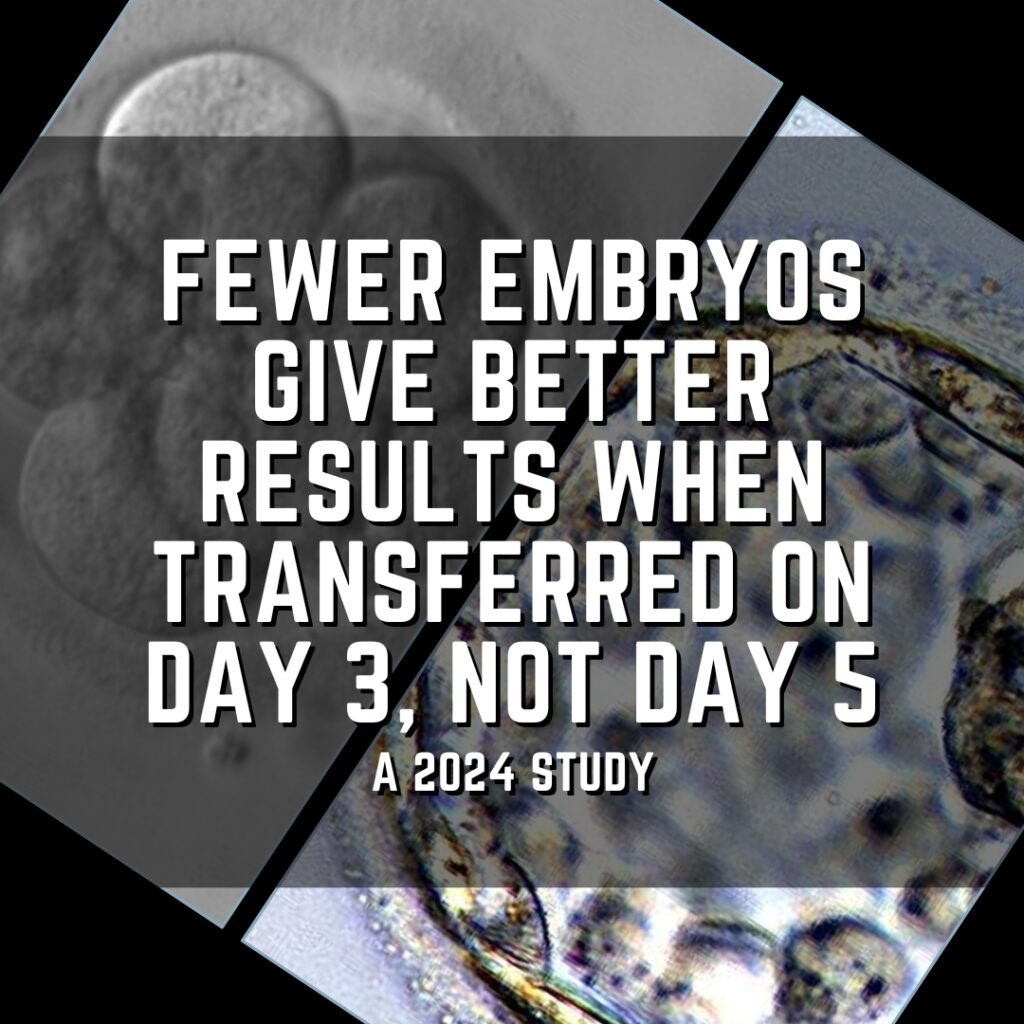
A 2024 study compared outcomes of IVF cycles that transferred day 2/3 or day 5/6 embryos, finding that day 2/3 embryos have higher live birth rates per cycle, particularly for patients with 3 or less embryos. Read more.

Researchers in their 2022 Cochrane review, performed a meta-analysis and combined the results of 32 studies that compared pregnancy outcomes of blastocyst and cleavage stage embryos, and found that blastocysts tend to produce better outcomes. Read more.

Not sure what your embryo grade means—or if it affects your chances of success? This guide walks you through everything from day 3 and day 5 grading systems to what each number and letter combo (like 3BB or 5AA) actually means. You'll also find success rate research, embryo photos, and insights from a former embryologist to help make sense of your report. Read more.
Reference
Oisin Fitzgerald, Wentao Li, Catherine Vallence, Georgina M Chambers, Luk Rombauts, Cleavage stage versus blastocyst stage transfers in patients with a single zygote: an emulated target trial, Human Reproduction, 2026;, deag075, https://doi.org/10.1093/humrep/deag075

About Embryoman
Embryoman (Sean Lauber) is a former embryologist and the founder of Remembryo, an IVF research and fertility education website. After working in an IVF lab in the US, he returned to Canada and now focuses on making fertility research more accessible. He holds a Master’s in Immunology and launched Remembryo in 2018 to help patients and professionals make sense of IVF research. Sean shares weekly study updates on Facebook, Instagram, and Reddit regularly. He also answers questions on Reddit or in his private Facebook group.