
Researchers performed rescue IVM on immature eggs collected from poor prognosis patients, and found that a large number became mature and fertilized, allowing about 1 in 12 patients to have a live birth that they wouldn’t have had otherwise.
Many IVF cycles result in immature eggs, which are normally discarded, but continued culture of these immature eggs by rescue in vitro maturation (rescue IVM) can cause some of them to become mature.
This post is a summary of an article by Hashimi et al. (2025), who performed rescue IVM on immature eggs from poor prognosis patients, causing some of them to mature that went on to live births.
As a reminder, immature eggs come as two types: germinal vesicle (GV) or metaphase 1 (M1). Eggs mature starting from a GV, then to M1, then to M2. So a GV is less mature than an M1. For more background on egg quality and maturity, check out my Complete guide to egg quality.
🔗 Original studies are referenced in this post or within the linked Remembryo posts.
💡 Reminder: Terms underlined with a dotted black line are linked to glossary entries. Clicking these does not count toward your paywall limit.
Study details
- This was a retrospective cohort study that took place at a single IVF center in the UK between 2016 and 2023.
- Only poor prognosis patients were included.
- Eggs that were mature four hours after egg retrieval were inseminated by ICSI or IVF. Eggs that were immature after this time (either GV or M1) were cultured overnight and assessed in the morning and ICSI’ed if they became mature.
- Embryos were cultured up to 7 days.
There were a total of 250 patients in this study, consisting of 311 egg retrieval cycles that resulted in 2243 eggs collected:
- 911 were mature after egg retrieval.
- 1322 were immature (GV or M1).
Patients were between 25-40 years old, with an average age of 38.4.
Acceptable IVF outcomes from rescue IVM eggs
From the 2243 eggs collected after retrieval (311 cycles), 911 were mature and inseminated on the day of the egg retrieval and 1322 were immature (GV and M1). From the mature eggs that did not have rescue IVM:
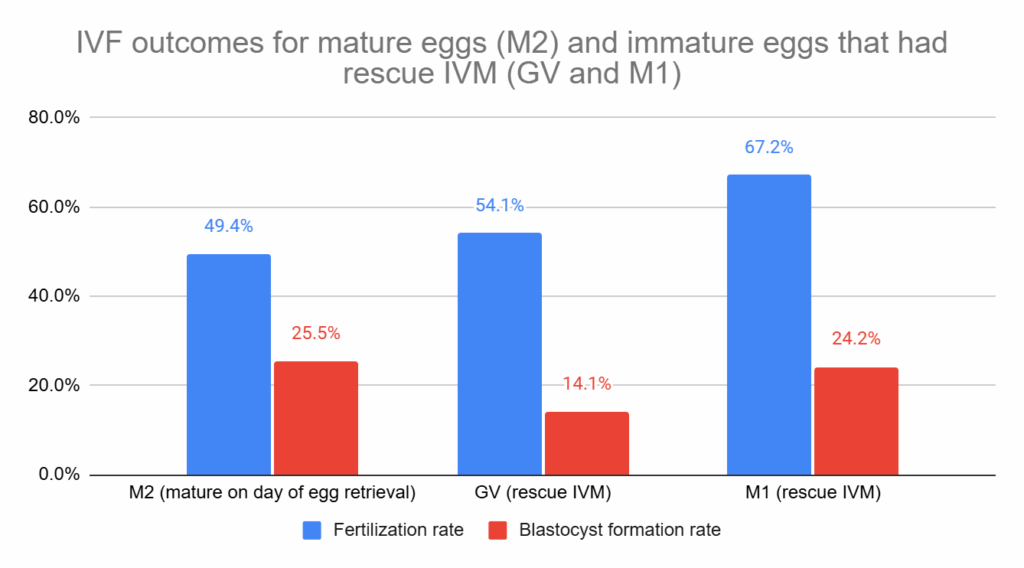
- M2: 49.4% fertilized and 25.5% became blastocyst (232 blastocysts).
The 1322 immature eggs were cultured overnight, with 798 of them becoming mature the next morning (60.4% maturation rate).
Of these 798 rescue IVM matured eggs, 170 came from GV immature eggs and 628 came from M1 immature eggs. ICSI was performed on these immature eggs that became mature after rescue IVM:
- GV: 54.1% fertilized, with 14.1% becoming blastocyst (24 blastocysts). There was no statistical difference in fertilization rate compared to M2 eggs, but there was a decrease in the blastocyst formation rate (p= 0.002).
- M1: 67.2% fertilized, with 24.2% becoming blastocyst (152 blastocysts). There was a statistical difference in fertilization rate compared to M2 eggs (p< 0.001), but no difference in blastocyst formation rate.
Euploid and healthy live births from rescue IVM
They performed PGT-A on the blastocysts that formed from mature eggs (no rescue IVM) and rescue IVM eggs:
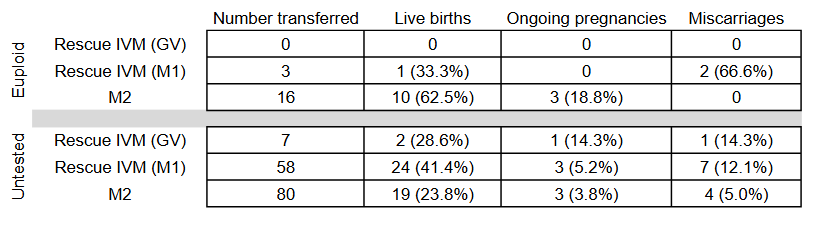
- Rescue IVM GV eggs: 0 out of 3 blastocysts were euploid.
- Rescue IVM M1 eggs: 7 out of 27 eggs were euploid (25.9%).
- M2 (no rescue IVM): 27 out of 101 eggs were euploid (26.7%). There was no statistical difference with M2 or rescue IVM M1 eggs in terms of the euploid rate.
Now let’s look at the pregnancy outcomes! Below is a chart that details the number transferred, the number of live births, ongoing pregnancies (because at the time this study was written up, there were still ongoing pregnancies) and miscarriages. There were no statistical differences in live birth rates for any of these results.
There were no differences in the gestation time for these births, the birth weights or the delivery method (vaginal vs caesarean).
Rescue IVM boosts live birth rate per cycle
Now let’s take a minute to appreciate how many cycles benefited from rescue IVM!
In this study, there were 209 egg retrieval cycles that didn’t have any blastocysts (they may have had mature eggs, but they didn’t produce any blastocysts). For these 209 cycles, there were 52 cycles that made blastocysts after doing rescue IVM (52/209 = 24.9%), with 18 of these cycles leading to a live birth (18/209 = 8.6%). In other words, 24.9% of cycles that didn’t produce blastocysts got blastocysts thanks to rescue IVM, with 8.6% of these cycles having a live birth! This effectively increased the live birth rate per cycle from 0% to 8.6%.
Besides the 209 cycles, there were another 102 egg retrieval cycles that did have blastocysts. For these 102 cycles, there were 29 cycles that had a live birth after transferring these blastocysts (29/102 = 28.4%) with an additional 9 live births thanks to rescue IVM (9/102 = 8.8%). So for those who made blastocysts, rescue IVM boosted the the live birth rate per cycle from 28.4% to 37.2%!
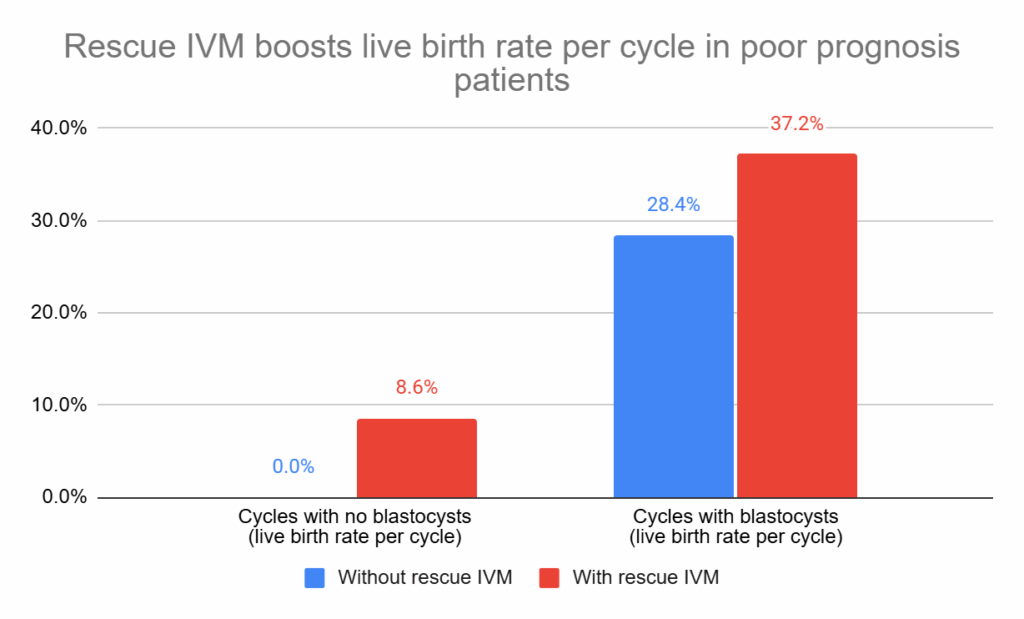
Note that this result is from my own analysis of the data, and not the author’s.
When we consider all of the births in this study, there were 27/311 = 8.7% that wouldn’t have happened without rescue IVM — about 1 in 12.
Also important to note is that there were additional blastocysts frozen from rescue IVM that could be saved for future cycles! Not all embryos were necessarily transferred in this study, so the rates above may be even higher when considering cumulative live birth rates.
Conclusions
This study found that rescue IVM matured 60.4% of immature eggs simply by culturing them overnight in the lab.
About half to two-thirds of these rescue IVM eggs were fertilized, leading to the formation of blastocysts that could be used for PGT-A or transferred.
They found no difference in euploid rates for blastocysts produced by mature eggs or through rescue IVM.
This study reported on 27 live births from blastocysts derived from rescue IVM, with no differences in gestation time, birth weights or delivery methods.
What’s most important, I think, is that rescue IVM led to live births for patients who wouldn’t have had a live birth otherwise. Without rescue IVM, these patients would have had to have another egg retrieval. What’s more is that rescue IVM can lead to more blastocysts on top of what a patient gets from their mature eggs, some of which can lead to a live birth.
This study generally agrees with other research, although there aren’t too many studies and the sample sizes are low. A recent meta-analysis by Batolacci et al. (2024) found that rescue IVM eggs had reduced fertilization, blastocyst formation rates and clinical pregnancy rates, with no differences in euploid and live birth rates. They concluded that rescue IVM could “maximize the efficiency of the treatment” in poor responders.
For more information, check out these other posts I wrote up on rescue IVM:
- Immature eggs cultured overnight by rescue IVM show promising IVF outcomes
- Culturing immature eggs overnight by rescue IVM increases number of euploids in cycle
- Immature eggs matured in-lab for 2-6 h show acceptable IVF outcomes
Reference

About Embryoman
Embryoman (Sean Lauber) is a former embryologist and the founder of Remembryo, an IVF research and fertility education website. After working in an IVF lab in the US, he returned to Canada and now focuses on making fertility research more accessible. He holds a Master’s in Immunology and launched Remembryo in 2018 to help patients and professionals make sense of IVF research. Sean shares weekly study updates on Facebook, Instagram, and Reddit regularly. He also answers questions on Reddit or in his private Facebook group.