
Researchers in a 2022 study compared outcomes from mature M2 eggs and M1-M2 eggs that underwent “rescue in vitro maturation” and found that M2 eggs had improved fertilization, blastocyst conversion and euploidy rates, with no difference in pregnancy or live birth rates.
After retrieval, eggs can be in varying stages of maturity, such as M1 (immature) or M2 (mature). An immature M1 egg can continue its development outside the body, and some centers mature these eggs in the lab by rescue in vitro maturation (rescue IVM). To learn more, you can check out my post on egg maturation.
Moon et al. (2022), in their retrospective study, compared outcomes when using M2 eggs and eggs that were originally M1 but developed into M2 eggs within 2-6 hours after egg retrieval (M1-M2 eggs). This study took place between 2016 and 2020 at a single university based IVF center in the US.
For more background on egg quality and maturity, check out my Complete guide to egg quality.
Key points:
- 800 patients were involved in this study, with 7,865 M2 eggs and 2,369 sibling M1-M2 eggs (from the same patient).
- No overnight culture of M1 eggs was done – only incubation for 2-6 hours after retrieval, without the use of specialized culture media or equipment. Eggs that were still immature after reassessment were discarded.
- ICSI was performed on all eggs.
- PGT-A was performed on day 5-7 embryos with grades higher than 3CC.
- Single euploids were transferred (natural or medicated)
- Euploids derived from M2 eggs were prioritized over those derived from M1-M2 eggs.
- Average age was 37 years.
A “generalized estimating equation” was used to compare outcomes between M2 and M1-M2 sibling eggs in the same patient, and confidence intervals were calculated to show significance.
🔗 Original studies are referenced in this post or within the linked Remembryo posts.
💡 Reminder: Terms underlined with a dotted black line have glossary definitions. Hover or tap to see a short definition, or select “Read full definition” in the pop-up to view the complete glossary entry. Viewing glossary entries does not count toward your paywall limit.
Improved fertilization and blastocyst conversion rates in M2 eggs compared to delayed M1-M2 eggs
There was a statistically significant improvement in fertilization rates in M2 eggs compared to M1-M2 eggs (75.9% vs 56.1%, p<0.001). Fertilization from sibling eggs were compared and was found to be significantly higher in M2 eggs compared to M1-M2 eggs (odds ratio [95% CI]: 2.43 [2.19-2.70]). This means that the odds of M2 eggs fertilizing were 2.43 times higher compared to M1-M2 eggs from the same patient.

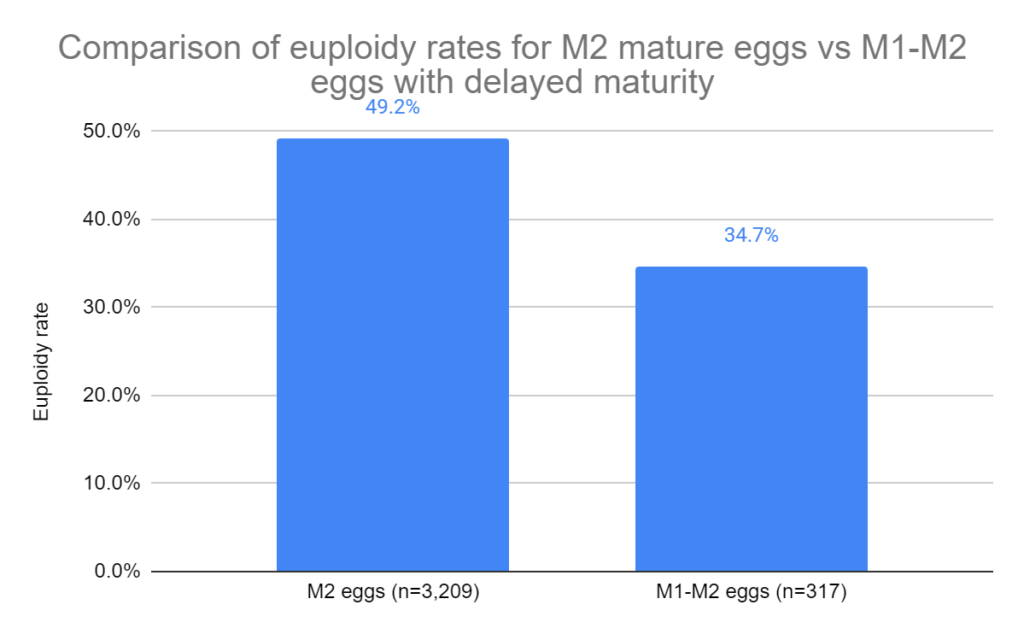
The blastocyst conversion rate was significantly higher in M2 eggs compared to M1-M2 eggs (53.8% vs 23.9%, p<0.001). Blastocyst conversion rates from sibling eggs in the same patient were compared and were found to be significantly higher in M2 eggs compared to M1-M2 eggs (odds ratio [95% CI]: 2.77 [2.39-3.21]). This means that the odds of M2 eggs forming blastocysts was 2.77 times higher compared to M1-M2 eggs from the same patient.
Improved euploidy rates from M2 eggs compared to delayed M1-M2 eggs
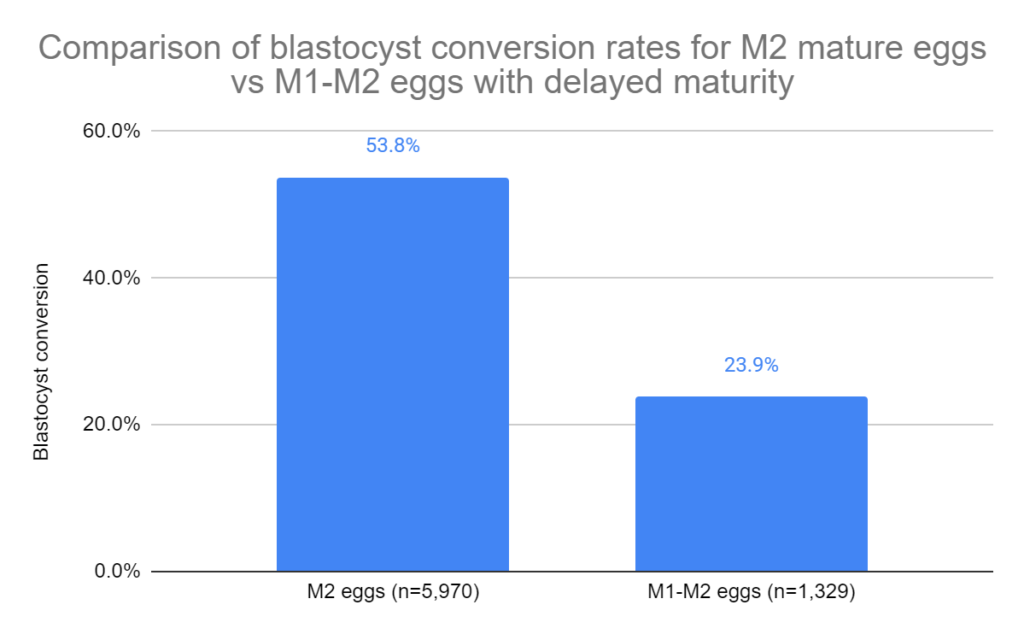
There was an increase in the euploidy rates in blastocysts derived from M2 eggs compared to M1-M2 eggs (49.2% vs 34.7%, p<0.001). Euploidy rates from blastocysts derived from sibling eggs in the same patient were compared and found to be significantly higher in M2 eggs compared to M1-M2 eggs (odds ratio [95% CI]: 1.51 [1.17-1.93]). This means that the odds of M2 eggs forming euploid blastocysts was 1.51 times higher compared to euploids from M1-M2 eggs in the same patient.
They also looked at euploidy rates for day 5, 6 and 7 embryos. While euploidy rates were higher in M2 eggs for all days, only day 5 was significant (58.2% vs 33.9%, p<0.001). The day 7 M1-M2 sample size was small (n=15), but it was higher for day 6 (n=190).
No change in pregnancy outcomes when using delayed M1-M2 eggs
They also compared pregnancy outcomes in those who transferred euploids derived from M2 and M1-M2 eggs. Priority was given to M2 transfers, so all of a patient’s M2 euploids would have been used up before they started using the M1-M2 euploids. Because of this, the sample sizes were low for the M1-M2 groups.
They found no differences after transferring euploids from M2 or M1-M2 eggs in terms of pregnancy rates (65.7% vs 74.1%, n=379 vs n=27, p=0.41), pregnancy losses (6.4% vs 5.0%, n=249 vs n=20, p=1.0) and live births (61.5% vs 70.0%, n=379 vs n=27, p=1.0).
Conclusions
This study found that mature M2 eggs had improved fertilization, blastocyst conversion and euploidy rates compared to delayed M1-M2 eggs. There were no differences in pregnancy and live birth rates, however the sample size for M1-M2 transfers was small.
This suggests that eggs that are immature after retrieval can have acceptable outcomes if left to continue development for 2-6 hours, without the use of specialized culture media or equipment. Some labs may culture immature eggs for even longer (overnight), but the authors state that this can lead to worsened outcomes and was not the focus of this study.
The authors explain that the reduced potential of the delayed M1-M2 eggs may be due to cytoplasmic immaturity. This involves a number of steps the egg must take internally to prepare for fertilization and is distinct from nuclear maturation, which is indicated by the presence of the polar body that characterizes an M2 egg. To learn more, you can check out my post on egg maturation.
By performing rescue IVM, patients can benefit from additional eggs and embryos for transfer.
Reference

About Embryoman
Embryoman (Sean Lauber) is a former embryologist and the founder of Remembryo, an IVF research and fertility education website. After working in an IVF lab in the US, he returned to Canada and now focuses on making fertility research more accessible. He holds a Master’s in Immunology and launched Remembryo in 2018 to help patients and professionals make sense of IVF research. Sean shares weekly study updates on Facebook, Instagram, and Reddit regularly. He also answers questions on Reddit or in his private Facebook group.