

Researchers in a 2023 study identified what factors are involved in predicting clinical pregnancy in endometriosis patients after a fresh transfer, and built a nomogram (calculator) from it that showed good predictive value.
Patients with endometriosis may have a reduced chance of success with IVF due to potentially lower egg quality. In this post, we’ll take a close look at a study by Zhu et al. (2023), who made a nomogram to help predict the chance of pregnancy in these patients after a fresh transfer.
🔗 Original studies are referenced in this post or within the linked Remembryo posts.
💡 Reminder: Terms underlined with a dotted black line are linked to glossary entries. Clicking these does not count toward your paywall limit.
Study details
This section covers key details of how the study was performed, including patient characteristics, how they were treated, and other methods used. For those who aren’t interested in these details, and just want to see the results, you can go ahead and skip this part.
- This was a retrospective study that took place at 2 IVF centers in China between 2018 and 2022.
- Patients were diagnosed with endometriosis using laparoscopy, with endometriosis stages I to IV.
- Exclusions: patients with uterine fibroids 4+ cm in size, severe adenomyosis, chromosomal abnormalities, autoimmune disorders, recurrent miscarriage, uterine abnormalities, metabolic disorders.
- Cleavage stage or blastocyst stage embryos were transferred fresh (about 20% of cycles were blastocyst transfers, and 80% were cleavage stage).
- Patients had a fresh transfer.
The point of this study is to develop a nomogram (calculator) to predict pregnancy in patients with endometriosis after a retrieval. To do this, they used 1,141 patients to train the model, and 489 to validate it.
Factors associated with clinical pregnancy in endometriosis patients
In order to develop this nomogram (calculator) to predict pregnancy, the researchers needed to figure out what factors were strongly associated with pregnancy. They did this using statistical methods (multivariate logistic regression).
The following factors were negatively associated (ie. as the factor increases, the chance of pregnancy decreases):
- Female age
- Endometriosis stage
- The time between endometriosis surgery and IVF
The following factors were positively associated (ie. as the factor increases, the chance of pregnancy increases):
- GnRH-agonist protocol
- AFC
- AMH
- Number of eggs retrieved
- Number of high quality cleavage stage embryos*
- Number of embryos transferred
* Note that high quality cleavage stage embryos were those with 6-9 cells, mostly uniform cells and ≤ 25% fragmentation. What about embryos with more or less cells? These weren’t addressed here, although some studies have shown that having more than 8 cells is comparable to 8 cells.
Now that they have all the factors figured out, they can put them into their nomogram to help predict pregnancy.
Nomogram (calculator) for predicting clinical pregnancy in endometriosis patients after a retrieval
You can see the nomogram below. To work with this, you need to add up the points for each factor and then put your total points on the bottom line to get the “diagnostic possibility” (clinical pregnancy rate). Keep scrolling and I’ll demonstrate this. Note that the ASRM stage refers to the endometriosis stage, AMH is in ng/ml.
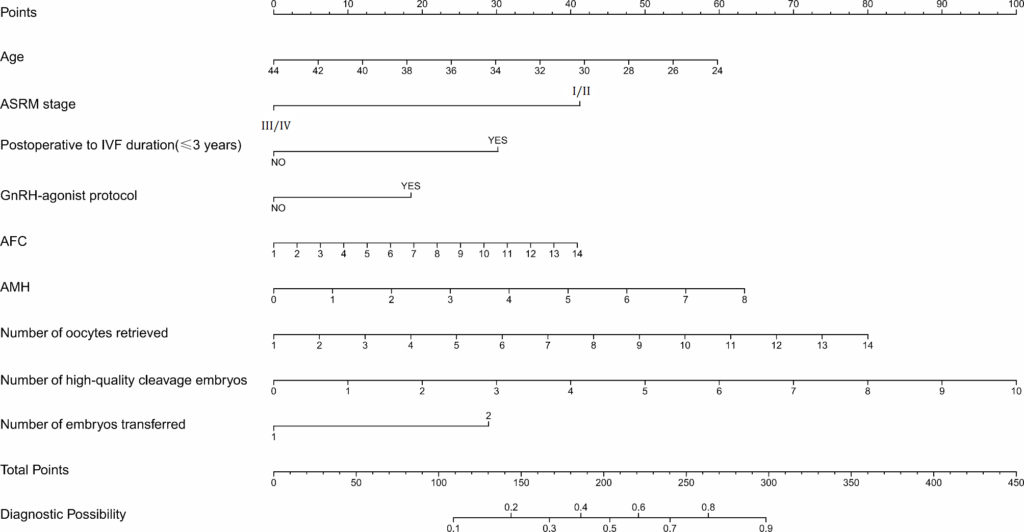
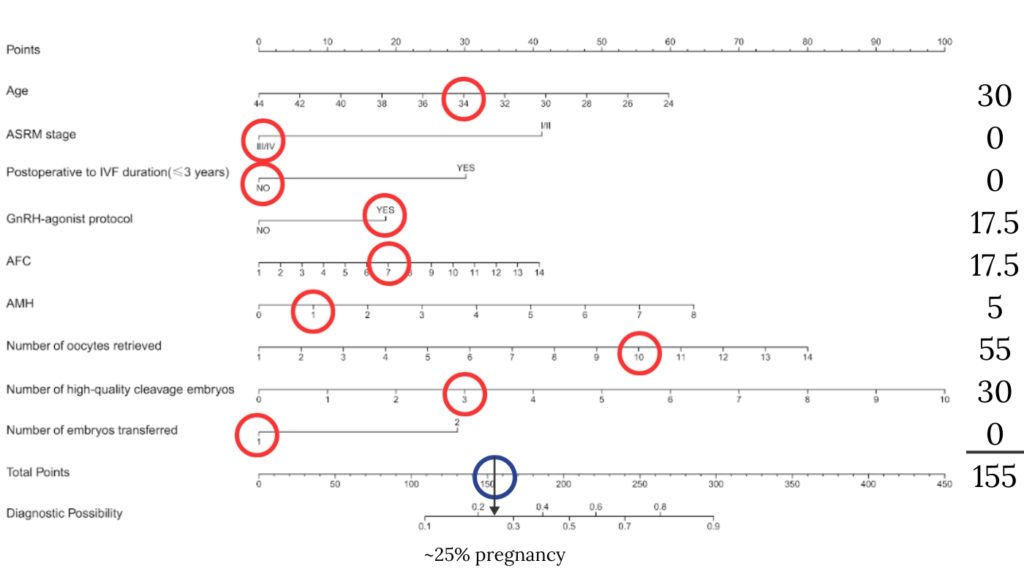
And here’s an example of a 34 year old woman, with stage III/IV endometriosis, who hasn’t had surgery for it within the last 3 years, did a GnRH-agonist protocol, has an AFC of 7, AMH of 1.0 ng/ml, with 10 eggs retrieved, 3 high quality cleavage stage embryos and one embryo transferred. Based on this, her total points are 155 and chance of a clinical pregnancy is 25%.
Now that they’ve made their wonderful nomogram, the researchers wanted to make sure it did a good job in predicting clinical pregnancy in endometriosis patients.
To do this, they did a ROC analysis. You can check the glossary for ROC, but it’s basically an analysis to see how well a test works, based on its AUC value.
This nomogram had an AUC value of 0.807, which means is has good predictive value for clinical pregnancy. The 0.807 is based on the model group. They got an AUC of 0.800 for the validation group. These are both good values, so it’s good!
Conclusions
This study found a number of factors that were associated with clinical pregnancy in endometriosis patients, including female age, endometriosis stage, the number of eggs retrieved, and more.
Based on these factors, the researchers constructed a nomogram that showed good predictive value for clinical pregnancy.
A limitation of this study is that they transferred both cleavage stage and blastocyst stage embryos. Since about 80% of transfers in this study were cleavage stage, with 20% blastocyst, the nomogram is more accurate for cleavage stage transfers. Transferring 2 blastocysts would likely earn more points on the nomogram, and boost the chances a bit more.
Another limitation is that this is based on fresh transfers only. Most patients with endometriosis will have a frozen transfer. It would be nice to see a nomogram for frozen transfers, but that would be a separate study all together.
The authors note that this nomogram should be validated externally, by another group, before it’s used clinically. Despite this, it’s still a useful tool to give an estimation of someone’s chances at pregnancy after a retrieval.
Related studies
For more information on endometriosis, check out my tag endometriosis on this site.
There were also a number of studies referenced in this study, which you can check out below (4 links):
Reference
About Embryoman
Embryoman (Sean Lauber) is a former embryologist and the founder of Remembryo, an IVF research and fertility education website. After working in an IVF lab in the US, he returned to Canada and now focuses on making fertility research more accessible. He holds a Master’s in Immunology and launched Remembryo in 2018 to help patients and professionals make sense of IVF research. Sean shares weekly study updates on Facebook, Instagram, and Reddit regularly. He also answers questions on Reddit or in his private Facebook group.