
Researchers in a 2019 study found that fast-growing day 3 embryos with >10 cells had comparable pregnancy outcomes to day 3 embryos with 8 cells.
These days, most IVF clinics transfer blastocysts on day 5 rather than day 3 embryos. But there still are plenty that perform transfers on day 3!
When it comes to day 3 embryos, cell number, fragmentation, and symmetry are typically evaluated to give a quality score. Of these, cell number is often considered to be a priority for ranking embryos, with 8-cells being considered ideal.
To learn more about day 3 (cleavage stage), check my Complete guide to embryo grading and success rates.
But what about fast growing day 3 embryos? In other words – embryos with more than 10 cells on day 3? There isn’t a lot of research on this topic but here are some highlights:
- Holte et al. (2007) found that the implantation rate was reduced with faster cleaving embryos.
- Kroener et al. 2015 found that embryos with >9 cells on day 3 were more likely to be chromosomally abnormal.
- Luna et al. (2007) found that blastocysts that developed from fast growing >10-cell day 3 embryos were higher quality.
So it isn’t a very consistent picture! Zhao et al. (2019) wanted to look at fast growing day 3 embryos in more detail in their retrospective, single-center study, between 2009 and 2016.
They looked at 3 different things: fresh transfers, frozen transfers, and PGT-A (NGS) to compare aneuploidy rates between 8 cell embryos and fast growing >10 cell embryos.
🔗 Original studies are referenced in this post or within the linked Remembryo posts.
💡 Reminder: Terms underlined with a dotted black line are linked to glossary entries. Clicking these does not count toward your paywall limit.
Fast growing Day 3 embryos (fresh transfer group)
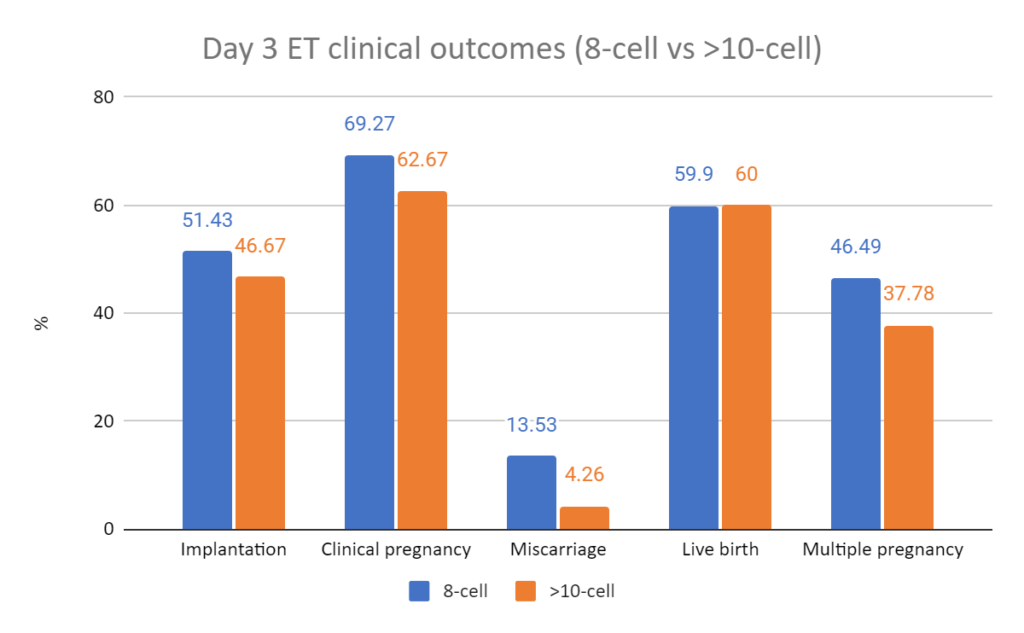
For the fresh transfer group, there were a total of 459 day 3 transfers: 384 with 8 cells, and 75 with >10 cells. The average age was about 30 and 2 good quality embryos were transferred.
They found no statistically significant differences in implantation, clinical pregnancy, live birth, or multiple pregnancy. They did find an increase in miscarriages with 8-cell embryos compared to the fast growing >10-cell embryos (13.53% vs 4.26%, p=0.04), although this may have been due to the smaller sample size for the >10-cell vs 8-cell group (47 vs 266). You can see a graph with the percentages below.
Fast growing Day 3 embryos (frozen transfer group)
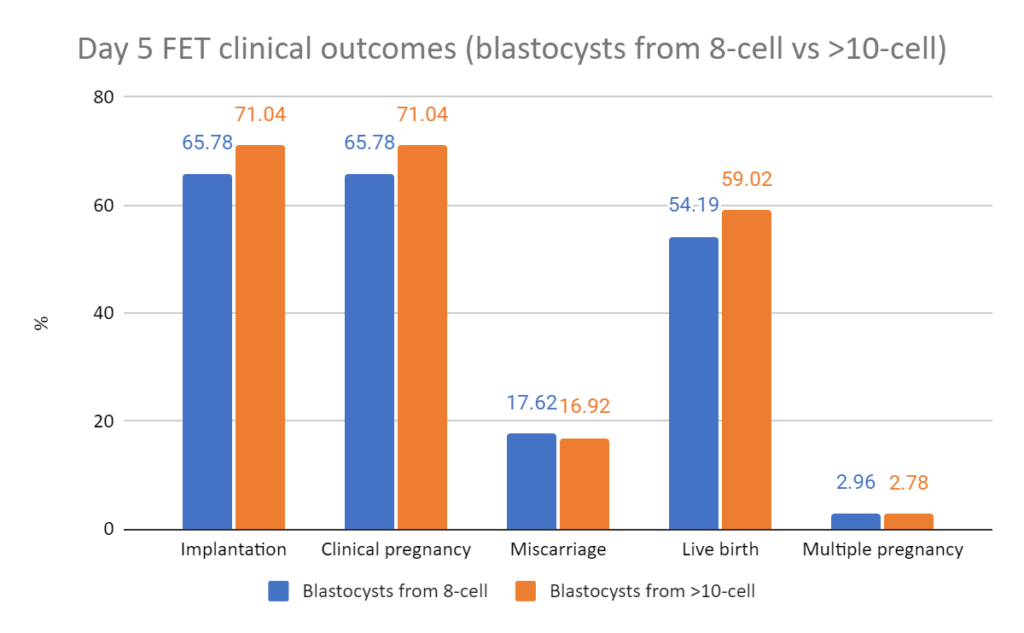
For the frozen transfer group, there were a total of 744 transfers. These were actually blastocyst transfers, but were from embryos that were either 8 cell (561 transfers) or >10 cell (183 transfers) on Day 3. The average age was about 29 and 1 blastocyst was transferred.
Like the fresh transfer group, there were no differences in implantation, clinical pregnancy, live birth, or multiple pregnancy. There was also no difference in miscarriage rates.
Are fast growing Day 3 embryos more likely to be aneuploid?
In the last analysis of this paper, PGT-A was performed on 240 blastocysts that came from either 8-cell day 3 embryos or fast growing >10-cell embryos. They wanted to see if the fast growing embryos were more likely to be aneuploid.
From the 8-cell derived blastocysts, 55.93% were aneuploid, compared to 55.56% from the >10-cell derived blastocysts. So there was no difference!
Conclusions
This study found no real difference between 8-cell day 3 embryos and fast growing >10-cell embryos, at least in women <35. This was true for implantation, clinical pregnancy, live birth, and multiple pregnancy rates. There was a reduced miscarriage rate for one of the groups studied but this may have been due to the smaller sample size.
Even blastocysts that developed from 8-cell and >10-cell embryos showed similar success rates. A previous study by these authors had found no difference in blastocyst conversion rates between these day 3 embryo groups (unfortunately they didn’t provide a reference for this one).
A limitation of this study is that it’s retrospective. The sample size for the fast growing >10-cell embryo group was smaller so it would be nice to see this study repeated in a larger setting.
Reference

About Embryoman
Embryoman (Sean Lauber) is a former embryologist and the founder of Remembryo, an IVF research and fertility education website. After working in an IVF lab in the US, he returned to Canada and now focuses on making fertility research more accessible. He holds a Master’s in Immunology and launched Remembryo in 2018 to help patients and professionals make sense of IVF research. Sean shares weekly study updates on Facebook, Instagram, and Reddit regularly. He also answers questions on Reddit or in his private Facebook group.
Related posts:
 Complete Guide to Embryo Grading and Success Rates
 Day 3 or Day 5 embryo transfer?
 Study examines potential of PGT-A on poor quality embryos
 Grade C (poor quality) embryo success rates
 Study examines where embryos do best: lab vs the uterus
 Transfer of day 7 embryos a viable option
 Predicting live birth rates, multiples based on 223,377 transfers
 Transferring a good and poor quality embryo together: a meta-analysis