

What’s the ideal follicle size for IVF? Researchers in a 2022 study compared follicle size at the time of trigger and related it to rates for egg maturity, fertilization, good quality embryos and euploidy. They also examined the association between follicle size and age and BMI.
To do this, they compared embryology outcomes for 4539 eggs derived from follicle of different sizes between 2017 and 2018. The average age was 33.5, and the majority of cycles were from those with diminished ovarian reserve, egg donors or male factor.
Follicles that were at least 12 mm developed to a median size of 16 mm and then were triggered, and individual follicle sizes were measured during retrieval. To clarify, if there were 3 follicles 12 mm, 14 mm and 18 mm, they would not trigger because the median (middle value) is 14 mm; but if they were 12 mm, 18 mm, 19 mm they would trigger because the median is 18 mm.
For more background on egg quality and quantity, check out my Complete guide to egg quality.
🔗 Original studies are referenced in this post or within the linked Remembryo posts.
💡 Reminder: Terms underlined with a dotted black line are linked to glossary entries. Clicking these does not count toward your paywall limit.
Larger follicles are more likely to contain mature eggs
The researchers found as follicle size increased, so did the percent of mature eggs. The average % of mature eggs from all follicle sizes was 75.5%. Eggs from 16-24.5 mm follicles were more likely than average to be mature, and eggs from <12.5 mm follicles were less likely than average to be mature, and this was statistically significant.

Follicle size has no impact on fertilization rate
Mature eggs that were obtained from different follicle sizes were inseminated by ICSI. They found no statistically significant difference in the number of 2 PN (fertilized) mature eggs from different follicle sizes from the average (average was 71.0%).

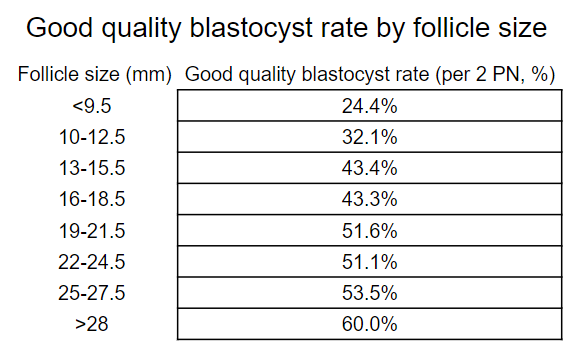
Larger follicles are more likely to produce good quality embryos
Fertilized eggs that derived from follicles smaller than 12.5 mm in size were statistically less likely to produce good quality embryos compared to the average (average was 45.4%). Above 12.5 mm there was no statistical difference from the average.
Good quality embryos were defined as not having a C grade for the trophectoderm or ICM (learn more about embryo grading if this is unclear).
Follicle size was not related to euploidy rate
Embryos that were submitted for PGT-A showed no correlation with follicle size. So neither small nor large follicles were more likely to make euploid embryos compared to the average (average was 53.1% euploid). However the ≤ 9.5 mm and ≥ 28 mm groups were small (5 and 6 embryos biopsied respectively), so having a larger sample size would possibly change the outcome.

Possible association between age, follicle size and rate of good quality blastocysts
Fertilized eggs obtained from women < 35 or ≥ 35 showed similar good quality blastocyst rates based on follicle size (no statistically significant differences), with the exception of the ≤ 9.5 mm and ≥ 28 mm groups where older women had fewer good quality blasts. However the ≤ 9.5 mm and ≥ 28 mm groups were small (3 and 2 embryos respectively, for the ≥ 35 group), so having a larger sample size would possibly change the outcome.

Conclusions
This study found that larger follicles were more likely to produce mature eggs as well as good quality blastocysts. Generally, follicles above 19 mm were optimal in producing good quality blastocysts. The authors noted that follicles ≤12.5 mm “rarely” produced good quality blastocysts.
Follicles that were ≥28 mm from patients less than 35 produced good quality embryos at the optimal rate. This suggests that smaller follicles ≤12.5 mm can be pushed further without compromising larger follicles. Follicles ≥28 mm from patients older than 35 showed a decline in good quality blastocyst rate, so in these patients larger follicles may be compromised. However the ≥35 data was limited by a small sample size, so further studies need to be done to address this.
Reference

About Embryoman
Embryoman (Sean Lauber) is a former embryologist and the founder of Remembryo, an IVF research and fertility education website. After working in an IVF lab in the US, he returned to Canada and now focuses on making fertility research more accessible. He holds a Master’s in Immunology and launched Remembryo in 2018 to help patients and professionals make sense of IVF research. Sean shares weekly study updates on Facebook, Instagram, and Reddit regularly. He also answers questions on Reddit or in his private Facebook group.