
Small studies find that some chaotic embryos can be euploid after PGT-A rebiopsy, while a case report details a live birth after the transfer of a chaotic embryo.
A chaotic embryo is an embryo that has 6 or more aneuploidies detected by PGT-A and are not recommended for transfer. Approximately 2-3% of embryos biopsied come back as chaotic.
However, there is emerging preliminary evidence that some of these embryos may actually be euploid after rebiopsy, and have the potential for live birth after being transferred.
Check my complete guide to PGT-A to get more background on PGT-A (aka PGS testing).
🔗 Original studies are referenced in this post or within the linked Remembryo posts.
💡 Reminder: Terms underlined with a dotted black line are linked to glossary entries. Clicking these does not count toward your paywall limit.
Some chaotic embryos are euploid after PGT-A rebiopsy
Two studies have examined the rebiopsy of chaotic embryos . These studies are abstract only studies and were presented at conferences, and may have not been peer reviewed.
Both of these studies were found through the Igenomix website, in a webinar titled “The Clinical Management of PGT-A Reported Chaotic Embryos” by Paulina Nassab and Alyssa Snider on August 2022. The webinar can be found here.
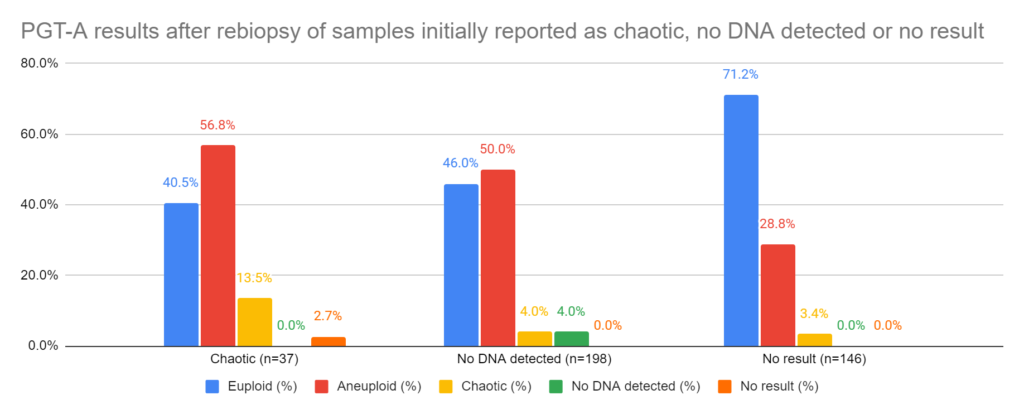
The first study is from Rodrigo et al. (2021) and is an abstract presented at the Spanish Association for the Study of Reproductive Biology (ASEBIR) conference in 2021. In this study they performed a rebiopsy on 381 embryos that tested as chaotic, no DNA detected or no result between 2018 and 2021. The average maternal age was between 37.2 – 38.5.
The second study is from Rabkina et al. (2022) and is an abstract from the American Society for Reproductive Medicine 2022 conference. In this study, 58 embryos that initially tested as chaotic were rebiopsied between 2018 and 2022. The average maternal age was 39.5.
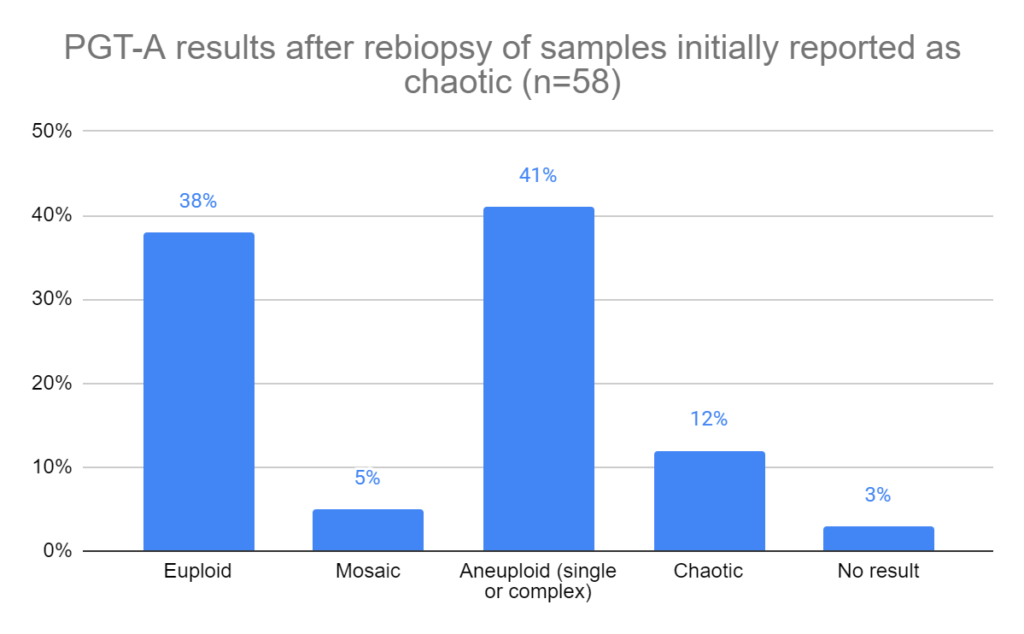
Note that the embryos in these studies were good quality, so it’s unclear if comparable results would be seen with lower quality embryos.
Another study by Lim et al. (2023) retested 64 chaotic embryos (this study was also an abstract):
They also found that chaotic day 7 embryos were more likely to be chaotic on rebiopsy compared to day 5 or 6.
Another study by Nassab et al. (2023), also an abstract, found that poor quality embryos were more likely to be chaotic vs good quality (3.95% vs 1.6%, p< 0.0001). They also found that chaotic results were more likely with biopsy day 5 vs 6 vs 7 (1.36% vs 2.17% vs 3.06%, p< 0.0001).
Calull et al. (2025) rebiopsied 93 chaotic blastocysts. The overall prevalence was 4.3% and thaw survival rate was 74.2%.
- 24.6% retested as euploid
- 37.7% chaotic
- 26.1% aneuploid
- 7.2% mosaic
- 4.4% no result
Yet another study by Huniadi et al. (2026) rebiopsied 19 embryos originally labeled as chaotic, with 16 that were reclassified as aneuploid, 1 as a mosaic, and 2 with a persistent chaotic result (10.5%).
Case report: live birth after transferring a chaotic embryo
A case report from Lin et al. (2022) details a same sex couple who transferred a chaotic embryo and had a live birth.
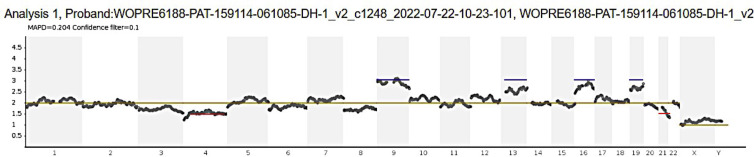
The embryo transferred was chaotic and had 6 abnormalities detected after PGT-A (-4, +9, +13, +16, +19, -21, male). You can see the next-generation sequencing results below that show these aneuploidies:
This was the only embryo they had available for transfer and despite being advised not to transfer the embryo, the couple insisted.
First trimester screening showed that the male fetus was negative for aneuploidy in chromosomes 13, 18 and 21. Second trimester amniocentesis confirmed a normal male fetus. The baby male was born full-term and healthy.
Conclusions and recommendations for chaotic embryos from Igenomix
The evidence from Igenomix may have not been peer reviewed and may contain errors. So until more studies come out (that are peer reviewed), it’s not clear what the potential of chaotic embryos are.
The presenters of the Igenomix webinar (linked above) explain that chaotic embryos may be the result of degraded DNA being picked up that shows aneuploid results, despite the embryo itself being euploid.
Igenomix recommends rebiopsy of chaotic embryos that are good quality and possible transfer after appropriate counselling. Chaotic embryos can also be stored until more data becomes available.

About Embryoman
Embryoman (Sean Lauber) is a former embryologist and the founder of Remembryo, an IVF research and fertility education website. After working in an IVF lab in the US, he returned to Canada and now focuses on making fertility research more accessible. He holds a Master’s in Immunology and launched Remembryo in 2018 to help patients and professionals make sense of IVF research. Sean shares weekly study updates on Facebook, Instagram, and Reddit regularly. He also answers questions on Reddit or in his private Facebook group.