
Researchers in a 2023 study found that fresh sperm had a slightly improved biochemical pregnancy rate compared to frozen sperm, but there were no differences in fertilization, miscarriage or live birth rates.
Sperm can be used fresh or frozen during IVF but it’s not clear if there is any negative effect in using frozen sperm. To learn more about sperm, check out my complete guide to sperm quality.
Torra-Massana et al. (2023), in their retrospective study, compared outcomes using fresh or frozen normal sperm (by semen analysis) in egg donation cycles. There were 2,865 cycles involving fresh sperm and 5,104 cycles involving frozen sperm. The study took place at a single IVF center in Spain between 2013 and 2019.
Key points:
- All patients had normal sperm based on the World Health Organization’s 2010 guidelines (normal sperm concentration, motility, semen volume, etc.).
- Ejaculatory abstinence of 2 to 7 days was recommended.
- Fresh donor eggs were used (aged <35).
- ICSI was used.
- Both fresh and frozen sperm were processed using a pellet swim-up technique.
There were a number of differences in the baseline characteristics between the fresh and frozen sperm groups, including male age (42.0 vs 41.6), male BMI (25.7 vs 25.6), tobacco consumption (26.07% vs 28.01%), the number of mature eggs (7.3 vs 6.8), the number of fertilized eggs (5.4 vs 5.0), blastocyst transfer (54.6% vs 10.8%) and the number of single embryos transfers (54.9% vs 14.7%). All of these confounders were controlled for during their statistical analysis.
Note that the frozen group was more likely to transfer 2-3 cleavage stage embryos, while the fresh group was more likely to transfer a single blastocyst.
🔗 Original studies are referenced in this post or within the linked Remembryo posts.
💡 Reminder: Terms underlined with a dotted black line are linked to glossary entries. Clicking these does not count toward your paywall limit.
No difference in fertilization rates between fresh and frozen sperm
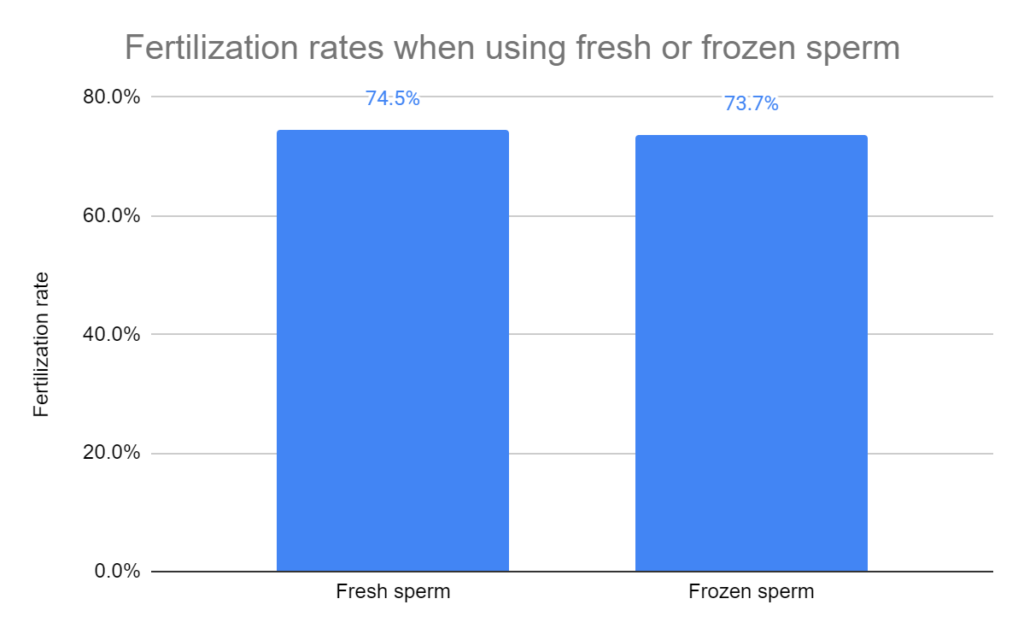
There were no statistically significant differences in fertilization rate when ICSI was performed using fresh or frozen sperm (74.5% vs 73.7%, p=0.0591). Additional analyses that controlled for male age, BMI, tobacco consumption and the number of mature eggs found no difference in fertilization rates (p=0.1361).
Fresh sperm improved biochemical pregnancy rates slightly compared to frozen sperm, but no difference in miscarriage, ongoing pregnancy or live birth rates
There was an increase in biochemical pregnancy rates (a positive hCG) when using fresh sperm over frozen sperm (52.7% vs 49.1%, odds ratio [95% CI]: 1.146 [1.018-1.291]). This means that after adjusting for confounders (male age, BMI, etc. as indicated above), using fresh sperm to perform ICSI resulted in embryos that were 1.146 times more likely to produce a biochemical pregnancy compared to embryos made from frozen sperm.

When comparing fresh vs frozen sperm, there were no statistically significant differences in ongoing pregnancy (12 or more weeks; 37.9% vs 34.7%, odds ratio [95% CI]: 1.096 [0.969-1.239]) or live birth rates (35.8% vs 33.3%, odds ratio [95% CI]: 1.078 [0.952-1.220]). There were no differences in clinical miscarriage rates (p=0.5095).
Conclusions
This study found no differences in fertilization rates when using fresh or frozen sperm. There was a slight increase in biochemical pregnancy rates (positive hCG) using fresh sperm over frozen sperm, but no difference in ongoing pregnancy or live birth rates.
A limitation of this study was that there were more people in the fresh sperm group who performed blastocyst transfers compared to the frozen group. Although they statistically adjusted this in their analysis, the authors note that there may be other factors that weren’t accounted for that could affect the results. One possibility that they note is the expertise of difference doctors, since this study spanned about 6 years.
Another point they mention is that these results apply only to the use of donor eggs, as previous reports have shown that eggs with defects may be more sensitive to the use of frozen sperm (Braga et al. 2015).
Reference

About Embryoman
Embryoman (Sean Lauber) is a former embryologist and the founder of Remembryo, an IVF research and fertility education website. After working in an IVF lab in the US, he returned to Canada and now focuses on making fertility research more accessible. He holds a Master’s in Immunology and launched Remembryo in 2018 to help patients and professionals make sense of IVF research. Sean shares weekly study updates on Facebook, Instagram, and Reddit regularly. He also answers questions on Reddit or in his private Facebook group.