

Researchers in a 2023 study found that embryos that take longer to develop had lower quality scores for both the ICM and trophectoderm, and had reduced clinical pregnancy and live birth rates.
Blastocysts can develop at different rates after insemination, with fast growing embryos reaching this stage as early as 4 days, and slow growing embryos taking as long as 7 days.
Coticchio et al. (2023) compared pregnancy and neonatal outcomes of 9,609 embryos that reached the expanded blastocyst stage on day 4, 5, 6 or 7. This is a retrospective study that took place at an IVF clinic in Japan between 2020 and 2021.
Check out my complete guide to embryo grading and success rates to learn more about embryo development, grading and success rates.
🔗 Original studies are referenced in this post or within the linked Remembryo posts.
💡 Reminder: Terms underlined with a dotted black line are linked to glossary entries. Clicking these does not count toward your paywall limit.
Study details
- Embryos were cultured by time-lapse (Embryoscope).
- Time to expanded blastocyst was measured by the embryo’s diameter (160 μm for day 4-6, 180 μm for day 7), which corresponds to an expansion of about 3-4 (based on this study).
- A single, frozen, untested embryo was transferred in a modified natural cycle.
- Exclusions: surgical sperm retrieval, recurrent implantation failure (four or more failed transfers).
Of the 9,609 embryos in this study:
- 70 were day 4 (0.7%) and took 98.4 h to reach the expanded blastocyst stage on average
- 6,147 were day 5 (64%) and took 112.4 h to reach the expanded blastocyst stage on average
- 3,243 were day 6 (33.8%) and took 131.6 h to reach the expanded blastocyst stage on average
- 149 were day 7 (1.6%) and took 151.2 h to reach the expanded blastocyst stage on average
They found that older women, older men, and women with a history of more IVF cycles were more likely to produce embryos that took longer to develop.
Embryo quality for blastocysts on days 4-7
In terms of embryo quality (the ICM/TE), embryos that became a blastocyst on an earlier day were more likely to be better quality compared to embryos that took longer to develop. Note that this data wasn’t statistically adjusted for confounders, so it includes a mix of different ages and other characteristics that may affect these proportions.

Pregnancy outcomes for blastocysts that develop on days 4-7
Below you can see the pregnancy outcomes after a single blastocyst was transferred.
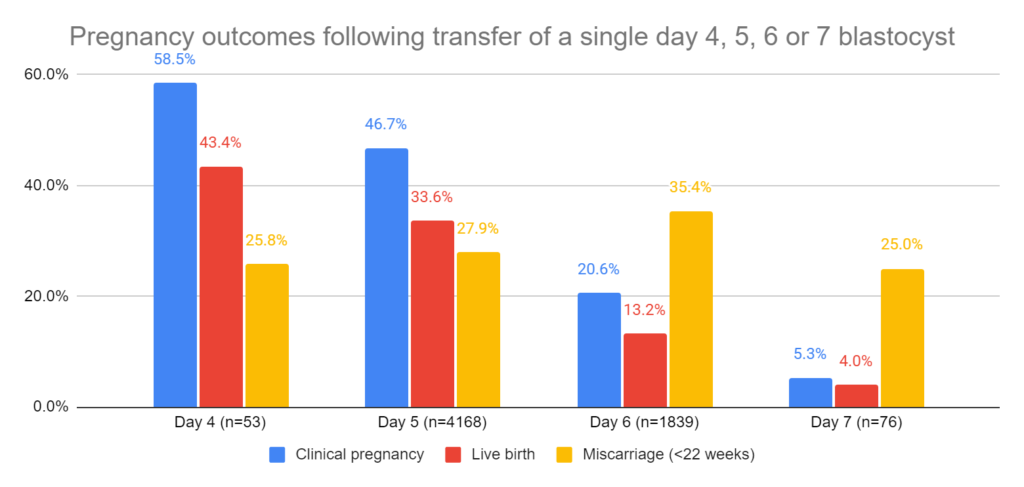
After statistical adjustment to control for confounders (age, number of previous transfers, quality of the ICM/TE, progesterone supplementation), there was a 40% decrease in the odds of pregnancy and live birth rates with day 6 vs day 5 (adjusted odds ratio [95% CI]: 0.604 [0.514-0.711]; 0.599 [0.496-0.723]).
There were no differences in pregnancy or live birth rates with day 4 or day 7, probably because of the low sample size. There were also no differences with miscarriage rates.
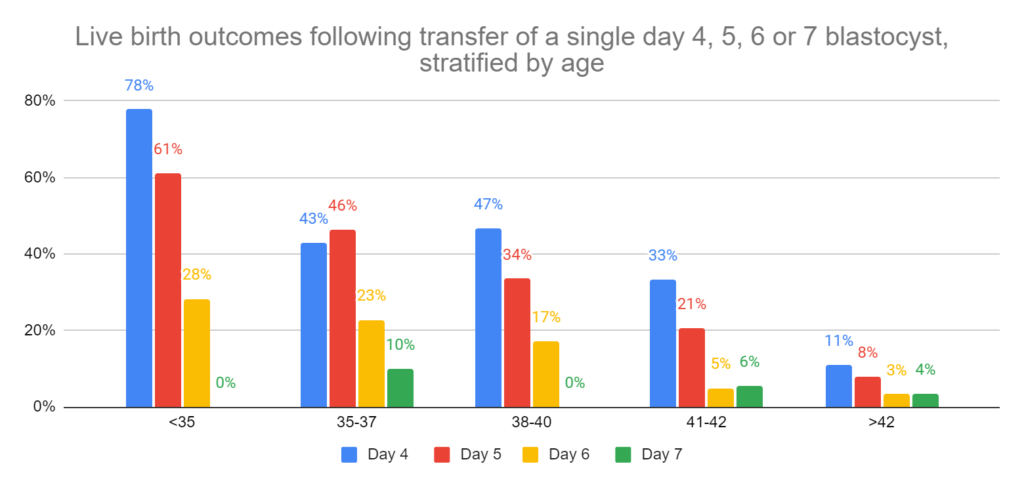
Next, they grouped live births by age. There were no statistical differences between day 4 and 5, but there was between 4 and 5 vs 6 or 7 (p< 0.0001). The sample size was large for the day 5 and 6 group, but was small for day 4 and 7. They didn’t control for confounders with this analysis, so these transfers included a mix of embryo grades and other factors which likely affected the results.
Neonatal outcomes for blastocysts that develop on days 4-7
For neonatal outcomes, they found no differences in:
- Birth length
- Birth weight
- Low birth weight
- Infant sex
- Birth defects
Again, for the neonatal outcomes there was a large number of day 5 and day 6 births, but only 23 and 3 for day 4 and 7, respectively. This low sample size makes it difficult to draw conclusions for these days.
Conclusions
This study found that embryos that take longer to develop had lower quality scores for both the ICM and TE, and had reduced clinical pregnancy and live birth rates. When they controlled for embryo quality, age and other factors, there was a significant drop in pregnancy outcomes with day 5 vs 6 blastocysts.
Miscarriage rates and differences in neonatal outcomes, such as birth length and weight, didn’t change with blastocyst development time.
In addition, the authors found that age and the number of previous cycles were also related to blastocyst development time.
The authors suggest that faster blastocyst development indicates better reproductive fitness and outcomes compared to embryos with slower development.
Limitations include the retrospective design of the study and the fact that it’s a single center. In my opinion, another limitation is the smaller sample size for the day 4 and day 7 groups, which likely prevented them from reaching statistical significance in some analyses. As it stands, this study seems better powered to address day 5 vs day 6 outcomes, instead of day 4-7.
For more information on day 7 embryos and their potential, particularly for those that are euploid, check out my post Transfer of day 7 embryos a viable option.
Reference

About Embryoman
Embryoman (Sean Lauber) is a former embryologist and the founder of Remembryo, an IVF research and fertility education website. After working in an IVF lab in the US, he returned to Canada and now focuses on making fertility research more accessible. He holds a Master’s in Immunology and launched Remembryo in 2018 to help patients and professionals make sense of IVF research. Sean shares weekly study updates on Facebook, Instagram, and Reddit regularly. He also answers questions on Reddit or in his private Facebook group.