
Researchers in a 2023 study compared cumulative live birth rates for nearly 25,000 women aged 43 and older, and determined how many cycles it took for birth rates to peak.
IVF success rates tend to decrease with advancing age, but there isn’t much research for women aged 43 and older.
Seifer et al. (2023) wanted to see how the cumulative live birth rate changed in women 43 and older pursuing IVF with their own eggs.
🔗 Original studies are referenced in this post or within the linked Remembryo posts.
💡 Reminder: Terms underlined with a dotted black line are linked to glossary entries. Clicking these does not count toward your paywall limit.
Study details
- This was a retrospective study involving women over the age of 42, that took place between 2014 and 2020.
- Data was collected from the Society for Assisted Reproductive Technology Clinic Outcome Reporting System (SART CORS) database, which collects data from the majority of US IVF clinics.
- All women in the study had no previous history of assisted reproduction, and no donor egg cycles were included (they used their own eggs). PGT-A cycles were included.
This study looked at the cumulative live birth rate for 24,650 women who had 54,132 treatment cycles. A “treatment cycle” included the retrieval cycle and all transfers from that retrieval, whether fresh or frozen. There were up to 10 cycles considered (ie. 10 retrievals and all the transfers within those 10 retrievals). You can see how this breaks down below (thanks to the corresponding author for sharing this data with me!):
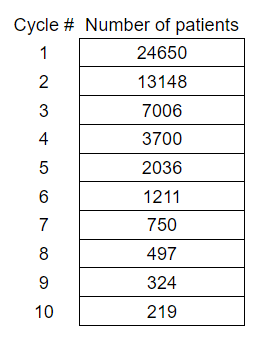
Ideally, and for the sake of science, each patient would transfer all the available embryos they had from retrieval #1 before moving onto retrieval #2. But in the real world this isn’t how things work. So it’s not known how many patients used up all their embryos before progressing to their next cycle. This is a limitation of the SART database.
In terms of the sample size for each age group (total number patients are 24,650):
- 43: 11,472
- 44: 6,654
- 45: 3,333
- 46: 1,677
- 47: 773
- 48: 401
- 49: 182
- 50 and older: 158
These are the ages that the patients started treatment. It’s not known how long it took for patients to complete a cycle, but this was data collected between 2014 and 2020, so it couldn’t have been more than 6 years.
Decrease in number of eggs and embryos with increasing age
The number of eggs retrieved and embryos obtained dropped as age increased, from about 6.5 and 4 at age 43 to about 1 by age 50 and older (p< 0.05).
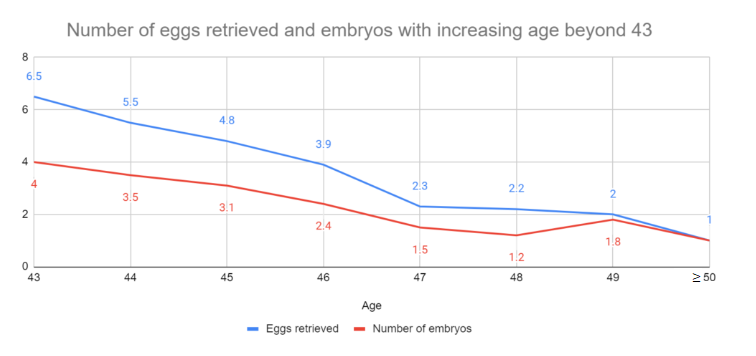
There were also decreases in the number of eggs and embryos with subsequent cycles for patients aged 43-47 (p< 0.05). In other words, patients who had their first retrieval collected more eggs compared to later retrievals.
There was also a decrease in the % of cycles that transferred blastocysts with increasing age, from about 15% at age 43 to about 2% for women 50 or older. Combined with this, there was also a decrease in the use of PGT-A with age, from about 35% of cycles at age 43 to about 3% in women 50 or older. This may be due to the decrease in blastocysts that was seen with increasing age.
A separate analysis found that transferring blastocysts was the best predictor of having a live birth in women with advanced age (adjusted odds ratio [95% CI]: 4.9 [4.0-6.0]).
Cumulative live birth rates drop with increasing age
With increasing age from 43 to 50 and older, the maximum cumulative live birth rates were 9.7%, 8.6%, 5.0%, 3.6%, 2.5%, 1.5%, 2.7% and 1.3%. After the age of 46, there was no statistically significant difference between the maximum cumulative live birth rates.
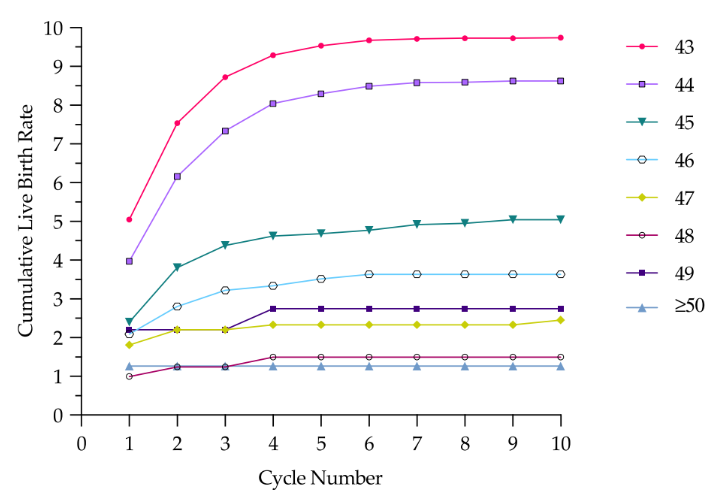
For those who need help understanding this graph, let’s look at the curve for the 43 year olds. Let’s pretend there’s 100 patients that start. For cycle 1, there’s a bunch of transfers and 5 live births, so the cumulative live birth rate for cycle 1 is 5/100=5%. Of the remaining 95 who didn’t have a live birth, 10 drop out, and 85 have another cycle. After a bunch of transfers, 3 have a live birth. In total, we have 8 live births after 2 cycles, or 8/100 = 8% cumulative live birth (in the graph it’s 7.5%, but this is an example and I’m pretty close!). And so on. With each cycle, more patients have a live birth or drop out, and the group that remains doesn’t have anymore live births, which is where it maxes out.
How many cycles did it take to achieve the maximum cumulative live birth rate for each age group?
In other words, at what point do additional cycles not lead to a statistically significant increase in live births?
For ages 43 and 44, this was about 5 cycles. This corresponded to a cumulative live birth of about 9% and 7%, with more than 3 cycles unlikely to lead to additional live births, the authors write.
For women 45 and 46, the max cumulative live birth rate was achieved around 2 cycles, at about 4% and 3%.
For women 47 and older, the max cumulative live birth rate was achieved after the first cycle, at about 1-2%.
Conclusions
This study found that the number of eggs retrieved and embryos obtained decreased as age increased from 43 onwards.
There was also a decrease in the proportion of cycles that transferred blastocysts with age. Transfer of blastocysts was found to be the best predictor of a live birth for older women.
Cumulative live birth rates dropped as age increased, with women aged 43 and 44 having about twice the rates of those aged 45 and 46, and those aged 45 and 46 having about twice the rates of women aged 47 and older.
The number of cycles it took to achieve the maximum cumulative live birth rate also varied with age, and was between 1-5 cycles.
The ASRM defines a “futile” attempt at pregnancy as having a live birth rate of <1%. The authors note that according to their data, having more than one cycle beyond the age of 46 and 47, or any cycles for women aged 48 and older, could be considered futile.
Given the high cost and stakes of IVF treatment, doctors should give clear and realistic information regarding the chances of success at advanced age, as stopping treatment may allow patients to consider other options, the authors write.
Related studies
Not all of the research on this topic may agree with this study.
For another study that I covered on this topic, you can check out my post IVF success rates in women over 43.
There were also a number of studies referenced in this study, which you can check out below (6 links):

Reference

About Embryoman
Embryoman (Sean Lauber) is a former embryologist and the founder of Remembryo, an IVF research and fertility education website. After working in an IVF lab in the US, he returned to Canada and now focuses on making fertility research more accessible. He holds a Master’s in Immunology and launched Remembryo in 2018 to help patients and professionals make sense of IVF research. Sean shares weekly study updates on Facebook, Instagram, and Reddit regularly. He also answers questions on Reddit or in his private Facebook group.