
Researchers in a 2023 study found decreased live birth rates, and other IVF outcomes, in patients of varying age with 5 or less follicles.
This study wanted to compare live birth rates for IVF cycles with 5 or less follicles on the day of trigger. They only included cycles where the patients used up all their embryos in transfers, which let them look at the full potential of these cycles. They also looked at other IVF outcomes, like the number of eggs and blastocysts obtained.
This data will help to give patients realistic expectations for IVF cycles with 5 or fewer follicles.
🔗 Original studies are referenced in this post or within the linked Remembryo posts.
💡 Reminder: Terms underlined with a dotted black line are linked to glossary entries. Clicking these does not count toward your paywall limit.
Study details
This section covers key details of how the study was performed, including the number of patients and their characteristics, how they were treated, and other methods used. For those who aren’t interested in these details, and just want to see the results, you can go ahead and skip this part.
- This was a retrospective study that took place between 2016 and 2020 at a single IVF center in the US.
- Cycles with 5 or fewer follicles (14 mm or more) on the day of trigger were included.
- PGT-A cycles were included (60% of cycles included were PGT-A).
- Only cycles that had a live birth, or used up all their untested blastocysts/euploids/mosaics, were included. Only 1 live birth counted per retrieval cycle.
- Transfers were fresh or frozen. Only blastocysts were transferred.
- Egg donation and freezing cycles were excluded.
- The primary outcome was the live birth rate
In terms of the sample size, there were 972 patients who had 1,502 IVF cycles.
Grouped by age, the breakdown of the 1,502 cycles was:
- Aged <35: 155 cycles
- 35-37: 254 cycles
- 38-40: 407 cycles
- 41-42: 379 cycles
- >42: 307 cycles
Grouped by number of follicles, the breakdown of the 1,502 cycles was:
- 1 follicle: 50 cycles
- 2 follicles: 217 cycles
- 3 follicles: 341 cycles
- 4 follicles: 435 cycles
- 5 follicles: 459 cycles
Women with fewer follicles were generally older and had a lower AMH (0.23 ng/ml for those with 1 follicle vs 1.57 ng/ml for those with 5 follicles).
Live birth rate of patients with 5 or less follicles, who used all embryos in a cycle
For all ages, the live birth rate was 4% (1 follicle), 8% (2 follicles), 10% (3 follicles), 18% (4 follicles) and 25% (5 follicles). You can see how this breaks down by age in the graph below.
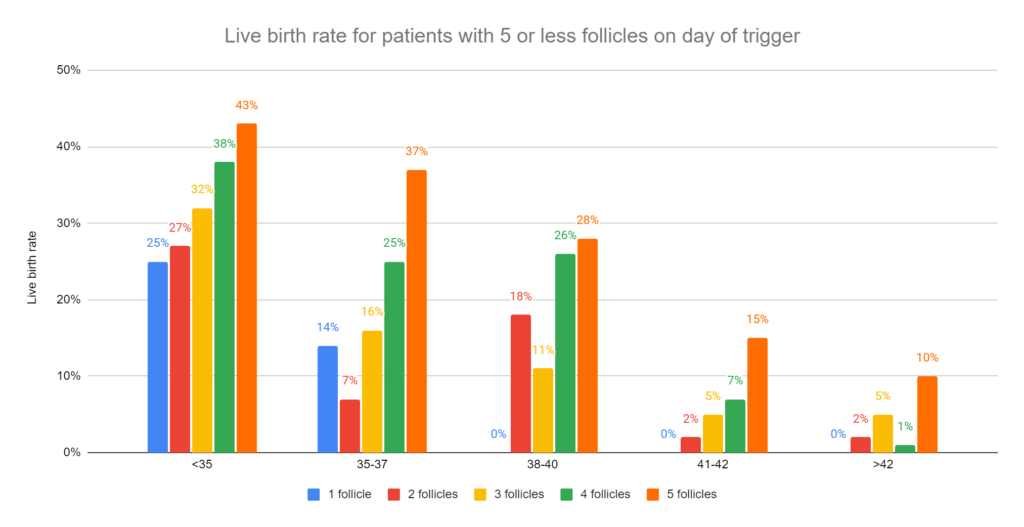
To simplify, the authors make the following conclusions for live birth rates based on age:
- For patients 41 or over with 1-3 or 4-5 follicles: <5% or <15%.
- For patients 35-40 with 1-3 or 4-5 follicles: <20% or 25-40%.
- For patients under 35 with 1-3 or 4-5 follicles: 25-30% or 40%.
If you’re wondering about the statistics on this…
- For <35: No difference between the groups (so live birth rates were the same for women with 1 follicle, 2 follicles, etc.).
- For 35-37: 2 or 3 follicles was lower than 5 (p< 0.02).
- For 38-40: 3 was lower than 4 or 5 (p< 0.02).
- For 41-42: 2 or 3 was lower than 5 (p< 0.03).
- For >42: 4 was lower than 5 (p< 0.03).
They did a comparison of PGT-A and non-PGT-A cycles, excluding cycles that didn’t have a transfer. After considering this, there were 787 cycles that used PGT-A, resulting in a live birth rate of 22.4%. There were 206 non-PGT-A cycles, resulting in a live birth rate of 23.8%. There were no differences between these two groups (p= 0.71). This makes sense because PGT-A is a selection tool and helps patients choose embryos to transfer. Since all the embryos in the non-PGT-A cycles were transferred, there shouldn’t be a difference.
IVF outcomes in patients with 5 or less follicles
Besides the live birth rate, they also looked at other outcomes in these patients!
The chance of having no eggs retrieved was higher for cycles with 1 follicle compared to cycles with more follicles. Note that cycles with 4 follicles had a 0.4% chance (2/435), which was higher than those with 3 follicles at 0% (0/341), but is very low and there likely isn’t any clinical difference here.
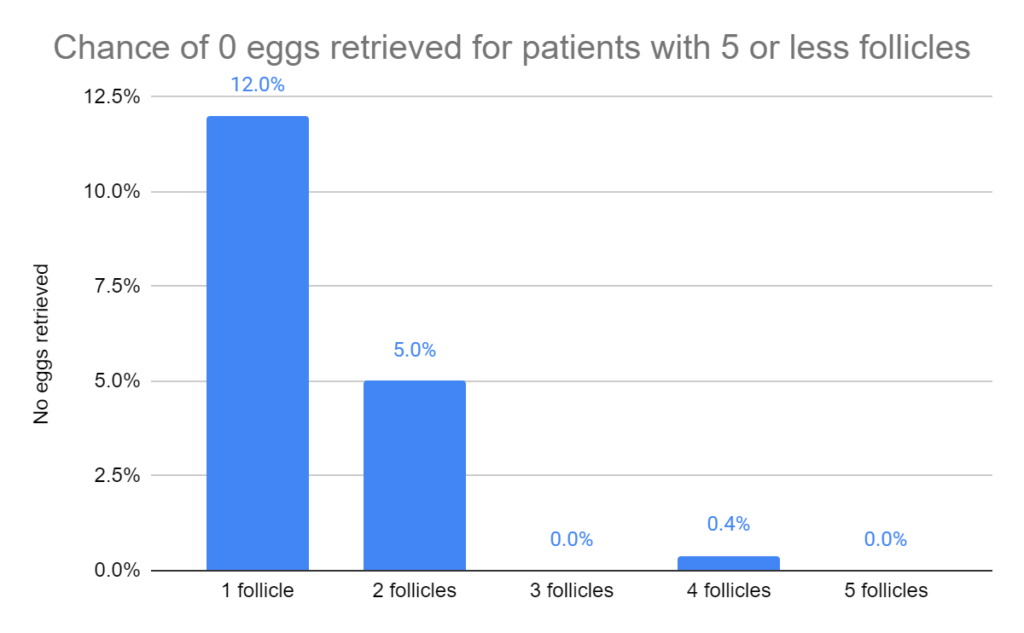
The chance of getting no euploids or no blastocysts also decreased with more follicles. Remember, this study included both PGT-A and non-PGT-A cycles, so that’s why they presented the data this way.

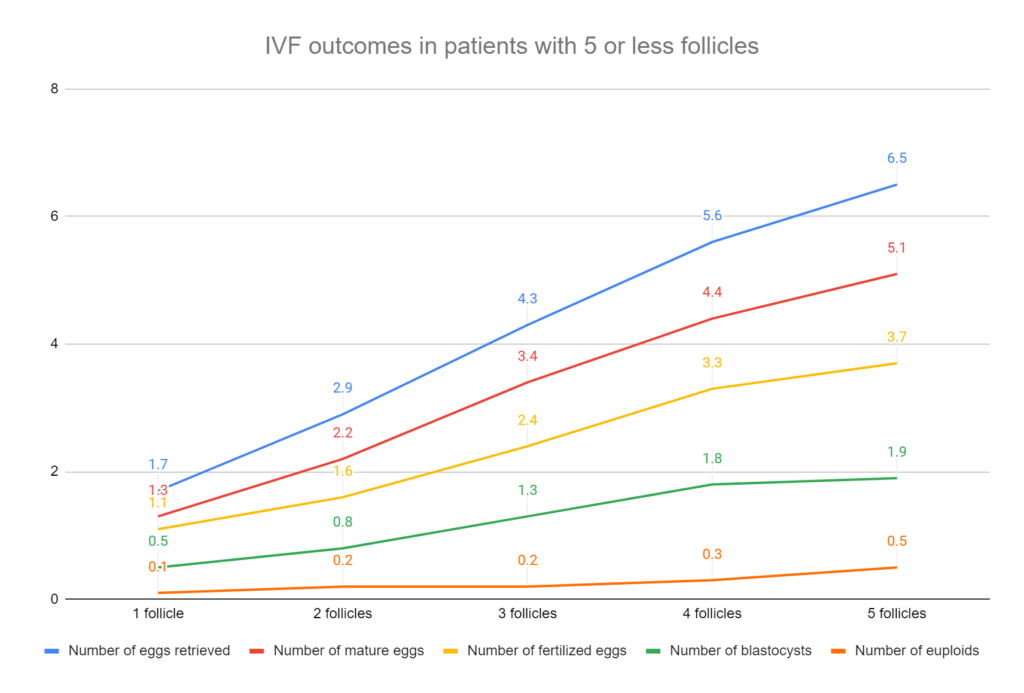
Now let’s look at some of the IVF outcomes! As expected, more follicles means more eggs, more mature eggs, more fertilized eggs, more blastocysts and more euploids.
Conclusion
As expected, cycles with 5 follicles resulted in a higher live birth rate than those with 4, 3, 2 or 1 follicle.
The live birth rates also varied based on age, with women >42 having the lowest rates, and women <35 having the highest rates.
They also looked at other outcomes from IVF cycles with 1-5 follicles.
Cycles with 1 follicle had a higher chance of not having any eggs retrieved, or blastocysts produced.
These cycles also had a lower number of eggs retrieved, mature eggs, fertilized eggs, blastocysts and euploids.
It’s interesting that patients younger than 35 with 5 or less follicles showed no difference in live birth rate regardless of follicle number. The authors explain that this might be due these eggs being higher quality, or possibly because of the lower sample size.
The authors also suggest that women with a lower number of follicles might benefit in converting their IVF cycle to an IUI cycle. However, data on this is limited (some studies are included below for further reading on this topic).
Related studies
Not all research may agree with this study. There were a number of studies referenced in this study that you might want to check out, as shown below (6 links):

Reference

About Embryoman
Embryoman (Sean Lauber) is a former embryologist and the founder of Remembryo, an IVF research and fertility education website. After working in an IVF lab in the US, he returned to Canada and now focuses on making fertility research more accessible. He holds a Master’s in Immunology and launched Remembryo in 2018 to help patients and professionals make sense of IVF research. Sean shares weekly study updates on Facebook, Instagram, and Reddit regularly. He also answers questions on Reddit or in his private Facebook group.