
The egg cell contains a high number of mitochondria, which are tiny cellular organs that produce energy that the egg needs to power fertilization and embryo development. Research has shown that these mitochondria can become dysfunctional with age, leading to reduced energy availability for the egg that could result in poor egg quality. Different treatments that target mitochondria, like antioxidant supplements or mitochondrial donation, may improve egg quality, although good quality research is lacking that shows these treatments are truly effective.
🔗 Original studies are referenced in this post or within the linked Remembryo posts.
💡 Reminder: Terms underlined with a dotted black line are linked to glossary entries. Clicking these does not count toward your paywall limit.
Note: Much of this information was sourced from a review by Ju et al. (2024).
Table of Contents
What are mitochondria?
Mitochondria are tiny cellular organs, or organelles, that have the job of producing energy for the cell, including the egg cell and embryo cells (the embryo inherits its mitochondria from the egg). They’re basically the batteries of the cell, and contain their own DNA called mitochondrial DNA (mtDNA). Mitochondrial DNA contains important genes that mitochondria need to produce energy.


Mitochondria make energy using the sugars in the food we eat, combined with the oxygen in the air we breathe, to form a molecule called adenosine triphosphate, or ATP. ATP is the energy currency of the cell, and all biochemical processes that need energy use ATP to get the job done. This is the simple explanation, for more details, keep reading — however, this is additional information and isn’t necessary to understand the rest of the article.
Mitochondria produce energy through aerobic respiration
This section is optional, and provides more background on the biochemistry of mitochondria and how energy is made. I could not write an article about mitochondria without including this information!
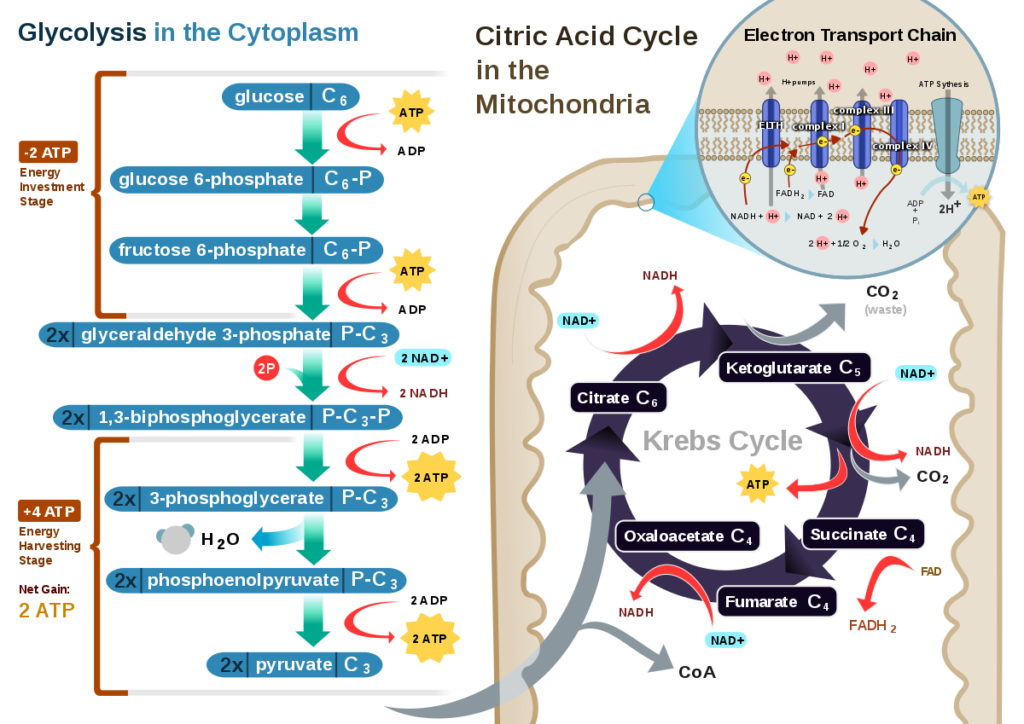
ATP is made through a series of chemical reactions called aerobic respiration:
- Glycolysis: This step takes place in the cell’s cytoplasm and breaks down glucose, a type of sugar from the food we eat, into smaller molecules called pyruvate. This process releases a small amount of energy.
- Citric Acid Cycle (aka the Krebs Cycle): The pyruvate molecules enter the mitochondria, where they are further broken down. This cycle churns through these molecules and produces more energy carriers that will be used in the next step. Energy carriers play a crucial role in transporting and transforming energy within a cell to facilitate the production of ATP (ie. NAD+, NADH, FAD, FADH2).
- Oxidative Phosphorylation (aka the electron transport chain): This final step occurs along the inner membrane of the mitochondria. Here, the energy from the carriers generated in the Citric Acid Cycle is used to power the production of ATP from ADP (adenosine diphosphate). This step relies on oxygen (hence “aerobic”) and produces the most ATP. Many genes in mtDNA code for proteins needed for oxidative phosphorylation. Fun fact! Coenzyme Q10 is a part of the electron transport chain.
How does aging cause mitochondrial dysfunction?
The egg cell has an important role in human reproduction and requires a lot of energy for fertilization and early embryo development. To get this job done correctly, egg cells are equipped with a lot of mitochondria: about 100,000 (Pikó and Matsumoto 1976)! This is the highest amount of any cell in the body.
As you get older, these mitochondria can become dysfunctional and produce less energy, resulting in decreased egg quality. This can happen for a number of reasons:
- Some studies have shown that the number of mitochondria inside an egg cell starts to decrease with age (Chan et al. 2005). Having fewer mitochondria means they won’t produce as much energy for the egg.
- With age, reactive oxygen species (ROS) accumulate and can damage mtDNA, causing mutations or breaks in the mtDNA. These errors can accumulate over time, mutating the genes in mtDNA and resulting in dysfunctional mitochondria that produce less energy (Cimadomo et al. 2018).
- Although high ROS can trigger the egg to make more mitochondria, older women may produce less of the factors needed to make new mitochondria (Iljas et al. 2020, Pacella-Ince et al. 2014).
- Dysfunctional mitochondria can be removed by a process called mitochondrial autophagy, where damaged mitochondria are destroyed by cellular structures called autophagosomes. There’s some evidence that autophagy is impaired with age (Jin et al. 2021), which could lead to an accumulation of damaged mitochondria that can’t produce as much energy.
Besides the egg itself, follicular cells that support egg development, called granulosa cells, can also be affected by mitochondrial dysfunction (Clay Montier et al. 2009). This can lead to apoptosis (programmed cellular death) of these cells, resulting in the follicle failing to develop or decreased egg quality.
How does mitochondrial dysfunction lead to lower egg quality?
With increasing age, birth rates drop and miscarriage rates rise:

Aneuploidy has been reported in 50-70% of miscarriage products of conception and is considered the leading cause of miscarriages (Hyde et al. 2015). Aneuploidy is the condition of having errors in the number or structures of chromosomes in the embryo. For more information on chromosomes and aneuploidy, you can check the beginning sections of my Complete guide to PGT-A.
Maternal age is strongly linked to aneuploidy. In women <35, about 60% of embryos are expected to be euploid, which drops to about 10% by age 44 (Demko et al. 2016).
Aneuploidy results when the oocyte makes a mistake in separating the chromosomes during meiosis, causing some eggs to have too many (or too few) chromosomes. Meiosis is a special type of cell division that splits up chromosomes to make egg or sperm cells. Check out my complete guide to egg quality to read more about meiosis.
The spindle is a cellular machine that has the job of separating the chromosomes during meiosis. The spindle produces fibers that anchor onto chromosomes and pull them to opposite sides of the cell. By separating the chromosomes to opposite sides, the cell can then divide into two, with each cell containing half the chromosomes.
You can see this below, going from one cell in A to two in D. Notice how the chromosomes are being separated by the fibers from the spindle.

Because of decreases in the amount of energy produced, mitochondrial dysfunction can affect how these spindles form (Cimadomo et al. 2018, Zhang et al. 2023), potentially leading to problems with chromosome segregation.
Besides mitochondrial dysfunction hindering energy production in the egg or granulosa cells, mitochondria also play an important role in apoptosis (programmed cell death). Apoptosis is how our body destroys defective cells, and mitochondria are a major trigger for apoptosis. Mitochondrial dysfunction might trigger apoptosis in the egg, or in granulosa cells, which can lead to follicles failing to develop.
Can mitochondria be used to predict embryo quality or IVF success?
There have been studies that have measured mtDNA and related this to embryo quality. This can be done as an add-on during PGT-A. We might expect that high levels of mtDNA indicate a high number of mitochondria, which should indicate a good quality embryo, right?
Well it turns out the opposite might be true:
- Lukaszuk et al. 2022 found that there was a higher amount of mtDNA in aneuploid embryos compared to euploid embryos.
- Ravichandran et al. 2017 found higher implantation rates with embryos that had higher mtDNA levels.
- Fragouli et al. 2017 found a higher ongoing pregnancy rate for good quality embryos that had normal/lower levels of mtDNA.
The idea is that a compensatory mechanism might be taking place, where poorer quality embryos try to make up for their lower quality by making more mitochondria (and therefore show higher mtDNA levels).
However, there isn’t any consensus on this, as studies have also shown mtDNA levels aren’t related to embryo grades or pregnancy outcomes (Shao-Ying Wu et al. 2021, Ritu et al. 2022). So it’s not clear how useful mtDNA is as a marker for embryo quality or reproductive outcomes.
What can be done to improve mitochondria and egg quality?
In this section, we’ll look at treatments that target mitochondria as a way to improve egg quality.
Antioxidant supplements to improve mitochondria and egg quality
Antioxidants combat ROS by neutralizing them. This lowers ROS levels and can prevent damage to the mitochondria, improve mitochondria metabolism or quality control mechanisms, or help regulate apoptosis through the mitochondria.
Here’s a list of supplements that may restore mitochondrial function:
- Coenzyme Q10
- Vitamin E
- Vitamin C
- L-carnitine
- Melatonin
- Quercetin
- Resversatrol
- Astaxanthin
- Ginsenoside Rb1
- Metformin
- NAD+ precursors (nicotinamide mononucleotide aka NMN; nicotinamide riboside aka NR; these produce NAD+ precursors that can be converted to NADH energy carriers as introduced earlier)
Many of these supplements above have shown a benefit animal models:
- Zhou et al. 2022 showed that ginsenoside Rb1 can prevent oxidative stress in mice.
- Bertoldo et al. 2020 and Yang et al. 2020 show that supplementing NAD+ precursors in aged mice can restore ovarian function, with improvements in mitochondrial metabolism. Huang et al. 2022 showed that treatment with NMN in aged mice can improve autophagy and mitochondrial biogenesis, with some improvements in ovarian reserve.
- Xu et al. 2022 showed that resveratrol can regulate autophagy in mitochondria and protect ovarian function.
- Yao et al. 2020 found that metformin can inhibit apoptosis of mitochondria in Laying Chickens.
- He et al. 2022 showed that astaxanthin prevented ovarian aging by improving the antioxidant capacity of laying hens.
- Jiao et al. 2022 found that quercetin could improve egg maturation and reduce ROS levels, while improving spindle assembly in aged pig eggs.
However, not all of these supplements have been tested in humans. Let’s look at some of the supplements that have been tested in humans:
- Xu et al. 2018 performed an RCT and found that women treated with CoQ10 60 days before IVF had more high quality embryos and fewer canceled transfers.
- Tamura et al. 2007 supplemented melatonin in women with a history of low fertilization, and found that women who took melatonin had an increased fertilization rate. Hosseini et al. 2021 performed a non-randomized controlled trial and found that melatonin didn’t increase the chance of clinical pregnancy or the number of retrieved eggs, but reduced the number of low-quality embryos.
- Kitano et al. 2018 showed that patients who had 82 days of treatment with L-carnitine had improved embryo quality.
- Ochiai et al. 2019 found that patients who had 200 mg/day of resveratrol had a reduced clinical pregnancy rate and increased risk of miscarriage.
Additionally, a Cochrane review (Showell et al. 2020) reviewed egg supplements in humans based on RCTs, finding:
- Melatonin: increased pregnancy rates (7 RCTs, 678 women)
- Vitamin E : no difference in pregnancy rates (1 RCT, 103 women)
- Vitamin C : no difference in pregnancy rates (2 RCTs, 899 women)
- CoQ10: increased pregnancy rates (4 RCTs, 397 women)
- L-carnitine: increased pregnancy rates (2 RCTs, 450 women)
In general, the evidence on egg supplements is low quality (where “the true effect might be markedly different from the estimated effect”). This is because a lot of the studies are small, have a high risk of bias or are inconsistent (some studies might look at different patient groups, use different dosages, combine supplements, etc.) — making it hard to draw conclusions. The supplement industry is also poorly regulated, with some supplements being found to have different ingredients or concentrations than what’s listed. I have a lot more information on egg quality supplements in my post Improving egg quality with supplements.
Some studies have looked at supplementing these antioxidants in culture media, so they can be taken up by the egg or embryo while it develops:
- Zhu et al. 2022 found that including melatonin in culture media led to an increased fertilization rate and more high quality embryos, while also increasing the clinical pregnancy rate.
- Morimoto et al. 2020 found that adding L-carnitine to the culture media led to more good quality blastocysts.
- Al-Zubaidi et al. 2020 found that including CoQ10 in the culture media resulted in more mature eggs.
Mitochondrial donation
Mitochondrial donation involves removing the nucleus and DNA from a donor egg, and then transferring the nucleus from a patient’s egg into the enucleated donor egg.

The outcome of this is the patient’s nucleus (and DNA) is now in the donor egg, which has healthy mitochondria. These healthy donor mitochondria might make fewer errors during meiosis than the patient’s mitochondria, potentially leading to improved euploidy rates and better outcomes.
Since the technique involves three individuals — the mother, father and donor — the embryos are sometimes called “three parent embryos,” or “three parent babies” when the baby is born.
There isn’t much research on mitochondrial donation, because it’s illegal in most countries and is considered a type of human genome modification. In countries where it is permitted (the UK and Australia), it’s allowed only for people with mitochondrial disorders and not for people with poor egg quality. There are certain countries where it isn’t regulated, and people will often travel to these places to have the treatment done (ie. Ukraine, Greece, Albania).
Here’s some information on successes with mitochondrial donation:
- The world’s first mitochondrial donation baby was born in 2016 after New Hope Fertility Center created the embryos in the US and then sent them to Mexico to be transferred to avoid US law. The baby’s mother had the inheritable mitochondrial disease Leigh syndrome.
- In the UK, mitochondrial donation is permitted to avoid transmission of mitochondrial disorders. The Newcastle Fertility Centre was the first to obtain a license to perform mitochondrial donation, with the first births reported in 2023. The trial is still ongoing.
- Costa-Borges et al. (2023) performed the first pilot study investigating mitochondrial donation in patients with poor egg quality. They found that all the women in the study had improved fertilization and blastocyst production, with 6 going on to have a live birth. All the babies were healthy, although one had mtDNA carryover. You can read the full summary of this study in my post Pilot study shows improved IVF outcomes after spindle transfer in women with poor egg quality.
Conclusions
Mitochondria are key organelles in the egg cell and produce the energy needed to drive fertilization and embryo development. As we age, mitochondria in the egg become increasingly dysfunctional and aren’t able to produce as much energy, which can lead to chromosome segregation errors during meiosis and aneuploidy.
Various antioxidant supplements have been used to improve mitochondrial function, although there is limited data to show their effectiveness in humans. Larger and better designed studies are needed to ensure these supplements are safe and effective in improving reproductive outcomes in patients.
Mitochondrial donation is an attractive technology to overcome issues with faulty mitochondria, although the technique isn’t permitted in most countries and data is lacking on its effectiveness for improving egg quality. Some countries are allowing its use in limited circumstances, and this might lead to more research being done and more lenient regulations worldwide.

About Embryoman
Embryoman (Sean Lauber) is a former embryologist and the founder of Remembryo, an IVF research and fertility education website. After working in an IVF lab in the US, he returned to Canada and now focuses on making fertility research more accessible. He holds a Master’s in Immunology and launched Remembryo in 2018 to help patients and professionals make sense of IVF research. Sean shares weekly study updates on Facebook, Instagram, and Reddit regularly. He also answers questions on Reddit or in his private Facebook group.