
A small 2025 study found that most pregnancies show detectable hCG by day 6 after a blastocyst transfer, and those that first become positive on day 8–10 indicate delayed implantation and reduced success rates.
hCG is one of the earliest measurable signs that implantation has begun, and most clinics rely on a single beta test about 9–12 days after transfer to confirm pregnancy.
What isn’t well understood is when implantation typically starts after a blastocyst transfer, or whether embryos that reach detectable hCG later have different outcomes.
To investigate this, Tu et al. (2025) tracked early hCG levels after single-blastocyst FET and compared pregnancies that first reached ≥5 IU/L on day 6 versus days 8–10 to see if later detection was linked to biochemical pregnancy, ectopic pregnancy, or ongoing pregnancy.
🔗 Original studies are referenced in this post or within the linked Remembryo posts.
💡 Reminder: Terms underlined with a dotted black line are linked to glossary entries. Clicking these does not count toward your paywall limit.
Study details
- Study type: Retrospective cohort that took place between 2022 and 2024 at a single IVF center in China.
-
Participants: 515 pregnancies with a first positive hCG after single blastocyst FET.
- Normal implantation: 455 pregnancies (first hCG ≥5 IU/L on day 6).
- Delayed implantation: 60 pregnancies (first hCG ≥5 IU/L on day 8 or 10).
- Exclusions: Fresh transfers, repeated implantation failure (RIF), and cycles without any positive early hCG.
Implantation timing and early hCG measurement after embryo transfer
The researchers measured serum hCG on days 6, 8, 10, and 12 after a frozen embryo transfer with a single blastocyst. A level of ≥5 IU/L was used as the threshold indicating that implantation had begun:
- 455 pregnancies (88%) first reached ≥5 IU/L on day 6, categorized as normal implantation.
- 60 pregnancies (12%) first reached ≥5 IU/L on day 8–10 (56 pregnancies on day 8 and 4 pregnancies on day 10), categorized as delayed implantation.
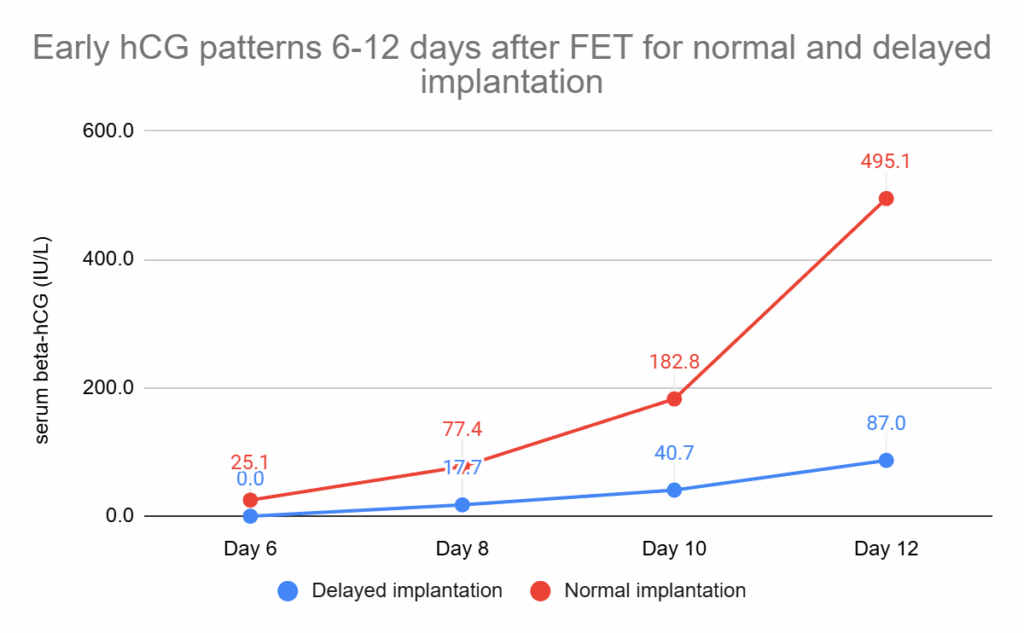
Early hCG levels differed between groups, and all were statistically significant (p= 0.000). On days 8, 10, and 12, the delayed-implantation group had lower hCG levels, even though both groups showed similar 48-hour rises between days 8 and 10 (2.4 vs 2.3). By day 12, however, the delayed group showed a slower 48 hour rise between day 10 and 12 (1.9 vs 2.5, p= 0.002).
This shows that most patients have detectable hCG by day 6, but for some it takes a bit longer and may only be detectable by day 8 or 10.
Pregnancy outcomes for delayed and normal implantation
Pregnancy outcomes were also different between the groups, with delayed implantation showing a higher chance of biochemical and ectopic pregnancy and a much lower chance of ongoing pregnancy:
- Ongoing pregnancy: 30.0% delayed vs 74.1% normal (p= 0.000)
- Biochemical pregnancy: 61.7% delayed vs 15.4% normal (p= 0.000)
- Early miscarriage: 5.0% delayed vs 10.1% normal (not significant)
- Ectopic pregnancy: 3.3% delayed vs 0.4% normal (p= 0.016)
Factors associated with delayed implantation
The researchers wanted to see if there were any factors that were associated with delayed vs normal implantation (using multivariable logistic regression after adjusting for age, BMI, and other confounders).
Two factors were strongly associated with a lower chance of delayed implantation: high-quality blastocysts and PGT-A cycles, meaning they were less likely to implant late.
Age, BMI, natural vs HRT protocol, and endometrial thickness showed no clear association, suggesting that embryonic factors may play a larger role in implantation timing than patient characteristics or the preparation protocol.
Conclusions
This study found that most patients show detectable hCG by day 6 (normal implantation), with some taking a bit longer at day 8 or day 10 (delayed implantation). Patients with delayed implantation had slower hCG doubling between days 8 and 10, but not between days 10 and 12.
Patients with delayed implantation had higher biochemical and ectopic pregnancy rates and a lower ongoing pregnancy rate compared with those whose hCG became positive on day 6.
They also found that transferring higher quality embryos or euploids after PGT-A had a lower chance of implanting later.
Because the delayed-implantation group was small (only 60 pregnancies), these results should be taken as early, preliminary findings, and larger studies are needed. Even so, the overall pattern makes sense: embryos that start implanting later or produce hCG more slowly early on may have a harder time maintaining pregnancy, or might not be fully synchronized to the implantation window.
Other studies have measured serum hCG even earlier, with some detecting it as soon as day 5 after a day 5 transfer. I haven’t found any data showing detection earlier than this, although it’s possible. Still, most clinics would likely prefer to check hCG at the usual 9–12 days after transfer, since that timing allows the hormone to rise enough for a clear and dependable result.
Taken together, these results outline an implantation timeline for serum hCG detection:
- Day 0 – Blastocyst transfer
- Days 1–3 – Blastocyst continues developing, hatches and attaches to the uterine lining. Early trophoblast cells begin producing hCG, but serum levels may remain below detection.
- Days 4–6 – hCG enters maternal blood and typically becomes detectable in serum, with most pregnancies reaching ≥5 IU/L by day 6 according to this study.
- Days 8–10 – First-detectable serum hCG in this window suggests delayed implantation.
- Day 10+ – Serum hCG continues rising.
Want to read more about hCG and pregnancy outcomes after IVF?

Researchers in a 2019 study compared pregnancy outcomes with different serum β-hCG levels that were measured on day 16 of the embryo's age (13dp3dt/11dp5dt). Read more.

Researchers in a 2022 study found that women with low β-hCG (<149 mUI/ml) are more likely to have a preterm delivery and abnormal placental pathologies compared to women with higher β-hCG. Read more.
Researchers in a 2023 study developed a model to predict the chance of live birth after a positive β-hCG (beta-hCG), using the first measurement and a second one taken 48 hours later. Read more.
A 2024 study found that beta-hCG levels were related to day 3 and day 5 embryo quality and development, with blastocyst expansion having the strongest impact on both initial beta values and their doubling. Read more.
Related studies
These additional studies were referenced by the authors of the paper and haven’t been covered on Remembryo. They may be helpful if you’re exploring this topic further. This section is available for paid subscribers.

Reference

About Embryoman
Embryoman (Sean Lauber) is a former embryologist and the founder of Remembryo, an IVF research and fertility education website. After working in an IVF lab in the US, he returned to Canada and now focuses on making fertility research more accessible. He holds a Master’s in Immunology and launched Remembryo in 2018 to help patients and professionals make sense of IVF research. Sean shares weekly study updates on Facebook, Instagram, and Reddit regularly. He also answers questions on Reddit or in his private Facebook group.