

Researchers in a 2022 study performed a randomized controlled trial and found no improvement in IVF outcomes using time-lapse (embryoscope) compared to conventional embryo grading.
Time-lapse (ie. Embryoscope by Vitrolife) is a special type of incubator that allows embryos to be cultured and monitored at the same time.

Time-lapse embryos are cultured individually in dishes and a picture of each embryo is taken every 10 minutes or so. Compiling these 10 minute shots together gives a “time-lapse” of the embryo’s development. Here’s an example below:

Besides being extremely cool and a great keepsake, time-lapse technology can monitor different developmental milestones of the embryo and use this information to rank them. This “morphokinetic” data can include the time to two cells, to four cells, to a blastocyst, etc. and can evaluate the quality of the ICM and trophectoderm. If you’re unclear about this terminology, check here to read more about embryo development and grading.
This morphokinetic data of an embryo’s development, as well as whether or not it implants, has been compiled into prediction models. One of these models is called the KIDScore Day 5 model (there’s also a Day 3 model, and other algorithms), which gives a numerical score to an embryo based on its development. The higher the KIDScore, the higher its chance for implantation based on this model.
So time-lapse technology is really only choosing the best embryo of a bunch. Like PGT-A, and conventional embryo grading, it’s a selection tool. The question is, does time-lapse perform better than embryo grading done by an embryologist? Is it worth the ~$500 add-on price?
A 2019 Cochrane review included 9 RCTs and didn’t find any good quality evidence for differences in clinical pregnancy, live birth, ongoing pregnancy, and miscarriage rates with time-lapse technology vs conventional grading. All the studies were low to very-low quality so a better quality study is needed.
In this week’s summary, we’ll look at an study by Ahltrom et al. (2022) that compares time-lapse and conventional grading. This was a double-blinded RCT that was conducted at 10 Nordic IVF clinics between 2018 and 2021. Initially, 1656 patients were expected to enroll in this study, but COVID-19 forced them to end the study early. So instead they had a total of 745 patients (369 in the time-lapse group and 376 in the conventional grading group). They only included patients who had fair/good quality embryos (≥3BB), and all embryos were cultured the same way (in the embryoscope, but half were then graded conventionally or selected based on the KIDScore).
🔗 Original studies are referenced in this post or within the linked Remembryo posts.
💡 Reminder: Terms underlined with a dotted black line have glossary definitions. Hover or tap to see a short definition, or select “Read full definition” in the pop-up to view the complete glossary entry. Viewing glossary entries does not count toward your paywall limit.
Time-lapse (embryoscope) vs conventional embryo grading IVF outcomes
For pregnancy outcomes, they found no difference in positive beta-hCG pregnancies, ongoing pregnancies, and early pregnancy losses as you can see below:
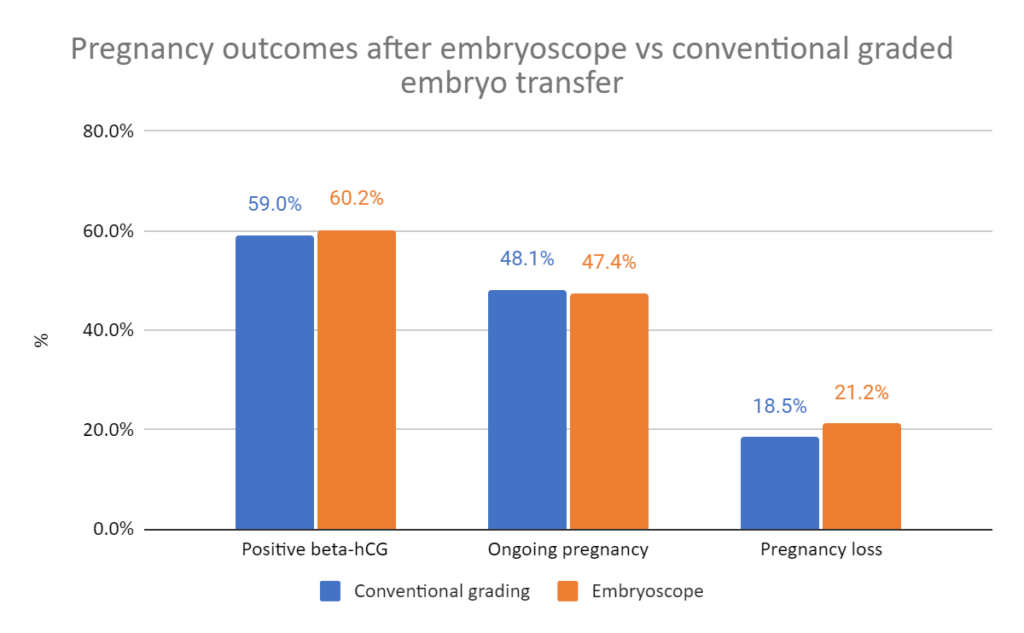
There are different version updates of KIDScore that were also evaluated in this study (version 2 and version 3 mainly). They found no differences in ongoing pregnancy rates.
Conclusions
This study found no improvement in IVF outcomes using time-lapse (embryoscope) compared to conventional embryo grading. Although they lost about half of their participants due to COVID-19, the authors state that this wasn’t an issue since there were no differences between the groups anyway.
So the embryoscope may not be worth the hefty price tag, at least based on this study!
It’s worth pointing out that the average age of the participants here was about 33. In a recent study by Kato et al. (2021), they found that KIDScore Day 5 prediction improved in patients who were >40 years old. The study I’ve summarized here didn’t have a large number of women who were >40, so there may be a connection here.
Another drawback of this study is that they focused on fair/good quality embryos only. The embryoscope might be better suited in identifying a better embryo when the quality scores are lower. There were some atypical cleavage markers that weren’t examined (chaotic cleavage, reverse cleavage, fragment internalization, etc.) and these may be more important in assessing poor quality embryos for their potential.
One other feature of this study is that they’re evaluating the algorithm vs conventional grading. The embryoscope is an isolated culture environment whereas standard culture involves (normally) checking on the embryos periodically. This uninterrupted culturing might have a benefit for IVF outcomes. Since all embryos were cultured in the embryoscope (and then graded and transferred on the basis of the KIDScore or embryo grade), they didn’t examine this here. I’ll do a follow-up post on uninterrupted culture next week to see how this might influence IVF outcomes.
As always, checking with your clinic and seeing how their stats compare with the embryoscope is a great idea before committing.
Using artificial intelligence to evaluate embryos is likely how things will be done in the future, so don’t give up on this technology just yet! But for now evaluating embryo quality, particularly for good quality embryos, might be better left to the embryologist.
Reference

About Embryoman
Embryoman (Sean Lauber) is a former embryologist and the founder of Remembryo, an IVF research and fertility education website. After working in an IVF lab in the US, he returned to Canada and now focuses on making fertility research more accessible. He holds a Master’s in Immunology and launched Remembryo in 2018 to help patients and professionals make sense of IVF research. Sean shares weekly study updates on Facebook, Instagram, and Reddit regularly. He also answers questions on Reddit or in his private Facebook group.