
Researchers in a 2024 study showed that by artificially removing the embryo’s zona (shell) right after fertilization reduced fragmentation, improved blastocyst development, and led to live births in patients with repeated IVF failure, though the findings are still preliminary and need confirmation in larger trials.
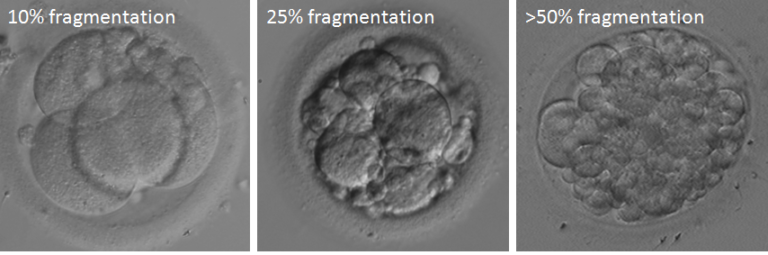
When embryos start dividing in the lab, sometimes little pieces of cytoplasm break off from the cells during the cleavage stage (day 1-3 after fertilization). These are called fragments, and the process is known as fragmentation.
Fragmentation is one of the main features embryologists look at when grading cleavage-stage embryos, since it’s linked to lower success rates. Embryos with severe fragmentation often arrest or fail to implant, but it’s not clear whether fragmentation can be prevented.
A study by Yumoto et al. (2024) tested a new idea in patients with repeated IVF failure due to severe fragmentation: what if you remove the zona pellucida (the shell around the embryo) right after fertilization? The zona normally keeps the embryo together, but it may also play a role in fragmentation. The researchers wanted to see if zona removal could reduce fragmentation and improve the chances of reaching the blastocyst stage.
For more background on embryo development and fragmentation, check out my Complete guide to embryo grading and success rates.
🔗 Original studies are referenced in this post or within the linked Remembryo posts.
💡 Reminder: Terms underlined with a dotted black line are linked to glossary entries. Clicking these does not count toward your paywall limit.
Study details
- Study type: Proof-of-concept based at a single fertility center in Japan between 2020 and 2021.
-
Participants: 34 patients with repeated IVF failure and poor blastocyst development due to severe fragmentation in at least two IVF cycles. From these patients, they collected 173 normally fertilized eggs that were split into two groups:
- 101 allocated to the zona-free group (zona was removed on day 1 using a laser and “medium blowing” to help separate the zona from the fertilized egg).
- 72 allocated to the zona-intact group
- These embryos were compared to results from these patients’ earlier cycles (between 2016-2020), which included 365 fertilized eggs.
- Culture system: Time-lapse incubator, embryos followed through cleavage and blastocyst stages
Less fragmentation with zona removal, more blastocysts
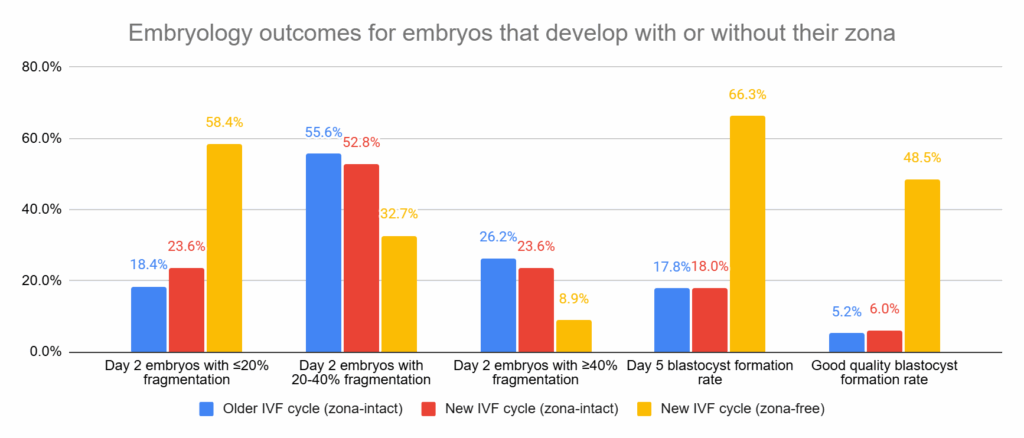
The study compared embryos grown in three settings: the patients’ earlier IVF cycles with the zona intact, their newer cycles with the zona intact, and the newer cycles where the zona was removed after fertilization.
Embryos without the zona showed less fragmentation, and by day 5 they were more likely to form blastocysts and to reach good quality compared to the zona-intact group and to their older IVF cycles (all statistically significant, p< 0.01).
Below you can see a video of an embryo developing without a zona (reproduced with permission from a patient who was not involved in this study):
Clinical outcomes with zona-free embryos
Here’s the clinical outcomes after transferring these embryos.
Earlier IVF cycle (average age ~35):
- 34 patients, 109 embryos transferred
- 0 pregnancies, 0 live births
Zona-free group (average age ~40):
- 24 patients, 37 embryos transferred
- 9 pregnancies (6 live births, 3 miscarriages). All were born healthy.
- Pregnancy rate: 38% per patient, 24% per embryo transferred
Zona-intact group (average age ~40):
- 17 patients, 19 embryos transferred
- 1 pregnancy (1 live birth)
- Pregnancy rate: 6% per patient, 5% per embryo transferred
Conclusions
This study showed that artificially removing the zona after fertilization reduced fragmentation and improved blastocyst development in patients with a history of severe fragmentation. Pregnancy and live birth rates also improved.
While this is promising, it’s important to remember that this was a small, exploratory study (34 patients, 173 zygotes), and more work is needed.
A larger follow-up study from another group (Mizuta et al. 2024) included 62 couples and 564 embryos, again with an average female age around 40. They also saw higher blastocyst rates (36% vs. 23%), better embryo quality, and much higher ongoing pregnancy rates (32% vs. 3%) in the zona-free group, with 15 live births reported. But even here, the authors emphasized the need for randomized controlled trials and sibling-oocyte studies before this approach could be considered routine. This study was published as an abstract.
Why might removing the zona reduce fragmentation? Time-lapse studies have shown that fragments often appear at the sites of perivitelline threads, fibrous structures that connect the zona to the embryo membrane. When fragments form, they can strip away cytoplasm, mitochondria, and other factors, weakening the embryo’s cells and impairing further development. By removing the zona, these connections may be eliminated, which could explain why there’s reduced fragmentation.
More research is needed to understand why this happens, to confirm safety, to know which patients are most likely to benefit, and to follow up on the health of children born with this method.
Related studies
These additional studies were referenced by the authors of the paper and haven’t been covered on Remembryo. They may be helpful if you’re exploring this topic further. This section is available for paid subscribers.

Reference

About Embryoman
Embryoman (Sean Lauber) is a former embryologist and the founder of Remembryo, an IVF research and fertility education website. After working in an IVF lab in the US, he returned to Canada and now focuses on making fertility research more accessible. He holds a Master’s in Immunology and launched Remembryo in 2018 to help patients and professionals make sense of IVF research. Sean shares weekly study updates on Facebook, Instagram, and Reddit regularly. He also answers questions on Reddit or in his private Facebook group.