
Researchers in a 2023 study found that about 17% of women with unexplained infertility have variations in genes linked to a variety of conditions, such as cancer.
According to the World Health Organization, infertility affects about 15% of reproductive-aged couples, and some studies suggest that it may be linked to other medical conditions.
Dougherty et al. (2023) performed a type of DNA sequencing called whole exome sequencing on 197 women with unexplained infertility to see if there were any variations in genes linked to disease.
These women were part of the Assessment of Multiple Intrauterine Gestations from Ovarian Stimulation (AMIGOS) trial from Diamond et al. (2015), that examined the use of aromatase inhibitors in women with unexplained infertility.
They were between 18 and 40 (average age was 32), had a normal uterine cavity, at least 9 menses a year, and had a partner with at least 5 million motile sperm after semen analysis. Most of the women were White (81%), with 9% Black, 9% Asian and 1% American Indian or Alaskan Native.
As a bit of background for this study, our DNA contains genes that provide the instructions to produce proteins that are needed by our cells. These genes are made up of a specific sequence of DNA, like letters in a paragraph in a book. Some people can have changes in the sequence of these genes (called variants), like spelling mistakes in a paragraph. Often these variants don’t have any impact on the function of the protein that is coded by the gene, but sometimes they do and can lead to a disease. Pathogenic or likely pathogenic (P/LP) variants are variants that can cause disease.
As a further note, another way of discussing variants is by using the word “mutation,” which often has a negative connotation and efforts are being made to use the term “variant” instead. I’ll mostly stick to “variant” in this summary, but “mutation” may slip in occasionally!
This study considered two groups of P/LP variants in women with unexplained infertility: those that are defined as “medically actionable” and those that are not.
Medically actionable genes are genes that have variations that are highly likely to lead to health issues and can be treated medically (ie. certain variants of BRCA1 gene have a high chance of leading to breast or ovarian cancer, which can be treated). The American College of Medical Genetics and Genomics (ACMG) provides a list of medically actionable genes, and this study used the 2016 version that includes 59 genes (Kalia et al. 2017). Newer versions are available that include more genes, but this study needed to use the 2016 version because that’s what their control samples used.
Many of the variants that the researchers discovered were not associated with these 59 genes, but were nonetheless involved in certain conditions based on various studies.
🔗 Original studies are referenced in this post or within the linked Remembryo posts.
💡 Reminder: Terms underlined with a dotted black line are linked to glossary entries. Clicking these does not count toward your paywall limit.
Women with unexplained infertility have more pathogenic/likely pathogenic (P/LP) variants in medically actionable genes
After DNA (exome) sequencing the 197 women with unexplained infertility, the researchers discovered 59 P/LP variants in genes associated with a number of diseases, including cancer and cardiovascular disease.
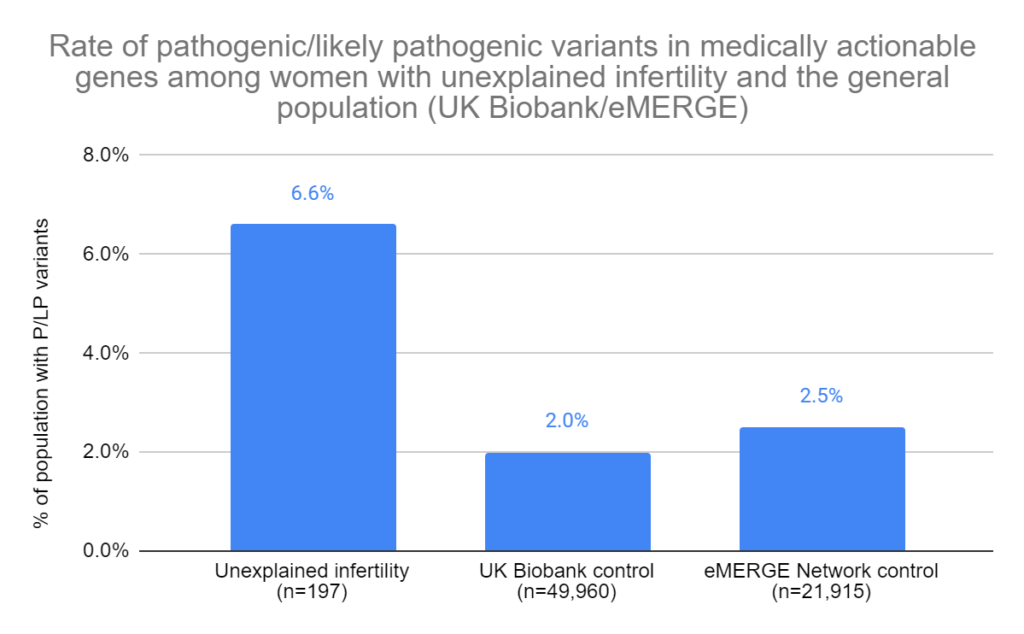
They found that 13 of 197 women (6.6%) had P/LP variations in medically actionable genes (see above). Here’s the list of the medically actionable genes that they found with P/LP variants in women with unexplained infertility:
- BRCA1
- BRCA2
- MYH11
- GLA
- PKP2
- KCNQ1
- SCN5A
- RYR1
- APOB
- CACNA1S
Of the 13 women with P/LP variants in medically actionable genes, 4 had P/LP variants in BRCA1 or BRCA2 that are associated with breast and ovarian cancer, 6 had P/LP variants in genes associated with cardiovascular disease, and 3 had P/LP variants in genes associated with other disorders.
They compared this group to two controls that contained DNA sequences from 49,960 people in the UK Biobank, and 21,915 people in the eMERGE Network.
Compared to the 6.6% with P/LP variants in medically actionable genes, there were 2% in the UK Biobank and 2.5% in the eMERGE Network, which was statistically significant (odds ratio 3.3 [95% CI]: 1.7-5.8; p < 0.001; odds ratio 2.60 [95% CI]: 1.35-4.59; p = 0.001). This means that the odds of having a P/LP variant in a medically actionable gene in women with unexplained infertility was 2.60 to 3.3 times greater than the general population.
Of the 13 women that had P/LP variants in medically actionable genes, 11 were White, 1 was Black and 1 was Asian. To better control for race, they looked at White women only in the UK Biobank/eMERGE (general population) control and still found a statistically significant increase in P/LP variants. This shows that White women with unexplained infertility are more likely to have P/LP variants of medically actionable genes. They didn’t have enough participants of other races to do a statistical analysis for them.
Women with unexplained infertility had additional pathogenic/likely pathogenic variants (not in medically actionable genes)
The analysis above was based on P/LP variants in the 59 medically actionable genes defined by the ACMG, however the researchers discovered other variants in genes associated with various disorders that weren’t part of this list.
They found these P/LP variants in genes in 21 women with unexplained infertility (10.7%), which were separate from the 13 listed above.
The P/LP variants were found in the following genes:
- ALPL
- ANXA11
- ATM
- BEST1
- C1QTNF5
- CFHR5
- CLCN7
- DUSP6
- ERCC6
- GBA
- IMPG2
- KCNJ11
- MEF2A
- PKD1
- PSEN1
- RAD51C
- SLC25A4
- TTN
- TTR
- VWF
These P/LP variants are associated with a variety of disorders, including cancer, early onset Alzheimer’s disease, Parkinson’s disease, polycystic kidney disease, osteopetrosis, amyotrophic lateral sclerosis, and more.
They found that these P/LP variants in women with unexplained infertility were “much more common” compared to the general population (using the VarSome database). As far as I can tell there were no statistics provided for this comparison, which may be related to the type of data collected by VarSome (but I’m not sure!).
Conclusions
This study found that women with unexplained infertility were more likely to have P/LP variants in medically actionable genes compared to the general population. These variants are associated with increased risks of cancer, cardiovascular disease, and other diseases.
Further analysis showed that this was significant in White women, but not other races. However the smaller sample size for the other races in their unexplained infertility group prevented them from doing a statistical analysis on other races.
They also found that P/LP variants in genes that are not considered medically actionable were more common in women with unexplained infertility. These variants are associated with a variety of conditions, such as cancer, neurodegenerative disease and amyotrophic lateral sclerosis.
Between the P/LP variants in medically actionable genes and other genes, there were a total of 13+21 = 37 women. This represents 17.3% of women with unexplained infertility.
This research shows that there may be a genetic link in a subset of women with unexplained fertility to other conditions. This is supported by other studies that shows a tie with infertility and cancer (Stentz et al. 2019, Zhang et al. 2020).
Mutations in the BRCA genes are associated with breast and ovarian cancer. These genes are involved in DNA repair, and errors in these genes may disrupt repair pathways and lead to the accumulation of other mutations, ultimately leading to cancer.
There’s evidence that the BRCA genes are also involved in infertility, and the authors point to a number of studies that have also linked these genes to early menopause onset and lower ovarian reserve. It’s possible that inheritance of certain BRCA variants may predispose someone to infertility.
In other words, some cases of unexplained infertility may be due to inheritance of gene variants that result in infertility and other future medical conditions.
Limitations of this study include the lack of a racially diverse population and no detailed family history or follow-up on patients. Additionally, these results really only apply to women with unexplained infertility, and more studies will need to examine other diagnoses.
Reference

About Embryoman
Embryoman (Sean Lauber) is a former embryologist and the founder of Remembryo, an IVF research and fertility education website. After working in an IVF lab in the US, he returned to Canada and now focuses on making fertility research more accessible. He holds a Master’s in Immunology and launched Remembryo in 2018 to help patients and professionals make sense of IVF research. Sean shares weekly study updates on Facebook, Instagram, and Reddit regularly. He also answers questions on Reddit or in his private Facebook group.