
Researchers in a 2023 study found increased miscarriage rates with mosaic embryo transfers compared to euploids, with no differences in neonatal outcomes.
PGT-A can be used to determine which embryos have the right number of chromosomes (euploids) or the wrong number (aneuploid). Mosaics are embryos that have a mix of euploid and aneuploid cells and have intermediate outcomes.
Viotti et al. (2023) compared miscarriage and neonatal outcomes for over 2,000 mosaic embryo transfers. This study contains international data from various centers between 2017 to 2023, using the International Registry of Mosaic Embryo Transfers (IRMET).
Check my complete guide to mosaic embryos to learn more about mosaics, or my complete guide to PGT-A to get more background on PGT-A (aka PGS testing).
🔗 Original studies are referenced in this post or within the linked Remembryo posts.
💡 Reminder: Terms underlined with a dotted black line are linked to glossary entries. Clicking these does not count toward your paywall limit.
Study details
- PGT-A was performed using Veriseq next generation sequencing platform.
- All centers reported mosaics the same way (20-80% as mosaic, <20% euploid, >80% aneuploid).
- High/low level mosaic outcomes weren’t reported.
- The primary outcomes were the miscarriage rate and select neonatal outcomes.
- Implantation was the detection of the gestational sac.
- Miscarriage was after confirmed implantation and before 20 weeks gestation.
This study is a collection of data from multiple centers reporting mosaic embryo transfer outcomes, so they needed to match these transfers with euploid transfers. Mosaics were matched with 14,673 euploids based on embryo sex, grade, maternal age at egg retrieval, reason for PGT-A, and pregnancy type (singleton or twins).
The main point of this study was to look at the miscarriage rate and some neonatal outcomes, so unfortunately, they didn’t match all the outcomes to euploids, or perform statistics for every outcome.
Mosaic embryo transfer outcomes
This study included 2,031 mosaic transfers, including 1,081 segmental mosaic and 1,013 whole chromosome mosaics.
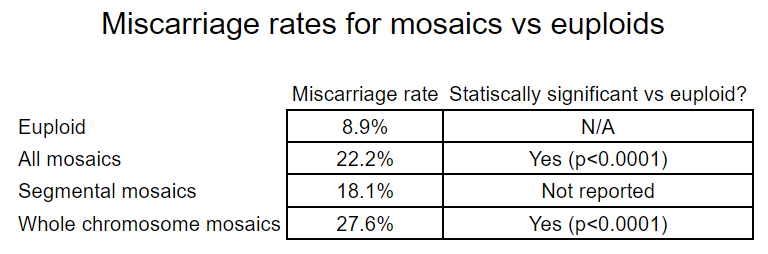
For their primary outcome they looked at miscarriages. Compared to euploids, mosaic embryos had a higher miscarriage rate (for all mosaics and for whole chromosome mosaics; they didn’t measure statistics for segmental mosaics).
For implantation (no statistics were performed):
- Euploids: 59.1%
- Segmental mosaics: 50.9%
- Whole chromosome mosaics: 39.0%
For ongoing pregnancy rates (no statistics, no euploid group):
- Segmental mosaics: 41.7%
- Whole chromosome mosaics: 28.2%
Prenatal testing of mosaic embryo pregnancies
There were 250 pregnancies with prenatal test results available (performed by non-invasive prenatal testing, chorionic villus sampling or amniocentesis), with 94.4% normal.
The 5.6% that weren’t normal represented 14 cases:
- 8 had abnormalities (unrelated to the mosaic result) that weren’t detected in the baby after birth.
- 1 miscarried with tetraploidy (unrelated).
- 2 had different mosaic results.
- 3 had the same mosaic result (1.2%).
Of the 3 that had prenatal test results that matched the PGT-A mosaic result:
- A low level complex mosaic with a trisomy 21 abnormality was confirmed and terminated.
- A low level segmental mosaic affecting chromosome 1 (1p36.33-p31.1) was confirmed and terminated.
- A low level segmental mosaic affecting two chromosomes (+4q32.2q34.3,-Xq27.3-q28) had the chromosome 4 abnormality confirmed by CVS. The pregnancy continued and resulted in a baby without birth defects.
Mosaic embryo neonatal outcomes
There were 711 ongoing pregnancies, with 488 that had newborn data reported and 223 that were lost to follow-up (no outcomes reported for these patients). So the data in this section applies to the 488 patients with reported newborn data.
There was no difference in birth weights or length of gestation between the euploid babies and the mosaic group (all) or the mosaic (whole chromosome) group. They didn’t report outcomes for the segmental group. Birth weights were between 3,052 g to 3,159 g and the length of gestation ranged from 37w 6d to 38w 2d.
One of the 488 births had a major congenital anomaly at birth (0.2%), involving aortic dysplasia.
Eight of the babies had a chromosome analysis done after birth, which were all normal.
Conclusions
This study found that mosaic embryo transfers had a higher miscarriage rate compared to euploid transfers. This was also true for whole chromosome mosaics (no stats for segmentals).
Implantation rates were comparable for euploid and segmental mosaics (no stats), and appeared lower for whole chromosome mosaics (no stats).
Note that because statistics weren’t reported for this data, we can’t say if the differences are real and because of the mosaic type or if they’re due to chance.
Prenatal testing was done on 250 pregnancies, with 3 (1.2%) showing the same mosaic abnormality as the PGT-A result. Two of these were terminated due to persisting abnormalities (one trisomy 21 and another segmental mutation on chromosome 1).
Birth weight and length of gestation were similar between euploids and mosaics.
If you want to read more about mosaic embryos leading to healthy births, check my post Can a mosaic embryo result in a normal baby?
Reference

About Embryoman
Embryoman (Sean Lauber) is a former embryologist and the founder of Remembryo, an IVF research and fertility education website. After working in an IVF lab in the US, he returned to Canada and now focuses on making fertility research more accessible. He holds a Master’s in Immunology and launched Remembryo in 2018 to help patients and professionals make sense of IVF research. Sean shares weekly study updates on Facebook, Instagram, and Reddit regularly. He also answers questions on Reddit or in his private Facebook group.