

In a 2025 meta-analysis, day 5 blastocysts were linked to higher pregnancy and live birth rates than day 6 blastocysts, while newborn outcomes were similar and poor quality day 5 embryos showed comparable potential to good quality day 6 embryos.
Generally, embryos that reach the blastocyst stage earlier tend to have higher chances of implantation, which is why day 5 blastocysts are often prioritized over day 6 or day 7 blastocysts.
A meta-analysis by Hou et al. (2025) combined the results of 49 studies to clarify the differences in success rates and newborn outcomes between day 5 and day 6 blastocysts.
🔗 Original studies are referenced in this post or within the linked Remembryo posts.
💡 Reminder: Terms underlined with a dotted black line are linked to glossary entries. Clicking these does not count toward your paywall limit.
Study details
- Study design: Systematic review and meta-analysis of 49 retrospective cohort studies
- Participants: 106,316 single frozen–thawed blastocyst transfer cycles (day 5: 66,329; day 6: 39,987)
- Transfer type: Single frozen–thawed blastocyst transfer only (no fresh transfers)
- Primary outcome: Live birth rate
NOTE: This meta-analysis did not adjust for age, but it included both untested and PGT-A cycles. Age is less of a confounding factor once euploid embryos are transferred, which makes the PGT-A results more stable than the untested results.
Day 5 blastocysts show a higher live birth rate compared to day 6
Day 5 vs day 6 (untested)
For untested blastocysts (no PGT-A), a single frozen day 5 blastocyst outperformed a day 6 embryo in terms of live birth, pregnancy and miscarriage rates:

- Live birth rate (non-PGT-A): higher for day 5 compared to day 6 blastocysts (43.8% vs 30.2%, risk ratio [95% CI]: 1.56 [1.42–1.71]; 13 studies, I² = 91%)
- Clinical pregnancy rate (non-PGT-A): higher for day 5 compared to day 6 blastocysts (55.3% vs 41.0%, risk ratio [95% CI]: 1.39 [1.28–1.50]; 19 studies, I² = 90%)
- Miscarriage rate (non-PGT-A): lower for day 5 compared to day 6 blastocysts (19.1% vs 24.3%, risk ratio [95% CI]: 0.76 [0.70–0.82]; 11 studies, I² = 0%)
Day 5 vs day 6 (PGT-A tested)
For PGT-A tested embryos, day 5 embryos also performed better than day 6:
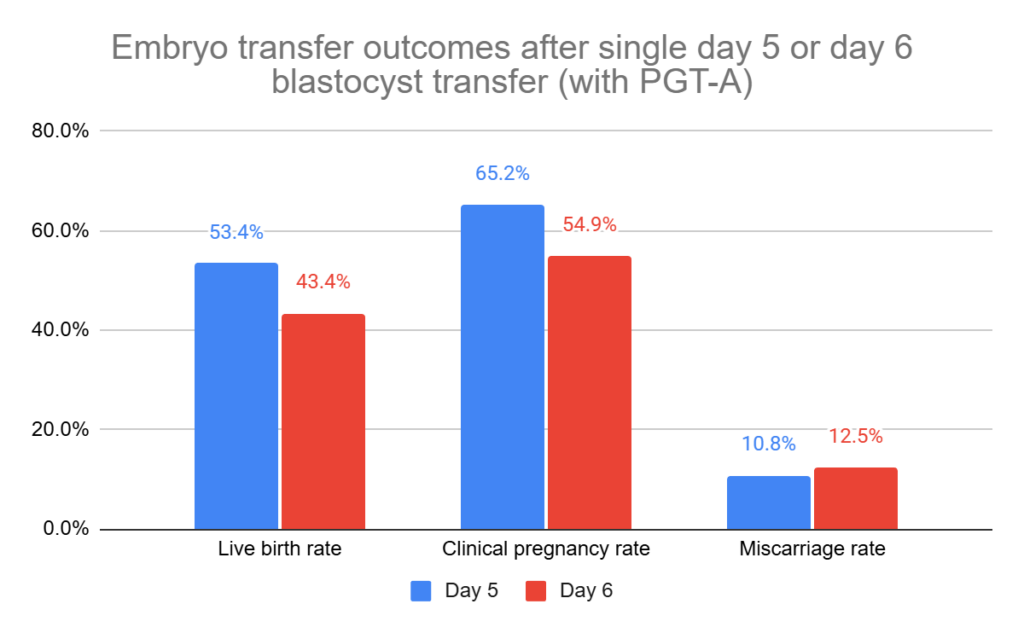
- Live birth rate (PGT-A): higher for day 5 compared to day 6 blastocysts (53.4% vs 43.4%, risk ratio [95% CI]: 1.27 [1.22–1.33]; 18 studies, I² = 17%)
- Clinical pregnancy rate (PGT-A): higher for day 5 compared to day 6 blastocysts (65.2% vs 54.9%, risk ratio [95% CI]: 1.20 [1.16–1.25]; 21 studies, I² = 35%)
- Miscarriage rate (PGT-A): lower for day 5 compared to day 6 blastocysts (10.8% vs 12.5%, risk ratio [95% CI]: 0.85 [0.75–0.96]; 13 studies, I² = 0%)
Poor quality day 5 embryos have similar success rates to good quality day 6 embryos
They also compared transfer outcomes for a single poor quality day 5 embryo vs a single good quality day 6 embryo, finding no difference in live birth rates:
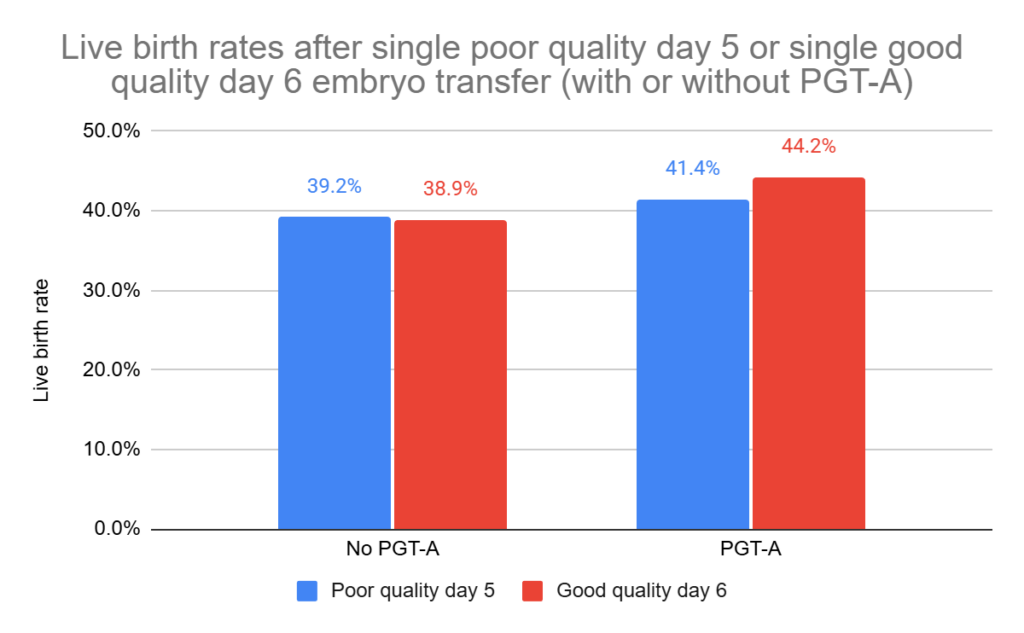
- Live birth rate (non-PGT-A): no difference between poor quality day 5 and good quality day 6 blastocysts (39.2% vs 38.9%, risk ratio [95% CI]: 1.00 [0.89–1.14]; 6 studies, I² = 72%)
- Live birth rate (PGT-A): no difference between poor quality day 5 and good quality day 6 blastocysts (41.4% vs 44.2%, risk ratio [95% CI]: 0.92 [0.69–1.21]; 5 studies, I² = 65%)
There were also no differences in clinical pregnancy rates or miscarriage rates.
Newborn outcomes
Across all analyses, blastocyst timing (day 5 vs day 6) was not associated with any differences in newborn outcomes, including:
- Mean birth weight
- Low birth weight rate
- Macrosomia rate (high birth weight, typically ≥4000 g)
- Gestational age at birth
- Preterm birth rate
- Sex ratio
This was true for PGT-A vs non-PGT-A groups, as well as for the poor quality day 5 vs good quality day 6 groups. The only exception was a higher rate of macrosomia with poor quality day 5 blastocysts (compared to good quality day 6), based on a small number of studies (relative risk [95% CI]: 2.13 [1.05–4.31], 4 studies).
Conclusions
Overall, this meta-analysis found that day 5 blastocysts were more likely than day 6 blastocysts to result in pregnancy and live birth, both with and without PGT-A.
Newborn outcomes were similar between day 5 and day 6 transfers, with no differences in mean birth weight, low birth weight, macrosomia, gestational age at birth, preterm birth, or sex ratio.
When embryo quality was considered, poor quality day 5 and good quality day 6 blastocysts showed similar pregnancy and newborn outcomes overall, although poor quality day 5 embryos had a higher chance of macrosomia.
Some studies (reviewed in this post) suggest that day 6 embryos have higher rates of aneuploidy than day 5 embryos, while others show that very slow-developing embryos, such as day 7, may be affected by metabolic stress and disrupted cell signaling in the inner cell mass (reviewed in this post). Together, these factors may help explain why embryos that take longer to reach the blastocyst stage tend to have lower success rates.
Limitations: The data came from retrospective studies, embryo grading and outcome definitions varied between clinics, and the results were not adjusted for age or lab practices.
Want to read more about day 5, 6 and 7 embryo outcomes?

Not sure what your embryo grade means—or if it affects your chances of success? This guide walks you through everything from day 3 and day 5 grading systems to what each number and letter combo (like 3BB or 5AA) actually means. You'll also find success rate research, embryo photos, and insights from a former embryologist to help make sense of your report. Read more.

Researchers in a 2023 study found that day 7 euploids have the lowest ongoing pregnancy rate, when compared to day 5 and 6 euploids. These embryos were mostly poor quality. Read more.

Researchers in a 2023 study found that embryos that take longer to develop had lower quality scores for both the ICM and trophectoderm, and had reduced clinical pregnancy and live birth rates. Read more.
Researchers in a 2023 study found comparable pregnancy and neonatal outcomes when transferring a day 5 poor quality or a day 6 good quality embryo. Read more.
Related studies
These additional studies were referenced by the authors of the paper and haven’t been covered on Remembryo. They may be helpful if you’re exploring this topic further. This section is available for paid subscribers.

Reference

About Embryoman
Embryoman (Sean Lauber) is a former embryologist and the founder of Remembryo, an IVF research and fertility education website. After working in an IVF lab in the US, he returned to Canada and now focuses on making fertility research more accessible. He holds a Master’s in Immunology and launched Remembryo in 2018 to help patients and professionals make sense of IVF research. Sean shares weekly study updates on Facebook, Instagram, and Reddit regularly. He also answers questions on Reddit or in his private Facebook group.