

Researchers in a 2024 study compared euploid and thaw-survival rates of blastocysts that were biopsied, based on embryo quality, day of biopsy and hatching status. Day 5 excellent quality embryos that were hatching had the best rates.
Check my complete guide to PGT-A to get more background on PGT-A (aka PGS testing).
🔗 Original studies are referenced in this post or within the linked Remembryo posts.
💡 Reminder: Terms underlined with a dotted black line are linked to glossary entries. Clicking these does not count toward your paywall limit.
Study details
This section covers key details of how the study was performed, including patient characteristics, how they were treated, and other methods used. For those who aren’t interested in these details, and just want to see the results, you can go ahead and skip this part.
- This was a retrospective study that took place at a single IVF center in Spain between 2016 and 2022.
- All blastocysts were expanding and hatching/hatched before biopsy.
- Excellent quality embryos were AA, good quality embryos were AB/BA/BB, and poor quality embryos were AC/CA/BC/CB/CC.
- Embryos were hatched on day 3 to prepare for day 5/6 biopsy (no day 7 blastocysts).
- Two different PGT-A labs were used (Igenomix from 2016 to 2019, and Juno Genetics from 2019 to 2022). Both used NGS, but they differed in how they amplified DNA. The researchers note that PGT-A resolution, euploid/aneuploid cutoffs and no-result rates were comparable.
- Mosaic embryos were introduced after 2020 at this clinic.
- Transferable embryos were euploid and low level mosaics, while non-transferable embryos were aneuploid and high level mosaics.
- After thaw, embryos were evaluated for survival, with surviving embryos having 50% or more living cells. Dead cells are dark and non-expanding, and you can see how this would look from this image by Richter et al. (2016) (I don’t have permission to share the image, so I need to share the link).
- The primary outcome of this study was the transferable embryo rate and thaw-survival rate.

In terms of sample size, there were 1,591 patients and 1,849 PGT-A cycles (1,732 who used their own eggs and 117 who used donor eggs) representing 6,130 biopsied blastocysts. Of the 6,130 biopsied blastocysts, 0.77% had no-result, 38.6% were transferable, and 61.4% were non-transferable. There were 942 frozen transfers using 1,316 thawed embryos, with 91.57% surviving the thaw.
From the 6,083 blastocysts biopsied that had a result, the distribution of embryo quality, the day of biopsy and hatching status were:
- 14.32%/63.73%/21.95% were excellent/good/poor quality.
- 73.40%/26.60% were biopsied on day 5/6
- 89.59%/10.41% were not fully hatched/were fully hatched.
Good quality embryos are more likely to be euploid or low level mosaic and have higher thaw-survival rates
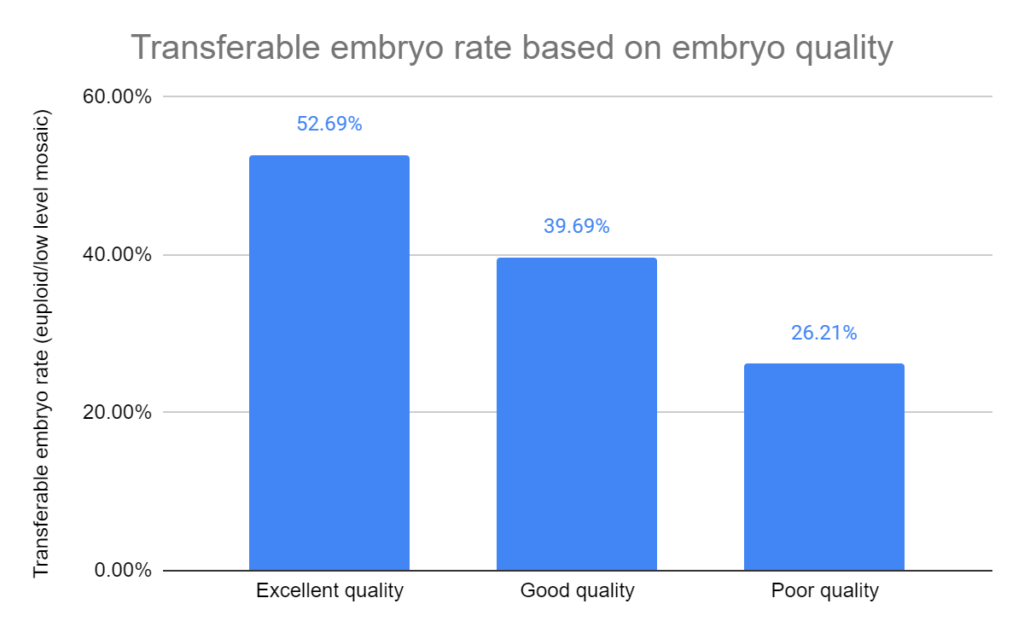
The transferable embryo rate, including both euploid and low level mosaics, was higher in excellent vs good vs poor quality embryos (52.69% vs 39.69% vs 26.21%, p< 0.001). This was true even after statistically adjusting for age (using multivariate regression).
In terms of embryo quality, thawed embryo survival was higher in excellent and good quality embryos compared to poor quality embryos (92.26%, 92.47% vs 84.61%, p= 0.009 and p= 0.002).
Day 5 embryos are more likely to be euploid or low level mosaic and have higher thaw-survival rates
The transferable embryo rate, including both euploid and low level mosaics, was higher in embryos biopsied on day 5 vs day 6 (39.98% vs 34.80%, p< 0.001). This was true even after statistically adjusting for embryo quality (using multivariate regression).

In terms of the day of embryo biopsy, day 5 embryos were more likely to survive the thaw compared to day 6 embryos (93.71% vs 83.60%, p< 0.001).
Fully hatched blastocysts are more likely to be euploid or low level mosaic, but have lower thaw-survival rates
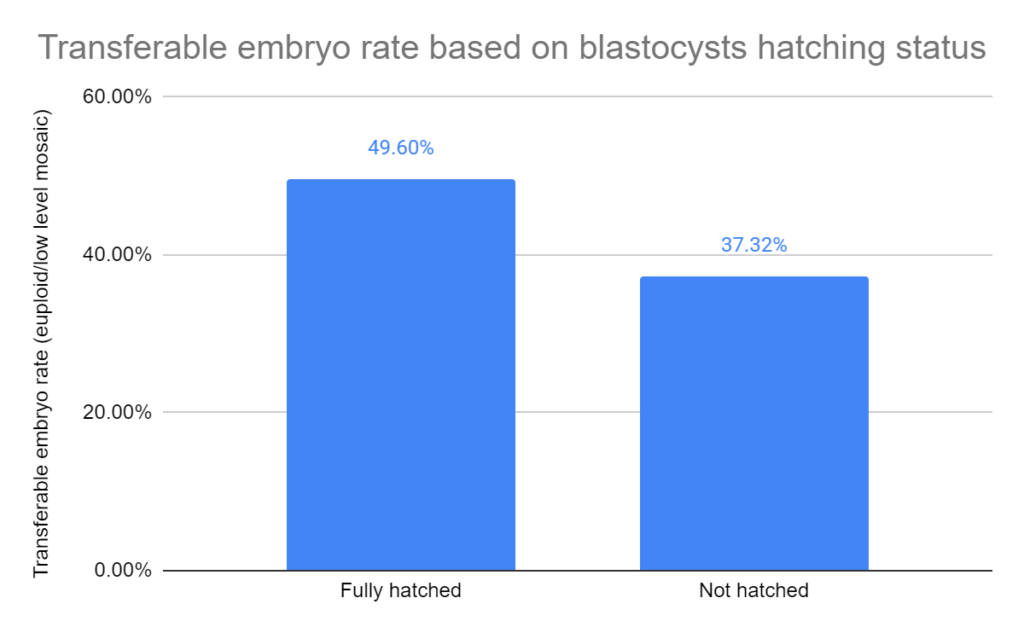
The transferable embryo rate, including both euploid and low level mosaics, was higher in blastocysts that were fully hatched vs not hatched (49.60% vs 37.32%, p< 0.001). This was true even after statistically adjusting for embryo quality (using multivariate regression).
In terms of the hatching status, fully hatched embryos had a lower survival rate than non-hatched embryos (78.61% vs 93.52%, p< 0.001). This is likely because hatched embryos don’t have the protection of the zona, so they could be more fragile. This is controversial though, as some studies have found the opposite, although this might be unique to PGT-A.
Conclusions
This study found that day 5 excellent quality (AA) embryos that were fully hatched were most likely to be euploid/low level mosaic.
In terms of thaw survival, day 5 excellent quality embryos that weren’t fully hatched were most likely to survive the thaw.
Other studies have found a link to embryo quality and euploidy, with better quality embryos more likely to be euploid. Studies have also found that day 5 embryos are more likely to be euploid compared to day 6 or 7 (linked below).
The relationship between a fully hatched blastocyst and euploidy rates is less clear and previous data has been mixed. This might be because embryos that are biopsied are often hatched on day 3 in preparation for the biopsy, and this could allow the blastocyst to hatch out earlier than it would otherwise.
There’s less information available regarding the survival rates of embryos. Data for day 5 vs day 6 is mixed, as is for non-hatched vs hatched blastocysts (referenced below).
Another study that I review in my post Factors associated with euploid death after thaw generally agreed with this study’s results, finding lower survival with poor quality embryos, hatched blastocysts and embryos biopsied on day 7 vs day 6 or 5, among other findings.
Related studies
To learn more about this topic, you can check out a number of studies referenced in this study below (9 links):

Reference

About Embryoman
Embryoman (Sean Lauber) is a former embryologist and the founder of Remembryo, an IVF research and fertility education website. After working in an IVF lab in the US, he returned to Canada and now focuses on making fertility research more accessible. He holds a Master’s in Immunology and launched Remembryo in 2018 to help patients and professionals make sense of IVF research. Sean shares weekly study updates on Facebook, Instagram, and Reddit regularly. He also answers questions on Reddit or in his private Facebook group.
Related posts:
 Meta-analysis combines 74 studies to examine factors linked to euploid transfer success
 Aneuploidy is a key factor in embryo arrest
 Complete Guide to Embryo Grading and Success Rates
 Study examines potential of day 7 euploid transfers
 Multiple embryo freeze/thaw for PGT-A doesn’t affect pregnancy or neonatal outcomes
 An Italian consensus on key performance indicators for assessing IVF clinics
 Study evaluates the potential of day 4, 5, 6 and 7 blastocysts
 Poor quality blastocysts show acceptable live birth rates, no change in perinatal outcomes