
Here’s your IVF research roundup for May 2026. Each month, I highlight everything I’ve shared on Remembryo — including new IVF study summaries, popular social posts, answers to community questions, and a full list of research highlights with links and short summaries from my newsletter. The paywall is off for this post.
📬 Like this roundup?
Get IVF research summaries, news highlights, and weekly subscriber-only content straight to your inbox.
Subscribe to the Remembryo Newsletter →
🔗 Original studies are referenced in this post or within the linked Remembryo posts.
💡 Reminder: Terms underlined with a dotted black line are linked to glossary entries. Clicking these does not count toward your paywall limit.
Remembryo posts
Here’s what I covered this month on Remembryo. Click any image to read more.
A 2026 meta-analysis examined how well PGT-A biopsies represented the rest of the embryo, and found higher mismatch rates in embryos labeled as aneuploid, especially segmental aneuploid embryos. Read more.
A 2026 study explored how IVF patients emotionally navigated the decision to transfer embryos labelled “abnormal” by PGT-A, with many describing grief, uncertainty, and loss of trust in the testing process. Read more.
Researchers in a 2026 study found that natural FETs using donor eggs were linked to higher live birth rates, lower miscarriage rates, and lower rates of some pregnancy complications compared to medicated FETs. Read more.
The ASRM published their 2026 guidelines on managing recurrent pregnancy loss (RPL), reviewing which tests and treatments are supported by evidence, which may be considered in certain situations, and which are not routinely recommended. Read more.
A 2026 meta-analysis combined the results of 105 studies to examine the causes of recurrent pregnancy loss (RPL), finding that unexplained RPL and acquired thrombophilia were the most common. Read more.
Aneuploid embryo success rates after transfer are very low, with about 1–2% leading to a live birth, likely due to undetected mosaicism after PGT-A rather than true whole chromosome aneuploidy. Read more.
Top viewed posts on social
Here you can see the top 3 most popular posts for the month on Instagram, excluding the posts from above.
- Meta-analysis finds no improvement from intrauterine hCG before embryo transfer. A 2026 individual participant data meta-analysis of 7 randomized IVF trials involving 2,244 patients found that intrauterine hCG before embryo transfer did not improve live birth, clinical pregnancy, miscarriage, or ectopic pregnancy rates, leading the authors to conclude it should not currently be offered routinely as an IVF add-on. Read more on Instagram or the original publication.
- Donor egg pregnancies may have higher complication risk. A 2026 individual patient data meta-analysis of 16 studies found that pregnancies from donor eggs had about a 2 to 3× higher risk of hypertensive complications like preeclampsia compared to IVF with own eggs or unassisted pregnancies, suggesting egg donation itself may contribute to risk, potentially through immune-related mechanisms. Read more on Instagram or the original publication.
- PGT-A not linked to worse pregnancy or newborn outcomes. A 2026 meta-analysis of more than 56,000 IVF/ICSI live births found that PGT-A was not associated with increased risks of complications like preeclampsia, preterm birth, low birth weight, or babies being small for gestational age compared to IVF/ICSI without PGT-A. Read more on Instagram or the original publication.
And here’s the top 3 older Remembryo posts (based on Instagram story views). Click any image to read more.
A 2025 study found that after a first frozen embryo transfer, experiencing an early pregnancy loss did not increase the risk of loss in the next transfer, for both euploid or untested embryos. Read more.
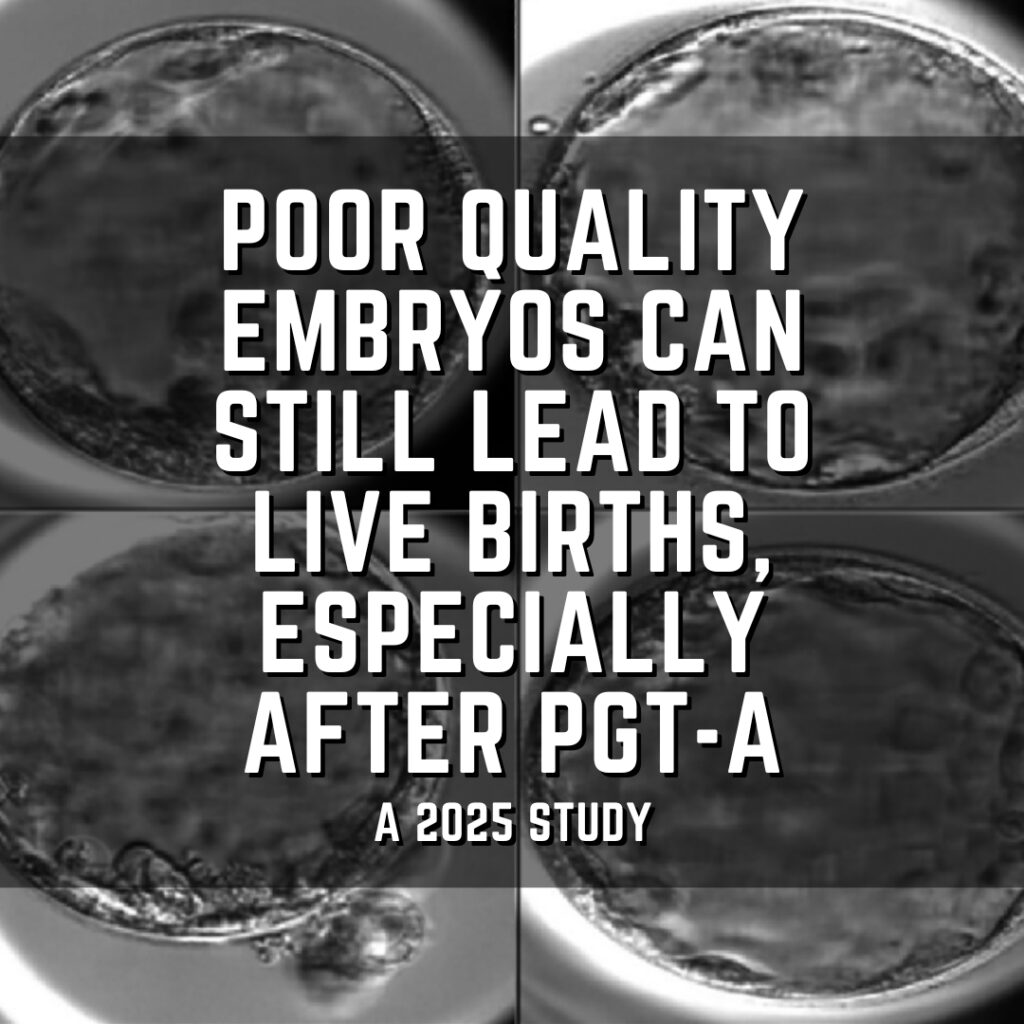
A 2025 study found that while poor quality blastocysts are less likely to be euploid, some can still lead to healthy live births. Tested poor quality embryos had higher live birth rates and lower miscarriage rates than untested ones, especially when they developed by day 5 instead of day 6. Read more.
A 2024 meta-analysis combined the results of 20 studies, showing that supplements improved IVF outcomes in women with ovarian aging, especially CoQ10. Read more.
IVF in the news highlights
Each week in the Remembryo newsletter, I share IVF-related stories that made headlines in the news. Below are 3 leading headlines for the month:
- Ozempic exposure around pregnancy not linked to major risks (MedicalXpress)
- PCOS gets new name after global review (STAT)
- Climate, chemicals may affect reproductive health (The Guardian)
💡 Enjoying this summary?
Join 10,000+ readers who stay updated on IVF research each week:
Sign up here →
IVF questions from the community
Here are select questions that I answered either in my Facebook group or on Reddit.
- Is it possible to have success with a lining under 7 mm? Plenty of people have success with linings under 7 mm, although outcomes can be lower. One large 2025 study of over 30,000 single euploid transfers found that endometrial thickness on its own was not a strong predictor of live birth, and even patients with linings at 4 mm still achieved live births. Read more in my post How lining thickness affects success in 30,000 euploid transfers.
- I’m 34 and I have a low AMH, what are my chances? Age matters a lot for egg quality, and even women with very low AMH can still have success with their own eggs. One study looking specifically at women with AMH ≤0.3 found live birth rates around 26% per initiated cycle for women under 35, although cancellation rates were also fairly high. After 3 cycles, they had an overall live birth rate of about 40%. Read more in my post IVF and pregnancy outcomes in women with low AMH (≤0.3 ng/ml), by age.
- Do some patients respond differently to Gonal-F vs Menopur? Yes, and there’s some emerging evidence that genetics may partly explain this. A 2025 study found that different versions of the FSH receptor gene (FSHR N680S) responded differently to recombinant FSH (like Gonal-F) versus urinary-derived FSH (like Menopur), and matching the FSH type to the patient’s genotype was linked to higher pregnancy and live birth rates. Read more in my post Matching FSH type to FSHR variant improves IVF outcomes.
IVF research brief
🔒 The full research brief for the month begins below (paid subscribers only)
Each week I flag ~10-20 IVF studies I find most helpful. Some are covered in detail on Remembryo, but paying subscribers get short summaries and links to all of them, organized into categories like implantation, egg quality, PGT-A, etc.
Below is the full list of about 50 short summaries and links for studies that weren’t featured on Remembryo this month (available to paying members only).
🔍 Sneak peek: 3 select summaries from the month
- A randomized trial found medicated FETs for euploids increased early pregnancy loss and reduced live birth rates compared to natural FETs. Read more (abstract only)
- Zymot improved fertilization, blastocyst development, and pregnancy and live birth rates compared to density gradient processing. Read more (abstract only)
- A randomized trial found a single VR session before FET increased clinical pregnancy rates and reduced anxiety compared to standard care. Read more (full article)
If you like these, consider subscribing below to get the full list.


About Embryoman
Embryoman (Sean Lauber) is a former embryologist and the founder of Remembryo, an IVF research and fertility education website. After working in an IVF lab in the US, he returned to Canada and now focuses on making fertility research more accessible. He holds a Master’s in Immunology and launched Remembryo in 2018 to help patients and professionals make sense of IVF research. Sean shares weekly study updates on Facebook, Instagram, and Reddit regularly. He also answers questions on Reddit or in his private Facebook group.