
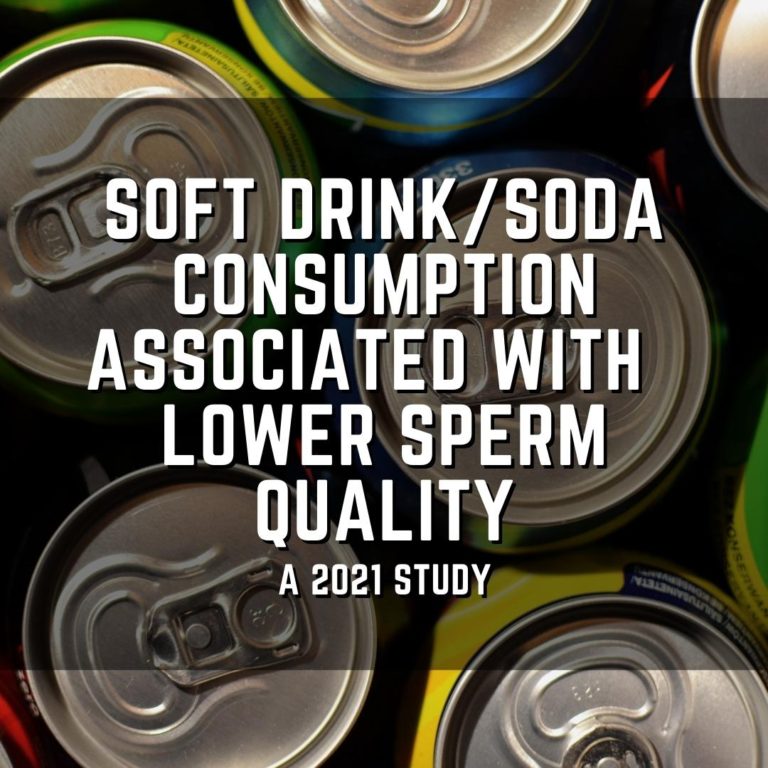
Researchers in a 2021 study found that intake of sugar-sweetened beverages was associated with lower sperm concentration and total sperm count.
Soft drinks and other sugar-sweetened beverages (SSBs) have been linked to other health issues, including higher rates of obesity, diabetes, and heart disease (Malik et al. 2010).
But what about SSBs and fertility? A few studies have looked at this:
- Chiu et al. (2014) found that men who had more than 1.3 servings/day had 9.8% lower progressive sperm motility.
- Yang et al. (2015) found that 1-2 servings/week decreased semen volume.
- Hatch et al. (2018) found that couples who had more than 7 servings/week had reduced time to pregnancy.
🔗 Original studies are referenced in this post or within the linked Remembryo posts.
💡 Reminder: Terms underlined with a dotted black line are linked to glossary entries. Clicking these does not count toward your paywall limit.
Nassan et al. (2021) wanted to add to this research. In their cross-sectional, retrospective study they compared semen quality in a group of nearly 3000 men. These were young men (about 19 years old) who underwent a compulsory physical examination to determine their fitness for military service in Denmark. They provided a single semen and blood sample along with a completed self-administered food frequency questionnaire.
The questionnaire included questions regarding their intake of:
- Sugar-sweetened beverages (SSBs): cola drinks with sugar, and fruit flavored beverages with sugar
- Artificially-sweetened beverages (ASBs): diet/light drinks and light fruit flavored beverages
- Energy drinks (ie. Red Bull)
- Fruit juice
They compared different semen quality parameters based on the WHO system (sperm concentration, count, motility, normal morphology) and hormone levels (inhibin-B and FSH levels, we’ll talk more about these hormones in a moment).
If you’re not sure about semen quality and these parameters you can read my post on understanding a semen analysis here.
The data is presented as the difference from the reference value (people who didn’t drink any SSBs) which they make equal to 0 . So if men who drank a lot of soft drinks had a lower sperm count, then this would be a negative number (eg. if the count is 100 million for the non-consumer, and 90 million for someone who drinks 1 SSB, then this is represented as -10 million).
Let’s check out the data!
In terms of sperm concentration, the average was 57 million/ml:
- For those who had 0 SSBs/day: this was the reference value and is 0
- 0.07 SSBs/day (= 1 SSB/14 days): -8.7 million/ml
- 0.21 SSBs/day (= 1 SSB/5 days): -10.6 million/ml
- 0.5 SSBs/day (= 1 SSB/2 days): -13.8 million/ml
- 1.07 SSB/day: -13.2 million/ml
So these are pretty big differences from a small intake of soda! Those who drank a single soda over a course of 2 weeks had a 15% drop in sperm concentration.
Before going forward, I just want to point out that this is a cross-sectional study. They took a snapshot in time of semen quality in these individuals. This kind of study won’t tell us that the soda caused this drop in sperm concentration, only that there’s an association. We’ll talk more about at the end of this article.
In terms of total sperm count (average: 183 million):
- 0 SSBs/day: reference value: 0
- 0.07 SSBs/day (= 1 SSB/14 days): -18.4 million
- 0.21 SSBs/day (= 1 SSB/5 days): -24.4 million
- 0.5 SSBs/day (= 1 SSB/2 days): -32.6 million
- 1.07 SSB/day: -28.1 million
In terms of inhibin-B/FSH ratios (average: 99):
- 0 SSBs/day: reference value: 0
- 0.07 SSBs/day (= 1 SSB/14 days): +0.3
- 0.21 SSBs/day (= 1 SSB/5 days): +2.0
- 0.5 SSBs/day (= 1 SSB/2 days): -3.0
- 1.07 SSB/day: -9.1
Inhibin-B is a hormone that inhibits FSH in men and is involved in sperm development (spermatogenesis). Generally, men with low fertility have low levels of inhibin-B and higher levels of FSH in their blood which may result in lower amounts of sperm production by the testes (Andersson et al. 2004). So the ratio of inhibin-B and FSH (“inhibin-B/FSH”) is lower in men with lower fertility. The data from above shows that more SSBs is associated with a greater decrease in inhibin-B/FSH, which may account for the decreases in sperm concentration/count.
In terms of sperm motility, progressive sperm motility, and normal sperm morphology: no differences.
Because the high SSB consumer group also consisted of more cigarette/marijuana smokers, they controlled for this in a multivariable adjusted analysis (where cigarette or marijuana smokers were assessed independently based on their soda intake). They found similar decreases as in the unadjusted analysis above.
And what about artificial sweetened beverages (ASBs)? Or energy drinks? Or fruit juice?
- Men in the highest category of ASB (about 1 drink a day) had lower sperm motility (-3.6%), progressive motility (-3.5%) and SHBG (-2.2, sex hormone binding globulin, a protein involved in binding testosterone).
- Energy drinks were found to increase normal sperm morphology (+1.5%), serum E2 (+4) and LH (+0.4) levels.
- Fruit juice didn’t have an impact on any of the factors studied (they performed similar to water).
The authors warned that these results should be interpreted with caution, since these results were not expected and no other data can confirm these findings. More studies are required for ASBs and energy drinks!
So consumption of SSBs was associated with a decrease in sperm concentration and total sperm count!
This might be due to the lowered inhibin-B and increased FSH levels as mentioned, but there are some other possibilities as suggested by the authors:
- Lower FSH levels might have other implications
- SSBs result in shorter telomeres which might cause advanced cellular aging
- Continued SSB consumption can lead to insulin resistance which is associated with oxidative stress
So we don’t know what is causing the decrease in sperm concentration/count, and further studies will need to be done to evaluate this. For instance, men who don’t drink SSBs can be evaluated at baseline, and then given SSBs for some duration and seeing if this alters their sperm quality. We don’t know if these changes can have any impact on IVF outcomes. So taking it further to show how this plays out with IVF in terms of fertilization, blastocyst conversion, embryo quality, implantation rate, etc. would be a great next step!
Reference

About Embryoman
Embryoman (Sean Lauber) is a former embryologist and the founder of Remembryo, an IVF research and fertility education website. After working in an IVF lab in the US, he returned to Canada and now focuses on making fertility research more accessible. He holds a Master’s in Immunology and launched Remembryo in 2018 to help patients and professionals make sense of IVF research. Sean shares weekly study updates on Facebook, Instagram, and Reddit regularly. He also answers questions on Reddit or in his private Facebook group.
Related posts:
 Complete guide to sperm quality
 Do sperm supplements work? Results from the MOXI trial
 Paternal (male) effect on embryo aneuploidy examined
 Meta-analysis confirms benefit of antioxidant supplements in infertile men
 Study reviews 34 common male fertility sperm supplement brands for safety, efficacy
 Study compares Fresh vs frozen sperm, finds no difference in live birth rates
 Endocrine disruptors and their impact on fertility
 Study evaluates interventions that lower endocrine disruptor levels