
Researchers in a 2023 study found that about 1 in 5 women achieve a natural pregnancy following a live birth by IVF, with most pregnancies occurring after 2-3 years.
Many women pursue IVF to overcome challenges in becoming pregnant naturally, but it’s unclear how many women go on to have a natural pregnancy after having success with IVF.
Thwaites et al. (2023) performed a meta-analysis to combine the results of 11 studies examining the occurrence of natural conception pregnancies following a live birth by IVF.
Note: This study is simply looking at the “effect size,” or how many women had a natural pregnancy. There are no comparisons to a control group here, so we’re not looking for any statistical differences. The effect size is also represented as a decimal, so 0.20 = 20%, and 0.18 = 18%, etc.
🔗 Original studies are referenced in this post or within the linked Remembryo posts.
💡 Reminder: Terms underlined with a dotted black line are linked to glossary entries. Clicking these does not count toward your paywall limit.
About 1 in 5 women achieve a natural pregnancy following successful IVF
After combining the 11 studies, they found that 20% of women had a natural pregnancy following IVF (effect size [95% CI]: 0.20 [0.17-0.22]). Note: The 0.20 here refers to 20%.
These 11 studies reported on women who had either a natural pregnancy or natural live birth following successful IVF. They performed a subgroup analysis to split these studies up. They found that 20% of women had a natural pregnancy following IVF, while 18% had a natural live birth.

Another analysis compared IVF, ICSI and mixed IVF/ICSI cycles. They found similar rates.
There was also a difference in the follow-up period for natural pregnancy after successful IVF, ranging from 2 years to more than 10 years. The researchers performed another subgroup analysis, and found that the natural pregnancy rates ranged from 16% at 2 years follow-up to 33% at <5 years follow-up.
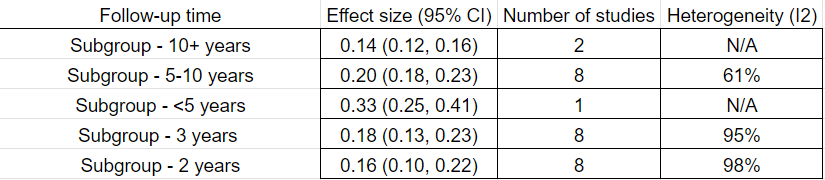
We can see from this that the majority of studies (8) had a follow-up of 2-3 years, and at this length of follow-up 16-18% of women had a natural pregnancy following successful IVF.
Conclusions
This study found that natural pregnancies after successful IVF occurred in about 1 in 5 women. This rate was a bit lower when only looking at studies involving natural live births.
These rates were mostly based on a follow-up of 2-3 years after IVF.
It’s not clear if a history of IVF can increase the rate of natural conception, although the authors note that improved ovarian function or endocrinological changes may be possible.
There was a large amount of variability (heterogeneity) in the studies, which was due to differences in outcomes (pregnancy, live birth rates), population, dates of treatment, and length of follow-up.
Some other factors that could affect the outcomes include:
- Maternal age (some studies found no association with maternal age, suggesting they were underpowered).
- Selection bias (women with a natural pregnancy may be more likely to report it).
- Change of partner
- Use of contraception (some studies didn’t consider it, or excluded women who used contraception).
Reference

About Embryoman
Embryoman (Sean Lauber) is a former embryologist and the founder of Remembryo, an IVF research and fertility education website. After working in an IVF lab in the US, he returned to Canada and now focuses on making fertility research more accessible. He holds a Master’s in Immunology and launched Remembryo in 2018 to help patients and professionals make sense of IVF research. Sean shares weekly study updates on Facebook, Instagram, and Reddit regularly. He also answers questions on Reddit or in his private Facebook group.
Related posts:
 Comparing frozen embryo transfer/FET protocols
 Comparing pregnancy outcomes for letrozole, natural and medicated FETs
 Identifying the optimal timing for embryo transfer in modified natural and natural FETs
 Pregnancy outcomes and complications with medicated, natural and mild stimulated FETs
 Worsened perinatal and obstetric outcomes for medicated FETs vs modified natural FETs
 Survey examines the use and attitude of natural cycle FETs in US clinics
 Study finds more flexible triggering timing for modified natural cycle FETs
 Optimizing natural FET protocols: key results from a meta-analysis