
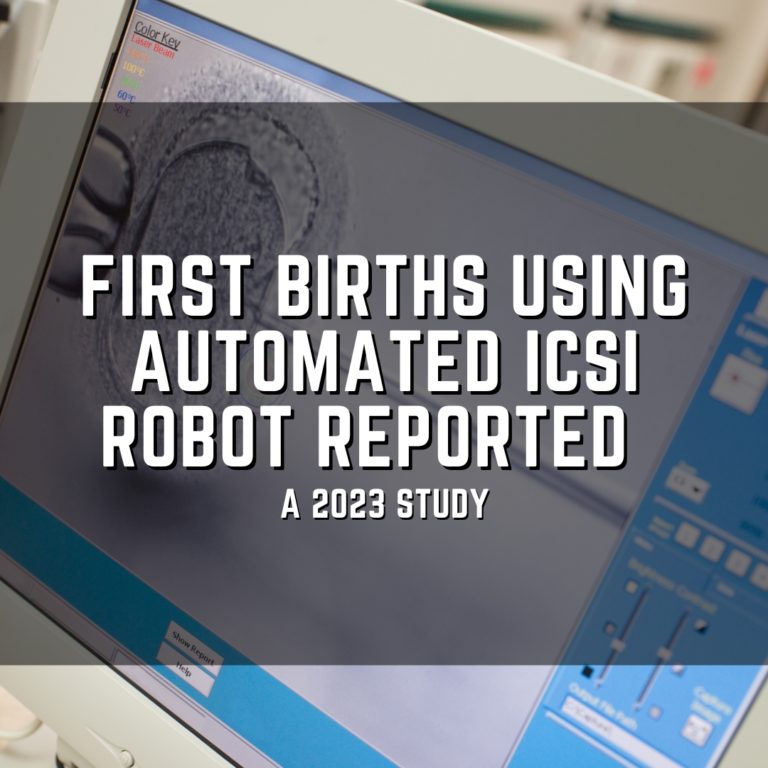
Researchers in a 2023 study report on the first use of an automated ICSI robot, or ICSIA, that resulted in the births of two healthy babies.
ICSI is a widely used procedure in assisted reproduction, but its success can vary depending on the skill of the embryologist.
Alternatives to ICSI, including piezo-ICSI, can lead to improved fertilization rates and reduced egg damage, but it requires expensive equipment that some labs may not have. More on piezo-ICSI below.
A robotic system with artificial intelligence capabilities has been developed to perform automated ICSI, or ICSIA, with minimal human intervention and expertise.
These are micropulses that drill through the zona, and can be accomplished using a flat needle with piezo-ICSI. ICSI normally uses a sharp needle, so piezo-ICSI is generally considered to be more delicate and better for fragile eggs. You can see this procedure below.
Besides being equipped with piezo capabilities, the artificial intelligence component of the ICSIA robot is able detect egg maturity and determine the best position for injection.
According to the study, once the sperm is captured, ICSIA and manual ICSI take about the same amount of time to perform per egg (about a minute).
With their ICSIA robot prototype in the lab, the researchers were ready to test it out!
They first tried it using animal eggs (mouse, hamster and rabbit), and then they tried it using discarded immature human eggs. They showed comparable results, in terms of egg survival after ICSIA vs manual ICSI and formation of embryos.
For testing in humans, they obtained 32 eggs from donors, 14 of which were used for ICSIA and 18 that were used for manual ICSI. They got 8 blastocysts from the ICSIA eggs, which were tested by PGT-A resulting in 4 euploids.
For manual ICSI, they got 12 blastocysts with 10 euploids.
So there was a higher euploidy rate with manual ICSI over ICSIA, which may be because sperm selection in the manual ICSI group was performed by an experienced embryologist, which wasn’t the case in the ICSIA group. Speed and temperature control could have also played a role, the authors write.
Regardless, two patients had a transfer using these ICSIA euploids, with one getting a single euploid and the other getting two. This resulted in the birth of two healthy babies.
Further studies are needed in a larger group, along with engineering improvements in the ICSIA robot, but this is the first time babies have been born using an automated ICSI robot. This may help future patients by providing more consistent results with ICSI.
Reference

About Embryoman
Embryoman (Sean Lauber) is a former embryologist and the founder of Remembryo, an IVF research and fertility education website. After working in an IVF lab in the US, he returned to Canada and now focuses on making fertility research more accessible. He holds a Master’s in Immunology and launched Remembryo in 2018 to help patients and professionals make sense of IVF research. Sean shares weekly study updates on Facebook, Instagram, and Reddit regularly. He also answers questions on Reddit or in his private Facebook group.
Related posts:
 Artificial oocyte activation improves IVF outcomes in clinical trial
 Repeated freezing and thawing impacts IVF outcomes in PGT-A cycles
 Comparing frozen embryo transfer/FET protocols
 Improved IVF outcomes when embryos are cultured in groups
 No benefit for ICSI over conventional IVF in non-male factor cases
 Embryologist and physician success rates variable, not related to experience
 Comparing pregnancy outcomes for letrozole, natural and medicated FETs
 An Italian consensus on key performance indicators for assessing IVF clinics