
Researchers in a 2022 study found that embryos grown together had improved clinical pregnancy and live birth rates compared to embryos grown alone.
Embryos develop inside culture dishes. You can see an example of a typical culture dish below:

See the 12 circular wells in the center of this dish? Each well can be filled with culture media that contains all the nutrients for the embryo to grow happily. Embryos are placed into these wells and develop over time. These culture dishes are stored in incubators and are often overlaid with oil to prevent evaporation of the culture media in these wells.
The number of embryos to include in each well is up to your clinic. Some clinics only put a single embryo in a well, while others might feel this is too lonely and group them in 2s, 3s, or more. Single embryo culture allows for individual monitoring and is often used in time lapse systems.
A previous study in 2010 found that embryos that were co-cultured showed improved fertilization and blastulation. These embryos also resulted in a higher clinical birth rate, although the sample size was small. Having embryo friends might be a good thing because they can secrete factors that can be beneficial to their neighbors!
In this summary, we’ll go over a prospective and randomized study by Fancsovits et al. (2022) that compared IVF outcomes when embryos were cultured grouped together or individually. A total of 532 cycles were followed with 264 that had grouped embryo culture and 268 that had individual embryo culture.
🔗 Original studies are referenced in this post or within the linked Remembryo posts.
💡 Reminder: Terms underlined with a dotted black line are linked to glossary entries. Clicking these does not count toward your paywall limit.
IVF outcomes of grouped and individual embryo culture
Embryo quality and the number of good quality embryos was the same between groups, but there was a higher number of cells on Day 3 (7.0 vs 6.7, p=0.013). Embryos on Day 3 with 8 or more cells tend to perform better than embryos with fewer cells.
There was also a higher number of IVF cycles that had embryos good enough to be frozen with grouped culture compared to individual culture (44.3% vs 32.9%), and more embryos overall were able to be frozen (41.4% of embryos vs 33.8%).
After transferring around two Day 3 embryos, clinical pregnancy and live birth rates were higher with grouped culture compared to single culture, but miscarriage rates were similar.
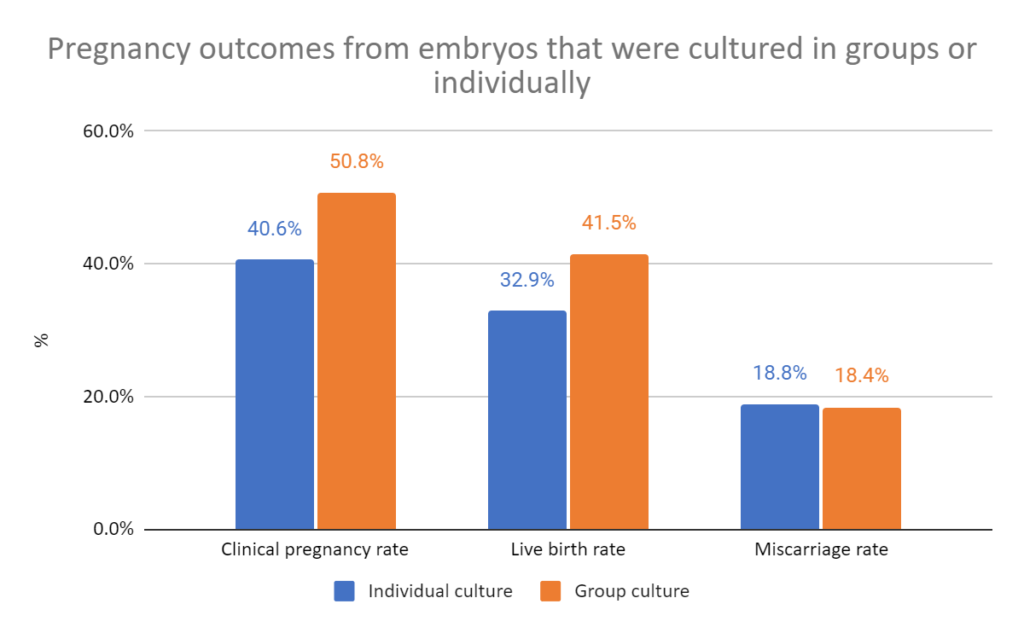
They found no differences in the length of pregnancy, male/female rate, and birth weights between the groups.
Conclusions
This study found a pretty substantial increase in IVF outcomes when embryos were cultured in groups rather than individually. So how does culturing embryos in groups result in embryos with a higher potential?
Many cells in our body, and embryos are no exception, can secrete different biochemicals that can be beneficial for their development and survival. This can be either the embryo secreting a factor that it responds to itself (called autocrine signaling) or it can be from another embryo nearby (called paracrine signaling). Groups of molecules called growth factors are often responsible for these beneficial effects, although other molecules like fatty acids or microRNAs can help too.
How close an embryo needs to be in order to benefit from the group culture seems to be <250 um (0.25 millimeters) based on a study in pig embryos by Stokes et al. (2005). Embryos further away than this might not benefit from group culturing.
The volume of culture media the embryos are in is also important. If the volume is too high then these beneficial factors might become too diluted to have any effect. This study used 25 uL (0.025 mL) which is typical for many dishes in IVF. One study found beneficial effects in mammalian embryos using 40 uL (Reed et al. 2011), so there is seems to be some wiggle room here!
This is a great study that shows the benefit of culturing embryos in groups. Many clinics already follow this practice, but there may be some that don’t, so make sure your clinic is doing this because there really doesn’t seem to be any disadvantage!
Reference

About Embryoman
Embryoman (Sean Lauber) is a former embryologist and the founder of Remembryo, an IVF research and fertility education website. After working in an IVF lab in the US, he returned to Canada and now focuses on making fertility research more accessible. He holds a Master’s in Immunology and launched Remembryo in 2018 to help patients and professionals make sense of IVF research. Sean shares weekly study updates on Facebook, Instagram, and Reddit regularly. He also answers questions on Reddit or in his private Facebook group.
Related posts:
 Embryologist and physician success rates variable, not related to experience
 Artificial oocyte activation improves IVF outcomes in clinical trial
 Repeated freezing and thawing impacts IVF outcomes in PGT-A cycles
 Comparing frozen embryo transfer/FET protocols
 Comparing pregnancy outcomes for letrozole, natural and medicated FETs
 An Italian consensus on key performance indicators for assessing IVF clinics
 Contamination linked to repeated failed transfers, patient has live birth after zona removal
 Using multiple plastic consumables in the IVF lab increases risk of embryo or gamete toxicity