
Researchers in a 2026 study found that a single ultrasound performed at 45 days of IVF gestation may be sufficient to diagnose many miscarriages without the need for a repeat scan.
During early pregnancy, several structures appear on ultrasound in a predictable order. The gestational sac is usually seen first, followed by the yolk sac, the embryo, and finally fetal cardiac activity (heartbeat).
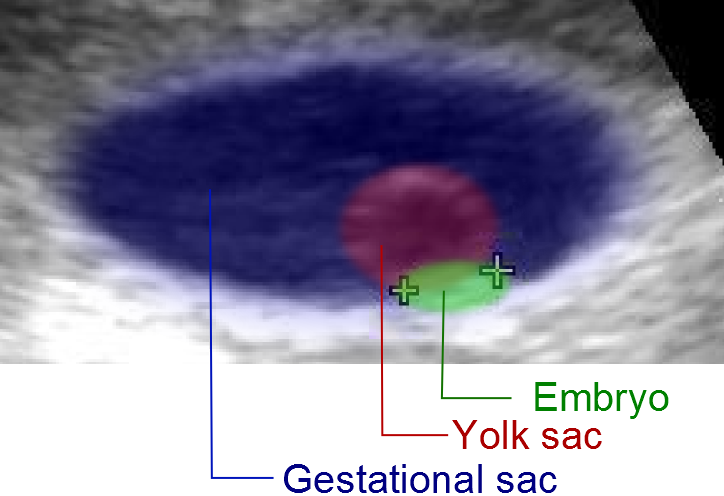

Miscarriage is usually diagnosed using ultrasound, based on the size of the gestational sac or embryo and whether a heartbeat is present.
Current guidelines are intentionally conservative to avoid mistakenly diagnosing a viable pregnancy as a miscarriage. As a result, many patients need repeat ultrasounds 1–2 weeks later for a diagnosis to be confirmed.
These guidelines were developed for pregnancies without IVF, where the exact date of conception is usually unclear. In IVF, the timing of fertilization and embryo transfer is known very accurately. Mortimer et al. (2026) wanted to determine whether this information could be used to diagnose early pregnancy loss sooner in IVF pregnancies, with both PGT-tested and untested embryos.
🔗 Original studies are referenced in this post or within the linked Remembryo posts.
💡 Reminder: Terms underlined with a dotted black line are linked to glossary entries. Clicking these does not count toward your paywall limit.
Study details
- Study type: Retrospective cohort study conducted between 2012 and 2022 at Brigham and Women’s Hospital in the USA.
- Participants: 6638 IVF pregnancies with a positive hCG test and at least one ultrasound showing a gestational sac (average age about 35). Researchers compared pregnancies that ended in miscarriage with those that were ongoing past the first trimester.
- Gestational age calculation: Researchers used known IVF treatment dates rather than menstrual dating to determine IVF gestational age. The day of egg retrieval (ovulation) was assigned to gestational day 14, matching standard pregnancy dating. For frozen transfers, ovulation was assumed to occur 3 days before cleavage-stage embryo transfer or 5 days before blastocyst transfer. For example, 45 days of IVF gestational age corresponds to:
- 31 days after egg retrieval (ovulation)
- 28 days after a day 3 embryo transfer
- 26 days after a blastocyst transfer
- Embryos: About 70% of transfers were day 5, mostly good to excellent quality.
- Primary outcome: Early pregnancy loss (miscarriage before 14 weeks gestation).
45 days of IVF gestation appeared to be an important cutoff
In the first part of the study, researchers analyzed 4926 IVF pregnancies, including 997 early pregnancy losses and 3929 ongoing pregnancies.
They first looked at ultrasound results in pregnancies that were viable.
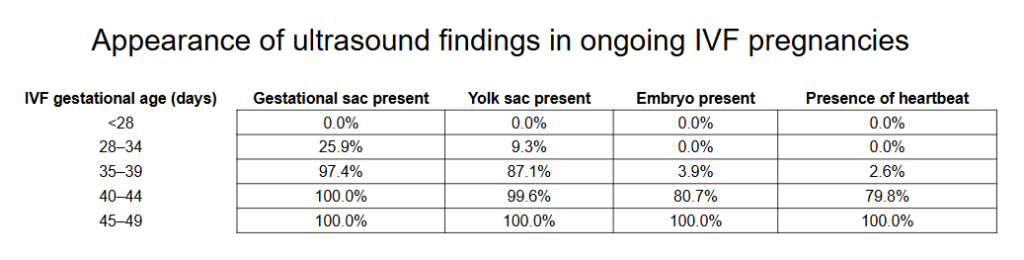
- By 40–44 days of IVF gestation, 100% of ongoing pregnancies had a gestational sac visible on ultrasound.
- By 45–49 days of IVF gestation, 100% had a yolk sac, embryo, and fetal cardiac activity (heartbeat).
This means that by 45-49 days of IVF gestation, all ongoing pregnancies had a visible gestational sac, yolk sac, embryo and heartbeat.
They next looked at pregnancy outcomes when a heartbeat or embryo was missing on ultrasound.
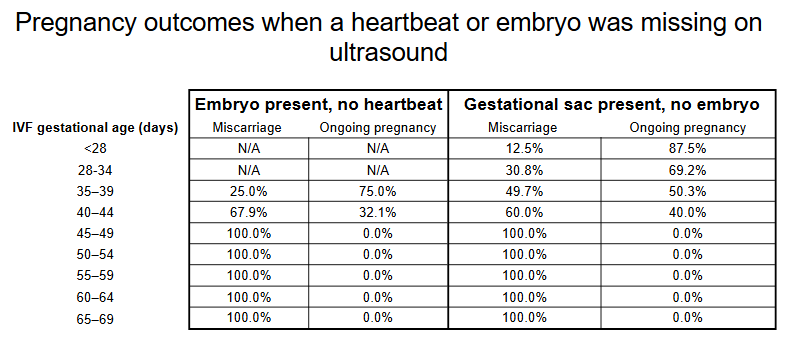
- At 45 days of IVF gestation or later, 100% of pregnancies with an embryo but no heartbeat ended in miscarriage.
- At 45 days of IVF gestation or later, 100% of pregnancies with a gestational sac but no embryo ended in miscarriage.
This means that at or after 45 days of IVF gestation, the absence of an embryo or heartbeat was always associated with miscarriage.
Researchers also repeated the analysis in pregnancies resulting from euploid embryos and found the same results.
Overall, this suggests that 45 days of IVF gestation may be an important cutoff, as ultrasound findings clearly separated ongoing pregnancies from pregnancies that ended in miscarriage.
They repeated all of this in a separate validation cohort of 875 IVF pregnancies and found the same results.
Conclusion
This study found that IVF pregnancies follow a predictable ultrasound timeline. A gestational sac without an embryo, or an embryo without a heartbeat, at 45 days of IVF gestation was always associated with miscarriage. This corresponds to 6 weeks and 3 days of pregnancy, which is about 4 weeks after a blastocyst transfer.
Based on these results, the authors propose that an early pregnancy loss can be diagnosed in IVF pregnancies at 45 days of IVF gestation or later if either:
- An embryo is present but no heartbeat is detected, or
- A gestational sac is present but no embryo is detected.
Although clinics can vary in when they perform the first ultrasound after a positive β-hCG test, many schedule it between 5 and 7 weeks of gestation. This study suggests that an ultrasound performed at or after 45 days of IVF gestation may provide a definitive diagnosis, without requiring a follow-up scan to see if the pregnancy has progressed. Without needing a repeat scan, the authors argue that this may reduce patient stress and uncertainty during the waiting period, while also lowering costs.
However, it’s important to note that the criteria only apply once a gestational sac or embryo can be seen on ultrasound. If these structures are not yet visible, follow-up ultrasounds would still be required.
Limitations include the retrospective study design and the use of data from a single fertility center, so the results should be validated at additional IVF clinics.
Want to read more about miscarriage risk?
This post covers the variety of reasons embryos can fail to implant or miscarry, including as a result of advanced maternal age, chromosomal translocations, lifestyle, endometritis, the microbiota, immunological issues, endometrial receptivity, the clinic, and more. Note that this is not a complete list, and will be updated periodically. Read more.

A 2024 study investigated the genetics of over 3,200 miscarriages, finding that two-thirds were associated with a chromosomal abnormality, with trisomy 16 and the 8p23.1 deletion as the most common abnormalities. Read more.

Researchers in a 2024 study measured leukocyte (white blood cell) levels in women preparing for pregnancy, and found that miscarriage risk was lower with high total leukocytes. Specific immune cells examined include monocytes, eosinophils, basophils, lymphocytes and neutrophils. Read more.
Reference

About Embryoman
Embryoman (Sean Lauber) is a former embryologist and the founder of Remembryo, an IVF research and fertility education website. After working in an IVF lab in the US, he returned to Canada and now focuses on making fertility research more accessible. He holds a Master’s in Immunology and launched Remembryo in 2018 to help patients and professionals make sense of IVF research. Sean shares weekly study updates on Facebook, Instagram, and Reddit regularly. He also answers questions on Reddit or in his private Facebook group.