
Researchers in a 2022 study examined the influence of paternal factors, such as semen parameters, paternal BMI and age, on aneuploidy.
PGT-A can be used to determine which embryos are euploid, and have the proper number of chromosomes, or aneuploid. Euploid embryos are believed to have a higher rate of live birth and a reduced chance of miscarriage, although this is controversial.
Check my complete guide to PGT-A to get more background on PGT-A (aka PGS testing).
Live birth rates generally decrease as maternal age increases, and this is believed to be due to increases in embryo aneuploidy. This is often blamed on deteriorating egg quality, however it isn’t clear what contribution the sperm makes in determining embryo aneuploidy.
In a study by Bonus et al. (2022), reviewed here, 453 IVF cycles (1720 embryos) were retrospectively analyzed from 2015 to 2020 to determine the paternal contribution toward aneuploidy. In order to do this, these embryos were tested with PGT-A using a SNP microarray with parental support bioinformatics.
Note: A SNP, or single nucleotide polymorphism, is a single difference in our DNA code. So if the DNA sequence “GTTAGCGA” is in most people, a SNP might be “GTTAGCTA”, where a “T” substitutes the “G.” We have millions of SNPs and these can be used to trace parental origin of a particular aneuploidy. For example, if the embryo has an extra copy of chromosome 17, it will have a large number of SNPs on that chromosome that will tell us if this chromosome came from the egg or sperm.
🔗 Original studies are referenced in this post or within the linked Remembryo posts.
💡 Reminder: Terms underlined with a dotted black line are linked to glossary entries. Clicking these does not count toward your paywall limit.
Of the 1720 embryos that were biopsied, 841 were euploid (48.9%) and 858 were aneuploid (49.9%), with the rest having no result.
Of the 858 aneuploid embryos, 632 (73.7%) embryos contained aneuploidies that were of maternal origin, 72 (8.4%) were of paternal origin, 72 (8.4%) were a mix of both paternal and maternal origin and 82 (9.6%) were not attributed to either (and were likely spontaneous mutations).

In evaluating semen parameters as normal vs abnormal, they used the 2010 WHO standards as a reference (Cooper 2010):
- Concentration (in millions): 15 – 259
- Total number (million/ejaculate): 39 – 928
- Motility (%): 40 – 81
- Progressive motility (%): 32 – 75
- Normal morphology (%): 4 – 48
If you want to learn more about these parameters you can check out my guide to sperm quality.
In this study, the average sperm concentration was 34.0 million/ml, total count was 78.6 million, motility was 53.9% and morphology was 5.0%.
They compared embryo aneuploidy of paternal origin in men who had normal or abnormal semen parameters:
- No difference in normal vs abnormal semen overall (8.8% vs 8.0%)
- No difference in normal vs abnormal sperm concentration (8.7% vs 7.0%)
- No difference in normal vs abnormal total count (8.5% vs 8.1%)
- No difference in normal vs abnormal motility (8.8% vs 6.0%)
- No difference in normal vs abnormal progressive motility (8.7% vs 6.9%)
- No difference in normal vs abnormal morphology (9.0% vs 7.8%)
A total of 153 embryos were from men with severe oligospermia (concentration <5 million/ml) and 6.5% of these embryos had aneuploidies that were of paternal origin, which wasn’t significantly different from men without severe oligospermia (8.6%).
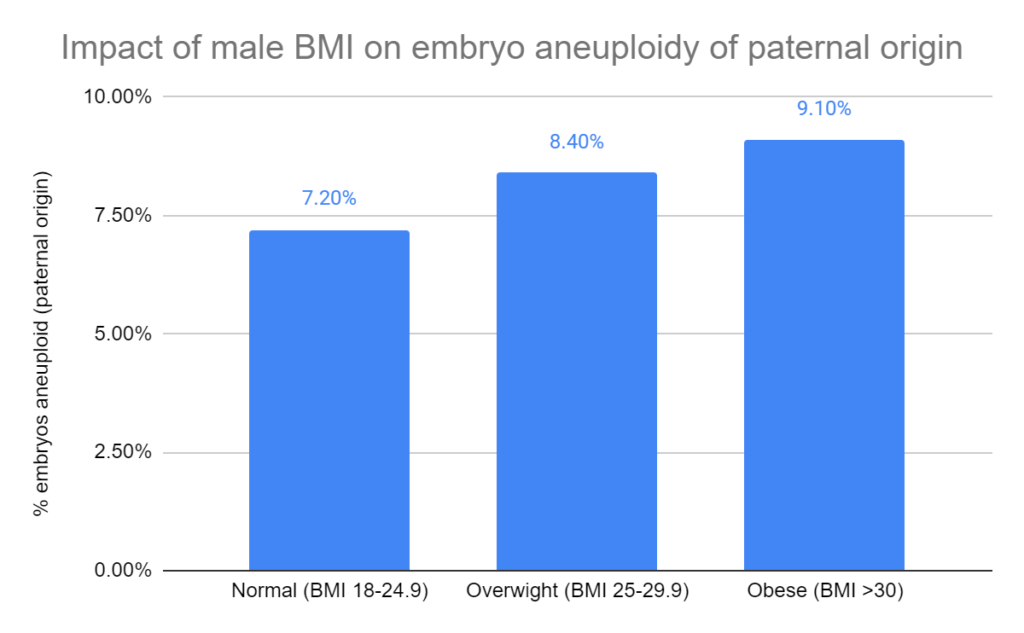
Next they compared body mass index, which on average was 27.5. Generally as BMI increased, there were more aneuploid embryos of paternal origin, although this was not statistically significant.
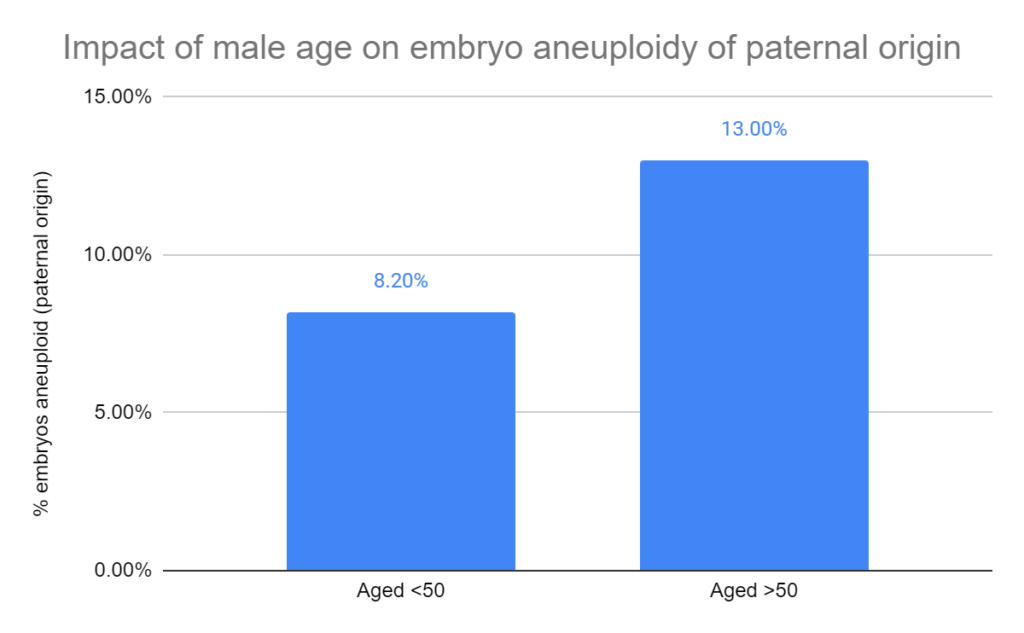
Finally, they compared the age of men (average age 39.1). Again, although the paternal rates of aneuploidy increased with male age, this was not statistically significant (p=0.07). This may be due to the small sample size of men >50 (46 in total).
Overall, this study found no statistically significant differences in rates of paternal origin of aneuploidy in terms of sperm parameters, BMI and age. They found a paternal rate of aneuploidy of 8.4%.
Since these were all blastocysts that were used for PGT-A, it’s possible that rates of aneuploidy are higher in earlier developmental stages but this leads to embryo arrest. However, Sills et al. (2014) found a similar rate of paternal aneuploidy with 18/151 (11.9%) of day 3 embryos. Note in this study they used a mix of day 3 embryos and blastocysts (day 5), with 86% being day 3.
Reference

About Embryoman
Embryoman (Sean Lauber) is a former embryologist and the founder of Remembryo, an IVF research and fertility education website. After working in an IVF lab in the US, he returned to Canada and now focuses on making fertility research more accessible. He holds a Master’s in Immunology and launched Remembryo in 2018 to help patients and professionals make sense of IVF research. Sean shares weekly study updates on Facebook, Instagram, and Reddit regularly. He also answers questions on Reddit or in his private Facebook group.
Related posts:
 Complete guide to sperm quality
 Sperm aneuploidy in recurrent pregnancy loss
 Do sperm supplements work? Results from the MOXI trial
 Meta-analysis confirms benefit of antioxidant supplements in infertile men
 Study reviews 34 common male fertility sperm supplement brands for safety, efficacy
 Study explores male and female influence on embryo euploid rates
 Soft drink/soda consumption associated with lower sperm quality
 Study compares Fresh vs frozen sperm, finds no difference in live birth rates