
Researchers in a 2022 study found that women with asthma are at an increased risk of infertility and pregnancy loss, but show no differences in birth rates.
Asthma is a disease that affects the lungs and occurs in about 10% of women. It’s caused by chronic inflammation of the airways and could have an impact on reproduction.
Jöud et al. (2022) evaluated the impact of asthma on the risk of infertility and pregnancy outcomes in over 200,000 women in Sweden between 1998 and 2019. Women were 15-45 years old and were included in the Swedish Skåne Healthcare Register, where 6,445 women were diagnosed with asthma.
Women with asthma were more likely to be obese. Obesity and other confounders (endometriosis, PCOS, age) were statistically adjusted for in their statistical models.
🔗 Original studies are referenced in this post or within the linked Remembryo posts.
💡 Reminder: Terms underlined with a dotted black line are linked to glossary entries. Clicking these does not count toward your paywall limit.
Table of Contents
Women with asthma are more likely to be infertile, but no difference in birth rates
Women diagnosed with asthma had a statistically significant increase in being diagnosed or treated for infertility compared to those without asthma (11.0% vs 8.1%, adjusted risk ratio [95% CI]: 1.29 [1.21-1.39]).
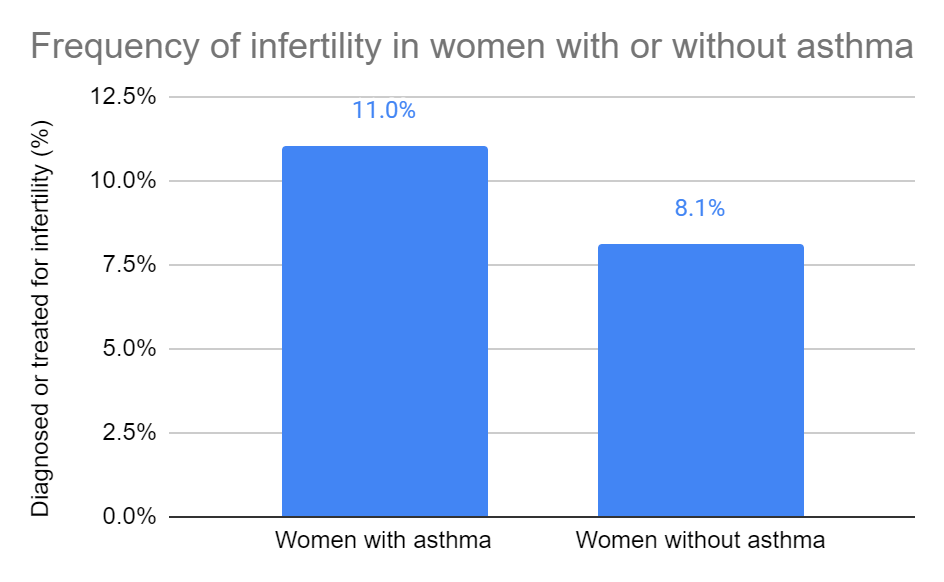
Asthmatic women were also more likely to undergo an IUI (0.6% vs 0.3%), IVF (1.3% vs 0.9%) or ICSI (1.5% vs 1.0%), and have unexplained infertility (1.8% vs 1.1%), anovulation (not PCOS, 1.4% vs 1.1%) or tubal factor infertility (0.6% vs 0.4%). There was no difference in endometriosis or PCOS diagnoses.
Despite the increased chance of infertility, women with asthma showed no clinical meaningful difference in the rate of childbirth compared to those without asthma (82.7% vs 82.4%, adjusted risk ratio [95% CI]: 1.02 [1.01-1.03]).
Increased risk of pregnancy loss and induced abortions in women with asthma
Women diagnosed with asthma had a statistically significant increase in the rate of pregnancy loss compared to those without asthma (16.4% vs 12.5%, adjusted risk ratio [95% CI]: 1.21 [1.15-1.28]).
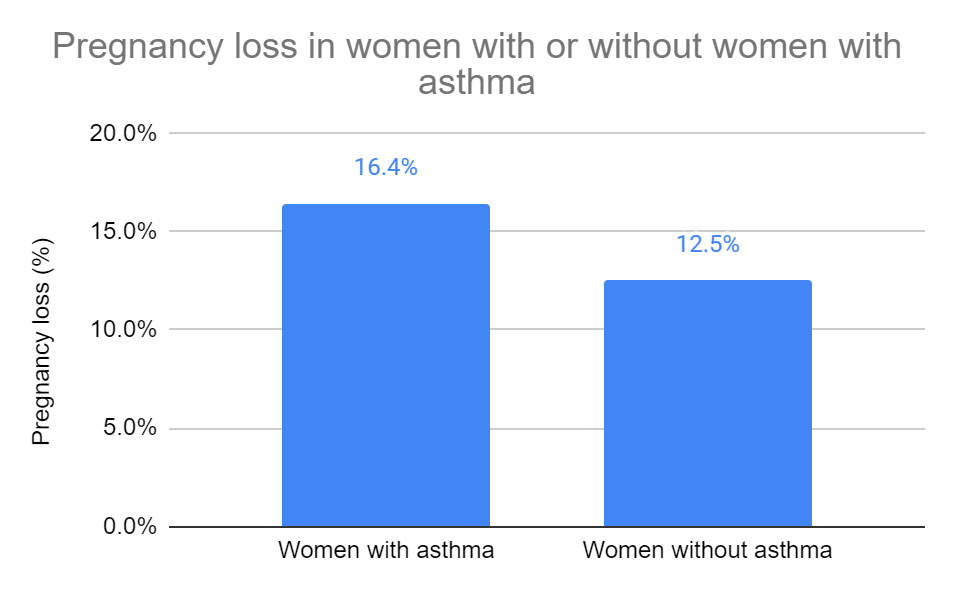
There was also an increase in the rate of induced abortions (22.8% vs 17.9%, adjusted risk ratio [95% CI]: 1.15 [1.11-1.20]). The authors noted that they were surprised by this, and it’s possible that there’s an increased risk of abnormalities that led to an abortion. However, this study didn’t investigate this.
No differences in study outcomes in women with active asthma
Since symptoms of asthma can go into remission at times, the researchers included an “active asthma” distinction (3,560 women). These women had visited a doctor within the last 3 years of reproductive start with asthma registered as the main diagnosis.
Women in this category also showed no difference in birth rates, and comparable increases in the rate of infertility, pregnancy loss and induced abortion.
Conclusions
Women with asthma had an increased risk of pregnancy loss, induced abortion and infertility. They were more likely to pursue IUI or IVF compared to women without asthma. There were no differences in the rate of endometriosis and PCOS, but showed an increase in unexplained infertility and some other diagnoses.
Importantly, there was no difference in their chance of giving birth. There was also no difference in birth rates in women with active asthma, which the authors defined as a visit to the doctor within the past 3 years with asthma as the main diagnosis.
Some women may hesitate in taking asthma medication while trying to conceive, but a previous study has shown that use of preventive medication (inhaled corticosteroids) has no impact on time to pregnancy (Grzeskowiak et al. 2018). Regardless, if you have asthma it’s important to discuss medications and to develop a plan with your doctor to manage the disease and optimize pregnancy outcomes.
Reference

About Embryoman
Embryoman (Sean Lauber) is a former embryologist and the founder of Remembryo, an IVF research and fertility education website. After working in an IVF lab in the US, he returned to Canada and now focuses on making fertility research more accessible. He holds a Master’s in Immunology and launched Remembryo in 2018 to help patients and professionals make sense of IVF research. Sean shares weekly study updates on Facebook, Instagram, and Reddit regularly. He also answers questions on Reddit or in his private Facebook group.
Related posts:
 Risk of poor ovarian response with repeat IVF cycles
 Comparing frozen embryo transfer/FET protocols
 Fresh or frozen embryo transfer? Results of the E-Freeze clinical trial
 Embryologist and physician success rates variable, not related to experience
 Study examines link between unexplained infertility and other medical conditions
 Meta-analysis compares COVID-19 vaccine impact on IVF and pregnancy outcomes
 Coopersurgical issues December 2023 recall of embryo culture media
 Rising levels of chlormequat, an agricultural chemical linked to infertility, in grain products