

Researchers in a 2023 study examined IVF outcomes with eggs that contain smooth endoplasmic reticulum clusters and found acceptable live birth and euploidy rates.
Eggs can have different types of abnormalities as seen under the microscope, one of which is called a “smooth endoplasmic reticulum cluster” or sERC.

In the egg, the smooth endoplasmic reticulum stores calcium needed to harden the zona after the sperm enters the egg, which prevents multiple sperm from penetrating the zona. The clusters are aggregates of smooth endoplasmic reticulum, mitochondria and dense granules (Stigliani et al. 2018), but how they form and what impact they have on IVF outcomes isn’t clear.
Mizobe et al. (2023), in their retrospective study, compared IVF outcomes from eggs with or without a smooth endoplasmic reticulum cluster. This study involved 190 cycles with sERC positive eggs and 708 cycles with sERC negative eggs, and took place between 2019 and 2021 at a single IVF center in Japan. The average female age was 37-38.
For more background on egg quality and morphology, check out my Complete guide to egg quality.
They looked at three groups which I’ll be referencing throughout this summary:
- sERC negative normal eggs — these are normal eggs from egg retrievals that didn’t have any sERC eggs
- sERC positive normal eggs — these are normal eggs from a retrieval that also had sERC eggs
- sERC eggs — these are sERC eggs
In terms of baseline characteristics for sERC negative vs sERC positive, there were differences in:
- Serum E2 concentration (1817.30 pg/ml vs 2179.82 pg/ml)
- Serum P4 concentration (0.49 ng/ml vs 0.71 ng/ml)
- Serum AMH concentration (2.48 ng/ml vs 2.95 ng/ml)
There were no statistical adjustments made in this study. In fact, it’s possible that increases in E2 and P4 might cause sERC development (discussed more in the conclusions).
🔗 Original studies are referenced in this post or within the linked Remembryo posts.
💡 Reminder: Terms underlined with a dotted black line are linked to glossary entries. Clicking these does not count toward your paywall limit.
Embryology outcomes of eggs with smooth endoplasmic reticulum clusters
In the 708 sERC negative cycles there were 2,467 normal eggs. In the 190 sERC positive cycles, there were 971 normal eggs and 230 sERC positive eggs. You can see the embryology outcomes below:
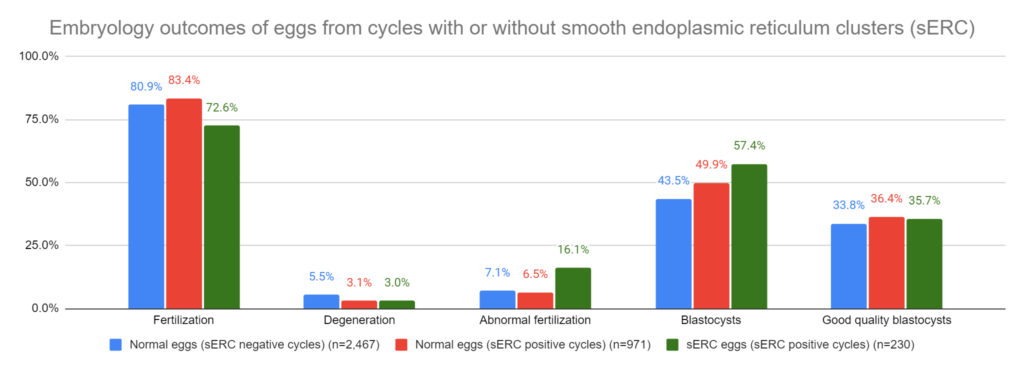
As far as what was statistically significant:
- Fertilization: no difference.
- Degeneration (when an egg breaks down and dies): sERC negative normal eggs had a higher degeneration rate than sERC positive normal eggs (5.5% vs 3.1%, p < 0.01).
- Abnormal fertilization (ie. 0 PN, 3 PN, etc.): sERC eggs had a higher abnormal fertilization rate than sERC positive normal eggs and sERC negative normal eggs (16.1% vs 6.5% and 7.1%, p < 0.01).
- Blastocyst formation: Eggs from sERC positive cycles (either with sERC or without) had a higher blastocyst formation rate than eggs in sERC negative cycles (57.4% and 49.9% vs 43.5%, p < 0.01).
- Good quality blastocyst formation: no difference.
Pregnancy and neonatal outcomes following transfer of embryos derived from eggs containing smooth endoplasmic reticulum clusters
A total of 25 blastocysts (not PGT-A tested) derived from sERC eggs were transferred, resulting in 15 pregnancies (60.0%), 9 live births (36.0%) and 6 miscarriages (24.0%). Note on the small sample size: The transfer priority of embryos from sERC eggs is low, and unfortunately this small sample size is common in research involving the transfer of these embryos.
The 9 live births had an average gestational length of 39.1 weeks and average birthweight of 3,236 g (normal range). There were no malformations in any of the children.
Strangely, this study didn’t have a control group for the pregnancy and neonatal outcomes, but I suppose it’s not really needed here as they’re just showing that embryos from sERC eggs can produce acceptable live birth rates with normal neonatal outcomes.
PGT-A outcomes of embryos derived from sERC eggs
The researchers also compared PGT-A outcomes of embryos derived from sERC eggs and normal eggs (from sERC negative cycles). There were no statistically significant differences in euploidy rates between the groups. The average age of the patients was 35.82 for the normal eggs, and 37.50 for the sERC eggs.

Conclusions
This study examined IVF outcomes from eggs with smooth endoplasmic reticulum clusters and found:
- No difference in fertilization rates.
- Increased rates of abnormal fertilization (ie. 0 PN, 3 PN, etc.).
- No difference in good quality blastocyst formation rate.
It was interesting that they found higher blastocyst formation rates (and lower degeneration rates!) in sERC eggs. The authors note that other studies have found no differences in blastocyst formation rates with sERC eggs.
Furthermore, they found that embryos derived from sERC eggs went on to have acceptable live birth rates, with no adverse neonatal outcomes. PGT-A on embryos from sERC eggs had comparable euploidy rates to normal eggs.
The authors noted that E2 values were higher in women with sERC positive cycles, and they suggest that sERC eggs might develop more frequently in overmature eggs. In addition, high P4 values were seen in women with sERC positive cycles, which the authors suggest may also play a role in sERC development.
The main limitation of this study is the small sample size, particularly for pregnancy and PGT-A outcomes, which makes drawing conclusions difficult. Transferring embryos from sERC eggs are low priority, and sometimes these eggs are even discarded as they’re assumed to be abnormal, but larger studies are needed to better understand their potential.
Reference

About Embryoman
Embryoman (Sean Lauber) is a former embryologist and the founder of Remembryo, an IVF research and fertility education website. After working in an IVF lab in the US, he returned to Canada and now focuses on making fertility research more accessible. He holds a Master’s in Immunology and launched Remembryo in 2018 to help patients and professionals make sense of IVF research. Sean shares weekly study updates on Facebook, Instagram, and Reddit regularly. He also answers questions on Reddit or in his private Facebook group.
Related posts:
 Complete guide to egg quality
 Egg freezing and thawing
 Oocyte quality and IVF outcomes linked to maternal lifestyle and diet
 Case report: Eggs with rare perivitelline space defect lead to healthy twins
 Study examines impact of ovarian stimulation on egg quality
 No differences in IVF outcomes when using fresh or frozen donor eggs
 Pilot study shows improved IVF outcomes after spindle transfer in women with poor egg quality
 Early triggering with the “HIER” protocol may be a better approach for older women