
Researchers in a 2022 study found no differences in IVF outcomes between fresh and frozen donor eggs.
These days, egg freezing is commonly performed using “vitrification” which has shown improved outcomes over older freezing techniques. However, it isn’t clear if eggs that are frozen and thawed perform differently than fresh eggs.
For more background on egg freezing, check my post Egg freezing and thawing, and for more background on egg quality, check out my Complete guide to egg quality.
Gursu et al (2022), in their retrospective cohort study, examined IVF outcomes of “sibling” fresh and frozen eggs from 609 egg donation recipient cycles between 2018 and 2019 at a single IVF center in Northern Cyprus. These were sibling oocytes, meaning that these 609 recipient cycles consisted of 304 donors who produced at least 24 eggs, where 12 went to a recipient as “fresh” (304 cycles) and 12 went to a recipient as “frozen” (305 cycles).
Only thawed eggs that survived were given to recipients (the thaw survival rate was 95.1%), so each frozen recipient got 12 eggs. Freezing was done by vitrification using Kitazato kits (an open vitrification system). Recipients were between 23-50 (average was 41.1) with partners that had a normal semen analysis. The majority of transfers involved 2 embryos (about 90%), with no difference between the groups.
🔗 Original studies are referenced in this post or within the linked Remembryo posts.
💡 Reminder: Terms underlined with a dotted black line are linked to glossary entries. Clicking these does not count toward your paywall limit.
No difference in embryology outcomes using fresh or frozen eggs
The researchers compared embryology outcomes in sibling fresh (n= 3670) and frozen eggs (n= 3661). There were no statistical difference in fertilization rates or blastocyst conversion rates as shown below. There was also no difference in the number of blastocysts obtained from each cycle (about 5) or in the number of high quality embryos obtained (high quality being 5AA, 5BA, 5AB, 4AA, 4AB or 4BA).

No difference in pregnancy outcomes using fresh or frozen eggs
When comparing pregnancy outcomes, the researchers found no statistically significant differences in clinical pregnancy rates, live birth rates or miscarriage rates as shown below. Since they mostly transferred two blastocysts (about 90% of cycles), they saw a higher twin birth rate (about 30%), with no differences between the fresh and frozen groups.
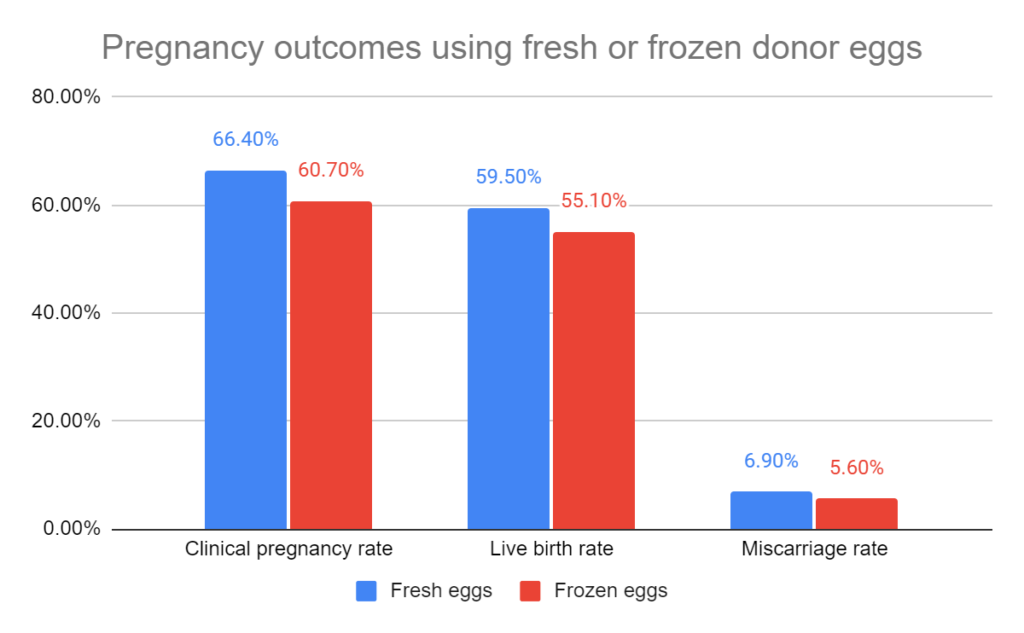
They also statistically adjusted the clinical pregnancy and live birth rates to control for confounders and found no differences between the fresh and frozen groups.
Conclusions
This study investigated IVF outcomes in fresh and frozen sibling donor eggs and found no differences in fertilization rates, blastocyst conversion rates, clinical pregnancy rates, live birth rates or miscarriage rates.
An important aspect of this study is that they controlled for the efficiency of the thawing process – meaning that there were the same number of thawed eggs as there were fresh eggs for each cycle. They froze 10% more eggs to account for loss after thawing, and this is how they matched the number of fresh eggs in each cycle.
The authors conclude that there are no differences in IVF outcomes between sibling fresh and frozen egg cycles when using an open vitrification system in donors aged 20-30. They also point out that these results may not apply to autologous (self) eggs, particularly in older women where egg quality may be compromised.
Reference

About Embryoman
Embryoman (Sean Lauber) is a former embryologist and the founder of Remembryo, an IVF research and fertility education website. After working in an IVF lab in the US, he returned to Canada and now focuses on making fertility research more accessible. He holds a Master’s in Immunology and launched Remembryo in 2018 to help patients and professionals make sense of IVF research. Sean shares weekly study updates on Facebook, Instagram, and Reddit regularly. He also answers questions on Reddit or in his private Facebook group.