
A study type refers to how a research study is designed, including how data is collected and how participants are grouped. Understanding the study type helps you evaluate how reliable the results are.
Studies can be performed prospectively or retrospectively. In a prospective study, data is collected moving forward in time, allowing researchers to track outcomes and establish cause-and-effect relationships. This design minimizes bias. In contrast, retrospective studies analyze past data, often from existing records, but they are more prone to bias and may be incomplete. Prospective studies are generally considered higher-quality evidence because they more accurately assess causal relationships.
In evidence-based research, studies are ranked by strength in the “pyramid of evidence.” At the top are meta-analyses, which combine data from multiple studies to provide high-level evidence. Below that are randomized controlled trials (RCTs), or clinical trials, the gold standard for experimental research. These are usually prospective and designed to minimize bias through random assignment.
Below RCTs are non-randomized studies, many of which are observational. Observational studies include cohort studies (prospective or retrospective) and case-control studies (often retrospective), where researchers observe outcomes without assigning treatments. These studies can provide valuable insights, but are more prone to bias because groups may differ in important ways.
At the bottom of the pyramid are case reports and expert opinions, which are less reliable due to small sample sizes or their subjective nature. The pyramid helps researchers and healthcare providers assess the quality of evidence and make informed decisions.
For more details, keep reading below!
- Meta-analysis: A meta-analysis is a statistical technique that combines data from multiple studies on the same topic to provide a more precise estimate of the effect of an intervention or association. By pooling data, it increases the statistical power and can help overcome the limitations of individual studies, providing high-level evidence. For more information on the different types of meta-analysis and a SUCRA analysis, see the section below.
- Randomized Controlled Trial (RCT): An RCT, or randomized trial, is a type of experimental study where participants are randomly assigned to different groups, typically including a treatment group and a control group. This randomization reduces bias and is considered the gold standard for evaluating the effects of an intervention. RCTs are designed with careful planning and are often registered beforehand to ensure transparency and minimize selective reporting or manipulation of results. Blinding is often used: in single-blind studies, participants don’t know which group they’re in, while in double-blind studies, neither participants nor researchers know, to minimize bias.
- Cohort study: A cohort study is an observational study that follows a group of people (a cohort) over time to observe how certain exposures or characteristics affect their outcomes. There are two main types: prospective cohort studies, where data is collected moving forward, and retrospective cohort studies, where researchers look back at existing records. Cohort studies are useful for understanding associations between exposures and outcomes, though they cannot establish causality as clearly as RCTs.
- Case-control study: Case-control studies compare people with a specific condition (cases) to those without the condition (controls). Researchers look back at the exposures or characteristics of each group to identify potential causes or risk factors. While these studies are often used to study rare diseases or conditions, they can be prone to recall bias, as participants may not accurately remember their past exposures.
- Case report: A case report is a detailed account of the symptoms, diagnosis, treatment, and follow-up of an individual patient. Case reports are often used to document unusual or novel occurrences in medical practice and can provide valuable insights into rare conditions. However, they are not generalizable and lack the rigor of larger studies, making them the lowest level of evidence.
- Expert opinion: Expert opinion refers to the perspectives of recognized authorities in a particular field. This type of evidence is often used when high-quality studies are lacking or when clinical judgment is necessary. While expert opinions can be valuable, they are subjective and influenced by the individual’s experience, making them the least reliable form of evidence.
Pairwise vs network meta-analysis
There are different types of meta-analyses, including the traditional (pairwise) and network meta-analysis. To explain these types of meta-analysis, let’s use the example from Xu et al. (2024) that performed a network meta-analysis for studies involving growth hormone (GH) in IVF.
There are many different types of protocols for GH during IVF, which you can see below (labeled A-G):
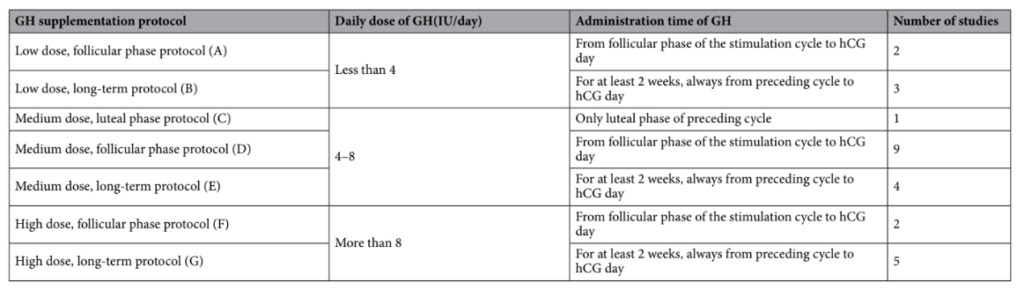
A traditional meta-analysis, or a pairwise meta-analysis, combines the results of multiple studies that are looking at the same type of protocol. For example, it would combine multiple studies involving GH protocol A vs control. You can’t really include studies involving protocol G vs control, because A and G are very different.
With a network meta-analysis, you can combine the results of all the protocols. So instead of only including studies with A vs control, you could include studies that look at C vs control, or A vs C vs control, or E vs control, etc. and combine the results this way.
You can see this network below, in studies that look at clinical pregnancy rates using different GH protocols.
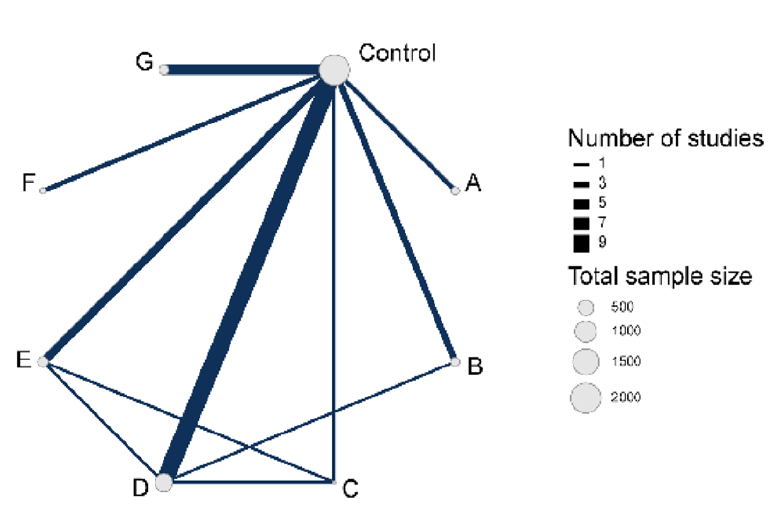
So we can see here that there’s many studies involving protocol D vs control (the line is thicker), and some that also compare D vs E, D vs B, and D vs C (and C vs E!).
With a traditional meta-analysis, you’d only really want to include D vs control studies to make the most of it, but with a network meta-analysis you can combine all these studies.
An analysis that’s often mentioned in IVF research is the Surface Under the Cumulative Ranking (SUCRA) analysis. This analysis uses all available direct and indirect evidence from a network meta-analysis. The higher the SUCRA %, the better the treatment. If a SUCRA analysis is 100% for treatment A, then all other treatments are inferior to A.