
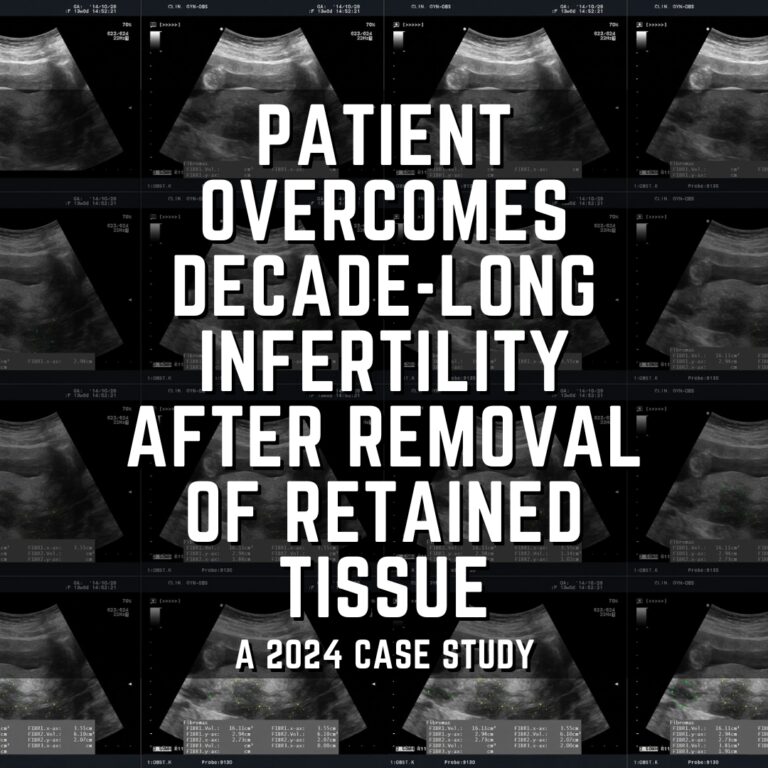
A 2024 case report details how a woman’s decade-long infertility was resolved after the removal of retained products of conception from a D&C procedure ten years prior.
Retained products of conception (RPOC) involve fetal or placental tissue that remains in the uterus after delivery, miscarriage, or procedures like dilation and curettage (D&C). RPOC can occur after delivery if the placenta or fetal tissue does not completely separate from the uterine wall.
RPOC is associated with several complications, including bleeding, infection and infertility. Infertility may result from RPOC physically blocking the uterine cavity and disrupting the normal endometrial conditions required for embryo implantation.
🔗 Original studies are referenced in this post or within the linked Remembryo posts.
💡 Reminder: Terms underlined with a dotted black line are linked to glossary entries. Clicking these does not count toward your paywall limit.
A recent case report by Harpey et al. (2024) describes a 36-year-old woman dealing with infertility for ten years. Her only pregnancy involved one from ten years prior, which was terminated by D&C at 12 weeks because of anencephaly (a serious birth defect where parts of the brain and skull are missing). Initial fertility tests did not explain her infertility until a transvaginal ultrasound showed a mass in her uterus, which the doctor believed to be a fibroid or polyp. After hysteroscopy, the mass was found to be retained placental tissue from her previous pregnancy ten years ago. Four months after hysteroscopy and removal of the tissue, she reported that she was pregnant.
The authors emphasize the importance of accurate imaging for diagnosing RPOC. One study demonstrated that the incidence of RPOC fell from 6.9% to 0% when transvaginal ultrasound was used following pregnancy termination (Larish et al. 2021). Additionally, another study revealed that pelvic ultrasound alone might not detect all cases of RPOC, as 24.4% of patients with normal ultrasound results were found to have RPOC during hysteroscopy, specifically in cases of early pregnancy loss following IVF (Jenny et al. 2023).
The choice of procedure to remove RPOC is also important, the authors note, as D&C may lead to higher risks of intrauterine adhesions that can complicate future attempts to conceive (Hooker et al. 2016). Alternatives like hysteroscopic removal and ultrasound-guided electric vacuum aspiration offer lower risks of adhesions and higher rates of complete removal (Wagenaar et al. 2024). There are also different hysteroscopic removal techniques, including electro-resection and morcellation, each of which may be better suited to different scenarios.
This case highlights the importance of considering RPOC in infertility cases, especially those with a history of pregnancy loss or delivery complications.
Reference

About Embryoman
Embryoman (Sean Lauber) is a former embryologist and the founder of Remembryo, an IVF research and fertility education website. After working in an IVF lab in the US, he returned to Canada and now focuses on making fertility research more accessible. He holds a Master’s in Immunology and launched Remembryo in 2018 to help patients and professionals make sense of IVF research. Sean shares weekly study updates on Facebook, Instagram, and Reddit regularly. He also answers questions on Reddit or in his private Facebook group.
Related posts:
 Study investigates role of intrauterine PRP in improving embryo transfer outcomes
 How many failed embryo transfers is too many?
 Why do embryos in IVF fail to implant or miscarry?
 Meta-analysis of commonly used IVF immunotherapies shows no benefit
 RCT finds no change in birth rates for standard or ERA-timed euploid transfer
 Meta-analysis combines 74 studies to examine factors linked to euploid transfer success
 “True” recurrent implantation failure is rare after five consecutive euploid embryo transfers
 Study investigates the use of EMMA & ALICE in IVF patients with RIF, RPL