
A 2024 meta-analysis combined the results of 10 studies to show that embryos that are thawed for PGT-A, or rebiopsied after inconclusive results, have lower chances of pregnancy and live birth, with higher miscarriage rates.
PGT-A allows embryos to be screened before transfer to help avoid transferring aneuploid embryos that have a high chance of miscarriage. To do this, a small biopsy is taken from the embryo, and the embryo is frozen while the biopsy’s DNA is tested.
Most of the time, each embryo is biopsied once and frozen once. But in some cases, like when PGT is decided after embryos were already frozen or when a biopsy result is inconclusive (“no result”), clinics may need to thaw and biopsy the embryo or perform a second biopsy (rebiopsy). This creates a situation with a different number of freeze or biopsy procedures:
- Embryos that were frozen once and biopsied once (standard practice)
- Embryos that were frozen twice and biopsied once (embryos are thawed to do PGT-A)
- And embryos that were frozen twice and biopsied twice (embryos are rebiopsied)
While a number of studies have investigated if thawing for biopsy or rebiopsying has any impact on pregnancy outcomes, results have been mixed. A new meta-analysis by Li Piani et al. (2024) combined data from 10 studies to help draw conclusions.
For more background on PGT-A, check my Complete guide to PGT-A.
🔗 Original studies are referenced in this post or within the linked Remembryo posts.
💡 Reminder: Terms underlined with a dotted black line are linked to glossary entries. Clicking these does not count toward your paywall limit.
Study Details
- This was a systematic review and meta-analysis of retrospective studies. From a pool of 4219 studies, the researchers identified 10 eligible studies published between 2017 and 2024 for the meta-analysis
- Included studies had to have a “trustworthy interpretation of the results,” had to use blastocysts, no reviews, study abstracts, research in non-humans or non-English studies were included.
- The primary outcome was the live birth rate per embryo transfer.
In terms of the sample size:
- Frozen twice and biopsied once: 638 embryo transfers
- Frozen twice and biopsied twice: 246 embryo transfers
- Frozen once and biopsied once: Over 17,000 embryo transfers
IVF outcomes after embryos are thawed and biopsied (frozen twice and biopsied once)
This group represents embryos that were thawed and then biopsied (ie. frozen, thawed, biopsied, and then frozen again).
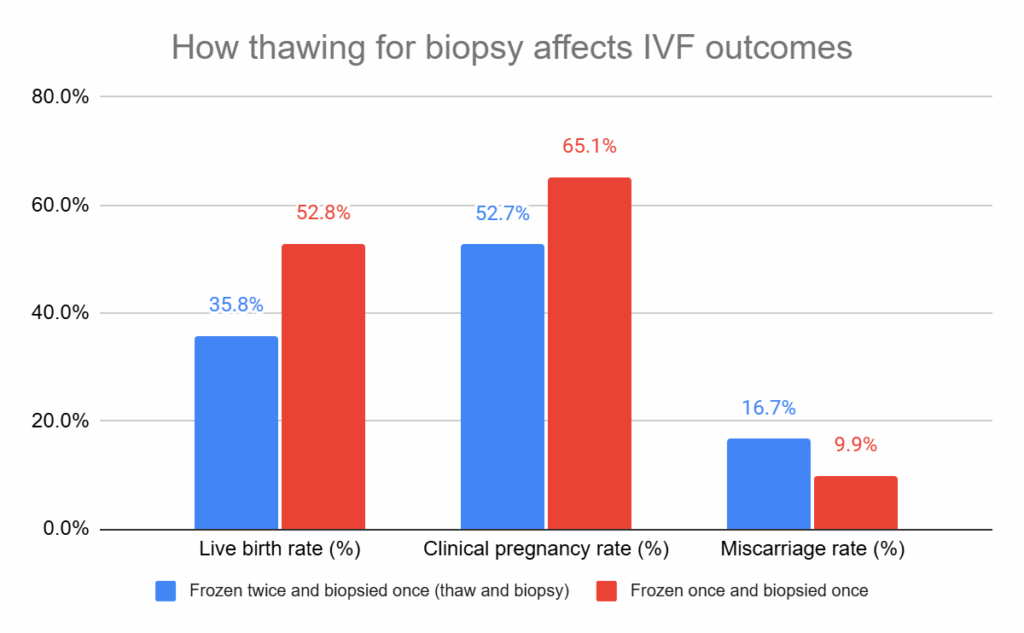
- Live birth rate: lower compared to embryos that were frozen and biopsied once (35.8% vs 52.8%, OR [95% CI]: 0.56 [0.38–0.81]; 6 studies, I² = 58%)
- Clinical pregnancy rate: also lower than once frozen and once biopsied embryos (52.7% vs 65.1%, OR [95% CI]: 0.68 [0.51–0.92]; 7 studies, I² = 57%)
- Miscarriage rate: higher risk of miscarriage per pregnancy (16.7% vs 9.9%, OR [95% CI]: 1.68 [1.02–2.77]; 7 studies, I² = 50%)
- Thaw survival rate: High rates of thaw survival before embryo transfer (95%-100% based on 5 studies).
- Neonatal outcomes: Gestational age and birthweights were normal (based on 4 studies).
While percentages are easier to understand, odds ratios (ORs) help show how consistent the results are across studies of different sizes In this case, embryos that were frozen twice and biopsied once had 44% lower odds of live birth (OR: 0.56), 32% lower odds of clinical pregnancy (OR: 0.68), and 68% higher odds of miscarriage (OR: 1.68) compared to embryos frozen and biopsied once.
These results show that embryos thawed for a biopsy (frozen twice and biopsied once) have lower chances of achieving a pregnancy or live birth and higher chances of miscarriage compared to embryos frozen once and biopsied once.
IVF outcomes for embryos that are rebiopsied (frozen twice and biopsied twice)
This group underwent both a second freeze and a second biopsy (for example, rebiopsy after a no-result or rebiopsy of previously banked embryos).
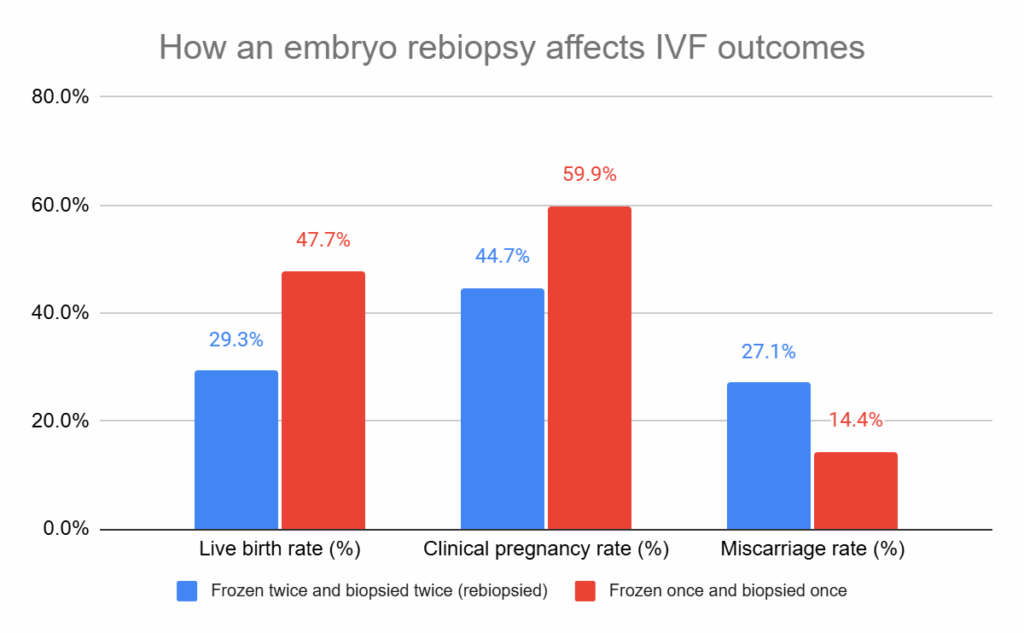
- Live birth rate: lower than once frozen/once biopsied embryos (29.3% vs 47.7%, OR [95% CI]: 0.51 [0.34–0.77]; 6 studies, I² = 24%)
- Clinical pregnancy rate: also reduced (44.7% vs 59.9%, OR [95% CI]: 0.60 [0.46–0.78]; 7 studies, I² = 0%)
- Miscarriage rate: significantly higher per pregnancy (27.1% vs 14.4%, OR [95% CI]: 2.08 [1.13–3.83]; 7 studies, I² = 28%)
- Thaw survival rate: High rates of thaw survival before embryo transfer (93%-100% based on 6 studies).
- Neonatal outcomes: Gestational age and birthweights were normal (based on 2 studies).
While percentages are easier to understand, odds ratios (ORs) help show how consistent the results are across studies of different sizes. In this case, embryos that were frozen and biopsied twice had 49% lower odds of live birth (OR: 0.51), 40% lower odds of clinical pregnancy (OR: 0.60), and more than double the odds of miscarriage (OR: 2.08) compared to embryos that were frozen and biopsied once.
These results show that rebiopsied embryos (frozen twice and biopsied twice) have lower chances of achieving a pregnancy or live birth and higher chances of miscarriage compared to embryos frozen once and biopsied once.
Conclusions
Embryos that were thawed for biopsy, meaning they were frozen twice and biopsied once, had lower chances of pregnancy and live birth, and a higher risk of miscarriage compared to embryos that were frozen and biopsied once. Thaw survival remained high, and birth outcomes like gestational age and birthweight were normal.
Outcomes were even less favorable for embryos that were rebiopsied (frozen twice and biopsied twice). This group had lower live birth and pregnancy rates and more than double the miscarriage rate. Thaw survival was still high, and neonatal outcomes appeared unaffected.
Freezing an embryo twice and biopsying it once may be less harmful than performing two separate biopsies because the second biopsy removes additional cells, which may compromise embryo integrity. Studies suggest that removing too many cells, especially beyond 15 to 20, can lower implantation potential.
Rebiopsy can often be avoided by preventing inconclusive biopsy results. Better training and lab practices have been shown to keep these cases under 3%.
The authors note that rebiopsying blastocysts labeled as mosaic or segmental aneuploid is not advisable, since it does not provide additional diagnostic clarity and may further compromise the embryo. A rebiopsy doesn’t override the original result — a mosaic result remains a mosaic. I’ve covered a few articles on the success rates for these embryos, so offering genetic counseling and discussing their potential may be a better approach than rebiopsy (Complete guide to mosaic embryos, Some embryos labeled as segmental aneuploid by PGT-A are actually euploid).
Let’s look at some of the limitations of this meta-analysis!
- Most of the included studies were rated as low to moderate risk of bias, but all were retrospective, so the overall quality of evidence is low.
- Embryos that were frozen and biopsied more than once may have been transferred only after other embryos had failed, which means they were often used in harder-to-treat cases.
- Embryo quality and speed of development also varied between groups in some studies, and these factors can affect how well an embryo handles a second freeze or rebiopsy.
- Differences in biopsy technique may have influenced results, as some protocols may be more harmful than others.
All of this highlights the need for more consistent standards when it comes to biopsy timing, technique, and embryo selection, and the need for better quality studies that address repeat freezing/rebiopsy.
Other meta-analyses on this topic have reported similar findings, including three more recent ones from 2024 and 2025 (see references below). However, they likely relied on the same retrospective studies, and like all meta-analyses, their conclusions are only as strong as the underlying data — highlighting the need for higher-quality research on this topic.
Want to read more about refreezing or rebiopsying embryos for PGT-A?
-
Multiple embryo freeze/thaw for PGT-A doesn’t affect pregnancy or neonatal outcomes
Researchers in a 2023 study found no differences in pregnancy and neonatal outcomes in embryos tested by PGT-A that were frozen and thawed once or twice. -
Repeated freezing and thawing impacts IVF outcomes in PGT-A cycles
Researchers in a 2021 study found reduced live birth rates when embryos were frozen before biopsying for PGT-A was performed. -
Does a PGT-A biopsy match the rest of the embryo?
Evidence up to 2022 shows that a single PGT-A biopsy is highly concordant (similar) with the rest of the embryo when the embryo is aneuploid or euploid, but not when it’s mosaic or segmental. -
Study examines PGT-A outcomes of inconclusive rebiopsied embryos and associated factors
Researchers in a 2023 study found reduced live birth rates with inconclusive embryos that were rebiopsied, and increased miscarriage rates. They also examined the factors that are associated with inconclusive results, and found that the method of biopsy was the most significant. -
Preliminary studies examine the rebiopsy and transfer of chaotic embryos by PGT-A
Preliminary data from Igenomix finds that some chaotic embryos are euploid after PGT-A rebiopsy, while a case report from Fertility and Sterility details a live birth after the transfer of a chaotic embryo.
Related studies
These additional studies were referenced by the authors of the paper and haven’t been covered on Remembryo. They may be helpful if you’re exploring this topic further. This section is available for paid subscribers.

Reference
Letizia Li Piani, Pasquale Petrone, Mariafrancesca Brutto, Anick De Vos, Annelore Van Der Kelen, Alberto Vaiarelli, Laura Rienzi, Alessandro Conforti, Danilo Cimadomo, Willem Verpoest, A systematic review and meta-analysis of double trophectoderm biopsy and/or cryopreservation in PGT: balancing the need for a diagnosis against the risk of harm, Human Reproduction Update, Volume 31, Issue 2, March-April 2025, Pages 102–115, https://doi.org/10.1093/humupd/dmae031

About Embryoman
Embryoman (Sean Lauber) is a former embryologist and the founder of Remembryo, an IVF research and fertility education website. After working in an IVF lab in the US, he returned to Canada and now focuses on making fertility research more accessible. He holds a Master’s in Immunology and launched Remembryo in 2018 to help patients and professionals make sense of IVF research. Sean shares weekly study updates on Facebook, Instagram, and Reddit regularly. He also answers questions on Reddit or in his private Facebook group.