

Researchers in a 2023 study found reduced live birth rates with inconclusive embryos that were rebiopsied, and increased miscarriage rates. They also examined the factors that are associated with inconclusive results, and found that the method of biopsy was the most significant.
Sometimes after PGT-A, an embryo might come back with inconclusive results, possibly because there wasn’t enough DNA for PGT-A or the quality of the sample was poor.
Nohales et al. (2023) examined PGT-A outcomes of rebiopsied embryos that had inconclusive results after an initial biopsy. This is a retrospective study that took place between 2016 and 2021 at an IVF clinic in Spain. A total of 517 inconclusive biopsies were considered.
🔗 Original studies are referenced in this post or within the linked Remembryo posts.
💡 Reminder: Terms underlined with a dotted black line are linked to glossary entries. Clicking these does not count toward your paywall limit.
Study details
- All biopsied embryos were day 5/6 and had expansions of 5 or 6.
- Embryos were biopsied by the standard pulling method (where a laser and pulling motion are used to remove cells), or by the flicking method (where the cells are lasered before being suctioned into a pipette and flicked against another pipette to remove the cells).
- PGT-A was performed by NGS.
- Single embryo transfers were performed using transferable embryos. Transferable embryos were euploid/mosaic, non-transferable embryos were aneuploid/mosaic (some mosaics were transferable, while others weren’t).
- Inconclusive embryos came from biopsies that didn’t have enough DNA to perform PGT-A, or produced PGT-A results that didn’t meet quality standards.
- The average age of the women in this study was 37.4.
- Clinical pregnancies were defined as gestational sacs at more than 5 weeks; miscarriages were defined as up to 20 weeks.
This study has some very statistically significant results, with p values that are very small. You’ll see numbers like 1.94E-10, which means 1.94 x 10^-10, or 0.000000000194 (that’s 10 zeros in all).
PGT-A outcomes for once-biopsied and rebiopsied embryos
Of the 18,208 embryos that were biopsied, 517 were inconclusive (2.84%).
Of the 517 embryos that had an inconclusive result, 400 of them survived another round of thawing to be rebiopsied (77.4%). There were still 16 that produced an inconclusive result for a second time (4%).
For once-biopsied vs rebiopsied embryos, rebiopsied embryos were more likely to be euploid (42.16% vs 56.00%, p= 4.97E-08), and lead to more transferable embryos (43.42% vs 59.50%, p= 1.94E-10). There was no difference in clinical pregnancy rates, but miscarriage rates increased (24.00% vs 41.02%, p= 0.01) and the live birth rate decreased (43.58% vs 23.08%, p= 0.003).
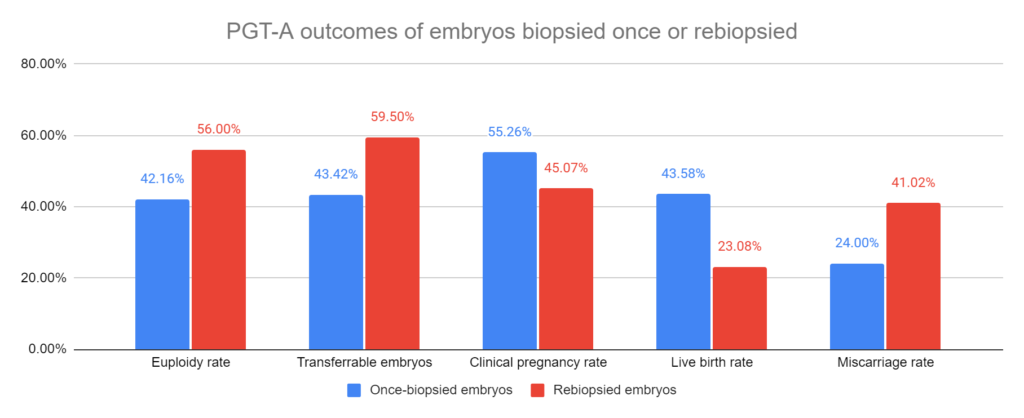
To give an idea on the sample size for some of these outcomes:
- There were 18,028 embryos biopsied once and 400 rebiopsied.
- There were 4,562 transfers of embryos biopsied once and 71 transfers of rebiopsied embryos.
Keep in mind that euploids or mosaics could have been transferred here. Although they don’t specify exactly what was transferred, 97.1% of transferable once-biopsied embryos were euploid and 94.1% of transferable rebiopsied embryos were euploid. It would have been nice if they transferred only euploids here for consistency, but this represents a more realistic situation as a rebiopsied embryo that’s a transferable mosaic would still be eligible for transfer.
Risk factors for inconclusive embryos
They compared the rates of an inconclusive result based on different factors:
- Day 5 vs day 6 (2.67% vs 3.25%, p= 0.02): day 6 embryos were more likely to have inconclusive results.
- Expansion 5 vs expansion 6 (2.67% vs 4.17%, p= 0.000053): embryos with expansion 6 (hatched) are more likely to have inconclusive results.
- Flicking vs pulling method of PGT-A (2.33% vs 5.44%, p= 3.88E-21): the pulling method of PGT-A was more likely to have inconclusive results.
- No differences with ICM or trophectoderm quality.
Conclusions
This study found that rebiopsied embryos had a lower live birth rate and increased miscarriage rate compared to embryos that were biopsied once.
Rebiopsied embryos were also more likely to be euploid. The authors explain that this may be due to aneuploid embryos being less likely to survive after thaw, which enriched their pool of rebiopsied embryos with euploids.
They also looked at different factors that could contribute to an inconclusive biopsy result.
They found that the day the embryo was biopsied, whether it was hatched or not, and the method of biopsy were all associated with inconclusive biopsy results.
The pulling vs flicking method of biopsy had the largest effect, which may be due to the number of laser pulses used, although the study didn’t report on this.
ICM and trophectoderm quality didn’t have any impact on inconclusive results.
Like other studies on the topic, one of which I reviewed here, this study is small and hard to draw conclusions from. Larger studies are needed, which is challenging considering that rebiopsied embryos are not prioritized for transfer over embryos biopsied once.
Reference

About Embryoman
Embryoman (Sean Lauber) is a former embryologist and the founder of Remembryo, an IVF research and fertility education website. After working in an IVF lab in the US, he returned to Canada and now focuses on making fertility research more accessible. He holds a Master’s in Immunology and launched Remembryo in 2018 to help patients and professionals make sense of IVF research. Sean shares weekly study updates on Facebook, Instagram, and Reddit regularly. He also answers questions on Reddit or in his private Facebook group.
Related posts:
 Multiple embryo freeze/thaw for PGT-A doesn’t affect pregnancy or neonatal outcomes
 Complete guide to PGT-A (PGS testing)
 PGS (PGT-A) success rates
 Repeated freezing and thawing impacts IVF outcomes in PGT-A cycles
 Factors associated with euploid survival after thaw
 Preliminary studies examine the rebiopsy and transfer of chaotic embryos by PGT-A
 Meta-analysis combines 74 studies to examine factors linked to euploid transfer success
 IVF outcomes following aneuploid embryo transfer