

Researchers in a 2022 study found that psychological burden was the number one reason Belgians would stop fertility treatment.
IVF can have a serious impact on a person’s physical and mental well-being, forcing many to stop treatment.
To learn more about why people stop fertility treatment, Vanden Meerschaut et al. (2022) analyzed questionnaire responses of 304 women with frozen embryos who stopped treatment after a failed attempt for at least a year. This study was conducted between 2012 and 2017 and consisted of 11 IVF centers in Belgium, representing 80% of the assisted reproductive technology (ART) activity in the country.
Key points:
- Patients were good prognosis with an average age of 35.3.
- This study took place in Belgium where public health insurance covers up to six ART cycles.
- Responses were scored based on the Likert scale from 1-10 (1: this doesn’t apply to me; 10: this applies to me entirely).
- The overall discontinuation rate was 9.0%.
- Study participants were included if they discontinued treatment after a year and had remaining embryos in storage. It’s not clear if they stopped treatment temporarily or permanently.
🔗 Original studies are referenced in this post or within the linked Remembryo posts.
💡 Reminder: Terms underlined with a dotted black line are linked to glossary entries. Clicking these does not count toward your paywall limit.
Psychological burden the top reason to stop fertility treatment
When considering Likert scores that were 6 or higher, most women stopped fertility treatment due to the psychological burden (50%), followed by the physical burden (43%) and the effect on work (29%).
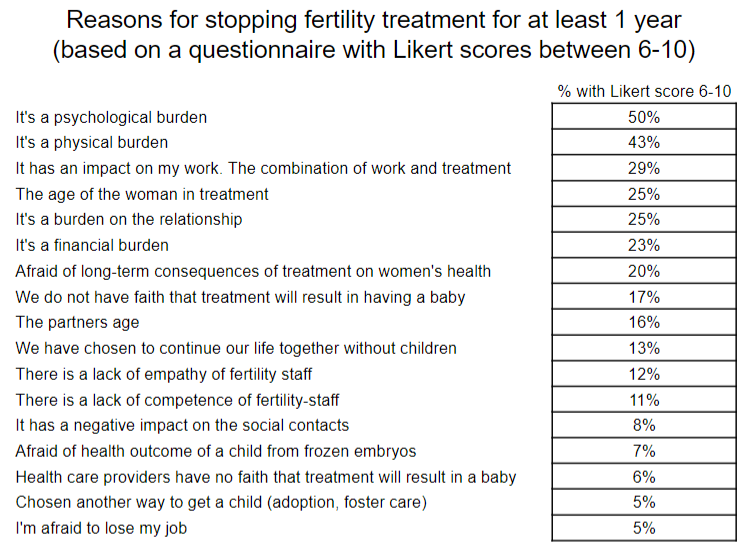
Women who had never been pregnant were more likely to list “psychological burden” as a reason for stopping fertility treatment (compared to women with 2 or more pregnancies or births).
Women who had given birth once listed “physical burden” and “effect on work” as reasons for stopping fertility treatment (compared to women with 2 or more births).
Women who had done two or more fresh or frozen transfers were more likely to indicate “physical burden” as a reason (compared to women who had done none).
The decision to stop fertility treatment was mostly made by the woman undergoing treatment, the partner or both
When asked who influenced the decision to stop IVF, 69% responded that it was the woman’s decision, the partner, or both, while 16% responded that it was due to external factors. In terms of external factors, the doctor was the major influencer, particularly in women aged 43 and above.
Women who had never given birth, or didn’t have any frozen transfers, were more likely to be the main influencer in the decision to stop fertility treatment (compared to women with two or more births or frozen transfers).
Women aged 36 or younger were more likely to have their partner as the main influencer in the decision to stop fertility treatment (compared to women 37 and older).
After stopping fertility treatment , “psychological support” is the most desired improvement at IVF center
In responding to what improvements they would like to see with their fertility clinic after discontinuing fertility treatment, most responded to having psychological support during and after IVF treatment (52%), followed by lifestyle advice (44%) and receiving digital communication regarding treatment (44%).
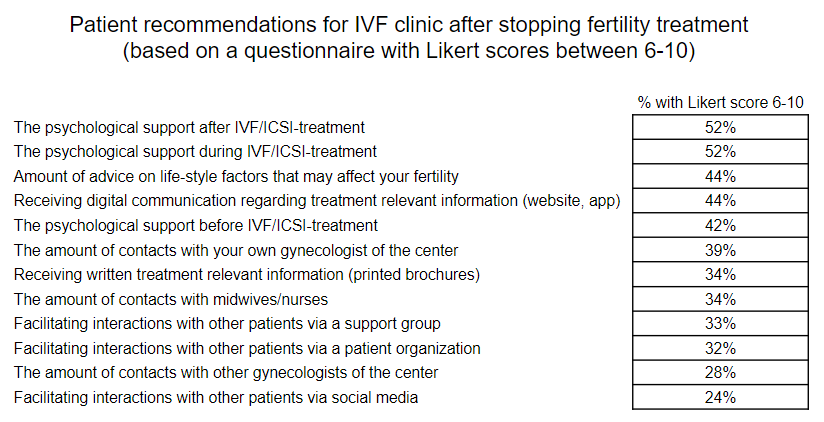
Women who had never been pregnant or given birth were more likely to list “psychological support,” “lifestyle advice” and more frequent “consultation with their own physician” as improvements (compared to women with 2 or more pregnancies or births).
Women who had no frozen transfers were more likely to indicate more frequent “consultation with their own physician” as an improvement (compared to women with two or more frozen transfers).
Conclusions
This study found that most women stopped fertility treatment due to it being a psychological or physical burden. When asked what improvements they’d like to see at their IVF center after stopping treatment, most respondents indicated “psychological support” during or after treatment, as well as “lifestyle advice.”
They also asked questions about who mainly influenced the decision to stop fertility treatment. Most responded it was the woman, partner or doctor. Younger women were more likely to be influenced by their partner, while women aged 43 and above were more likely to be influenced by their doctor.
Since this study was conducted in Belgium, where they receive up to six complete ART cycles through insurance, cost wasn’t a big motivator to stop fertility treatment. This is likely a very different story in the US, where the high cost of treatment and lack of coverage can easily be seen as a burden for many.
There are some limitations of this study. About 10% of respondents indicated that they don’t remember why they stopped treatment, so it’s possible that the other respondents might have trouble remembering why they stopped. Another limitation is that about 90% were satisfied with their IVF center and would recommend it, so their answers may be biased. Many of the people who didn’t respond may have felt differently. Furthermore, women who became pregnant were generally more satisfied than those who weren’t.
Reference

About Embryoman
Embryoman (Sean Lauber) is a former embryologist and the founder of Remembryo, an IVF research and fertility education website. After working in an IVF lab in the US, he returned to Canada and now focuses on making fertility research more accessible. He holds a Master’s in Immunology and launched Remembryo in 2018 to help patients and professionals make sense of IVF research. Sean shares weekly study updates on Facebook, Instagram, and Reddit regularly. He also answers questions on Reddit or in his private Facebook group.
Related posts:
 Ejaculation failure on the day of egg retrieval tied to psychological distress
 Does stress lower IVF success rates?
 Risk of poor ovarian response with repeat IVF cycles
 Pregnancy outcomes unaffected by catheter-retained embryos
 How many failed embryo transfers is too many?
 Comparing frozen embryo transfer/FET protocols
 Improved IVF outcomes when embryos are cultured in groups
 Embryologist and physician success rates variable, not related to experience