
A 2025 study found that chewing gum during labor significantly reduced both pain and anxiety in first-time moms, offering a simple, low-risk tool that may help make childbirth a little more manageable.
First-time moms often experience anxiety about labor pain, and while options like epidurals and other medications exist, they’re not always an option or preference for everyone.
That’s why there’s increasing interest in non-pharmacological pain relief methods, like music or breathing exercises, which may work by distracting the mind from the pain.
In a new study, Mohsenzadeh-Ledari et al. (2025) performed a randomized controlled trial to test another technique to distract from labor pain and anxiety — chewing gum!
🔗 Original studies are referenced in this post or within the linked Remembryo posts.
💡 Reminder: Terms underlined with a dotted black line are linked to glossary entries. Clicking these does not count toward your paywall limit.
Study details
- This study was a randomized controlled trial that took place at two hospitals in Iran between 2021 and 2022.
- All had singleton, head-down pregnancies that were delivered vaginally.
- None received epidurals, spinal blocks, or gas.
- Everyone was healthy and able to chew gum.
- The primary outcome was pain, measured using the standard 10-point visual analogue scale (VAS).
- The secondary outcome was anxiety, measured using the state-trait anxiety inventory (STAI).
In terms of sample size, there were 116 first-time moms who were in spontaneous labor at term (38-42 weeks).
- 58 didn’t chew gum
- 58 chewed sugar-free gum (Orbit brand)
They reported pain and anxiety during three stages of labor: at 3-4 cm dilation, at 5-7 cm and at 8-10 cm. The mothers were given gum at the beginning of each stage of labor.
Chewing gum reduced pain
Pain scores were basically the same in both groups before the intervention, around 6 out of 10. But as labor progressed, women who chewed gum reported significantly lower pain:
- At 3–4 cm dilation:
- Control group: 7.43
- Chewing gum group: 6.75 (p= 0.003)
- At 5–7 cm:
- Control: 9.32
- Gum: 8.57 (p< 0.001)
- At 8–10 cm:
- Control: 9.97
- Gum: 9.46 (p< 0.001)
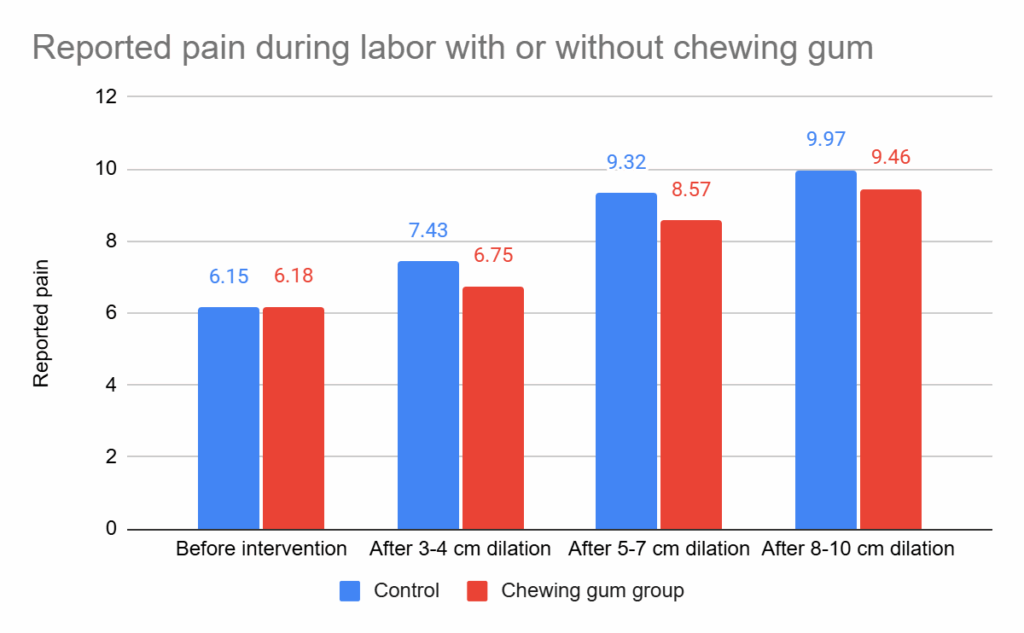
So even as the pain got more intense as labor progressed from 3-4 cm dilation to 8-10 cm, the women in the gum group reported lower pain levels.
Chewing gum also lowered anxiety
Trait anxiety and state anxiety are two different forms of anxiety: trait anxiety reflects a person’s general tendency to feel anxious across situations, while state anxiety is a short-term response to a specific event or circumstance.
They found that trait anxiety scores were lower for the gum group compared to the control group (47.0 vs 61.6, p< 0.001). For state anxiety, they found that the gum group also had lower scores compared to the control (40.98 vs 60.15, p< 0.001).
So chewing gum didn’t just help with pain, it also seemed to help keep anxiety levels lower.
Conclusions
This study found that chewing gum might actually help reduce both labor pain and anxiety. It’s cheap, non-invasive, and doesn’t pose any risk to the baby. While it obviously won’t replace an epidural, it might make labor pain a little more manageable.
The researchers suggest that chewing gum might help as it acts as a distraction and gives the mothers a sense of control. There’s also evidence that it may activate serotonin pathways in the brain that help to stop pain.
One limitation of the study is that pain and anxiety levels can vary between individuals due to genetic factors and how subjective the experience can be, though randomizing the groups helped reduce the impact of those differences.
Reference

About Embryoman
Embryoman (Sean Lauber) is a former embryologist and the founder of Remembryo, an IVF research and fertility education website. After working in an IVF lab in the US, he returned to Canada and now focuses on making fertility research more accessible. He holds a Master’s in Immunology and launched Remembryo in 2018 to help patients and professionals make sense of IVF research. Sean shares weekly study updates on Facebook, Instagram, and Reddit regularly. He also answers questions on Reddit or in his private Facebook group.
Related posts:
 Study examines risk of mortality in women with a history of adverse pregnancy outcomes
 Meta-analysis compares medicated and natural FET adverse pregnancy and birth outcomes
 Highlights from ASRM’s 79th annual meeting (2023)
 Monthly IVF research brief for January 2024
 ASRM’s 2024 committee opinion on the use of PGT-A
 Monthly IVF research brief for October 2024
 Monthly IVF research brief for November 2024
 Monthly IVF research brief for December 2024