
Researchers in a 2023 study found decreased adverse pregnancy and neonatal outcomes in those who performed a natural vs medicated FET, including abnormal birth weights, preeclampsia, preterm births, and more.
There are two main types of frozen embryo transfers (FETs): medicated and natural. Natural FETs rely on the corpus luteum to provide the necessary factors for embryo implantation, while medicated FETs may not supply these factors adequately. Recent studies suggest that these differences may impact obstetric and neonatal outcomes.
Zaat et al. (2023) performed a systematic review and meta-analysis and combined the results of 30 studies examining obstetric and neonatal outcomes in natural and medicated FETs.
Often a meta-analysis will include the raw data and show the percentages for different outcomes (ie. live birth rate), which can be used to prepare graphs. However, this study just lists the odds ratio for the most part, so be sure to check the glossary for this term if you’re not familiar with it or check out the brief explanation below.
Essentially, the odds ratio compares the odds of an event occurring in one group to the odds in another group. If the odds ratio is greater than 1, it suggests a positive association, meaning the event is more likely in the first group. If the odds ratio is less than 1, it suggests a negative association, meaning the event is less likely in the first group. The odds ratio helps us understand the strength of the relationship between the two groups.
🔗 Original studies are referenced in this post or within the linked Remembryo posts.
💡 Reminder: Terms underlined with a dotted black line are linked to glossary entries. Clicking these does not count toward your paywall limit.
Natural FETs show reduced adverse pregnancy and birth outcomes
The primary outcome was birthweight, which is usually higher in babies born after FETs, leading to more babies that are large for gestational age. They found that birthweight was lower for natural FETs vs medicated FETs (average difference 26.35 grams, 95% CI: 11.61-41.08; moderate heterogeneity I2 = 63%, based on 23 studies). The quality of evidence was moderate.
You can see the rest of the outcomes they looked at below.
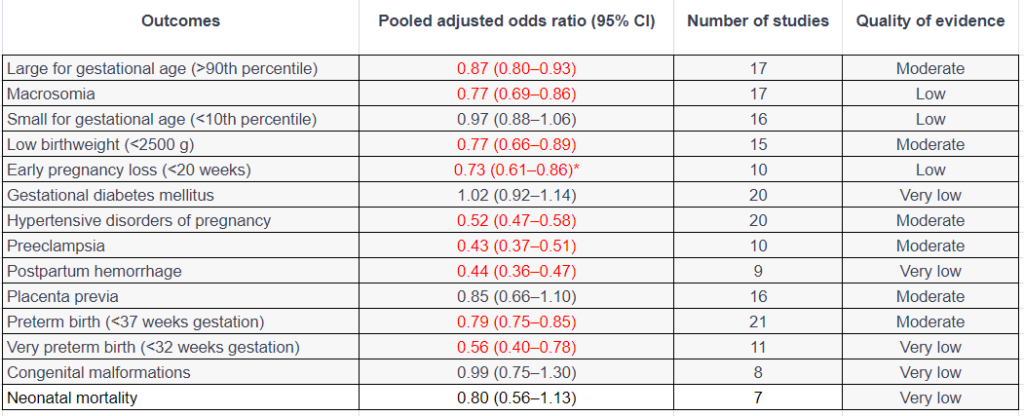
*Note that the “early pregnancy loss” odds ratio was not statistically adjusted.
Let’s look at the preeclampsia example in more detail. The odds of the patients developing preeclampsia who did a natural FET was 0.43 times the odds of those who had a medicated FET, or 57% less (1.00 – 0.43 = 0.57 or 57%).
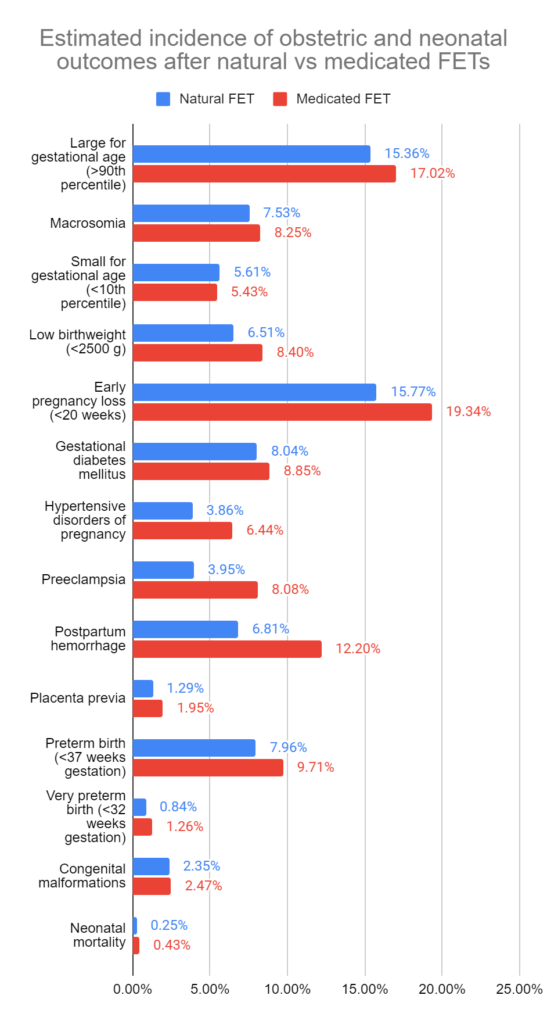
With just the odds ratio, we can’t figure out what the starting numbers were. Were there 5% of women with preeclampsia in the natural FET group vs 10% in the medicated FET group? We can’t say. The odds ratio just describes the strength of the relationship between the numbers.
So the researchers also provided estimates for the incidence of each outcome, but be warned! All have very high heterogeneity (most have I2 values that are >90%). This means that these incidences varied a lot between each study, and the estimates they have should be considered with caution.
In general, the same adverse outcomes were seen in women with or without PCOS
There were a lot of studies used that involved women with PCOS, so the researchers did a subgroup analysis to see if there were any differences in outcomes in PCOS or non-PCOS patients. The results are below and mostly agree with what we saw above.
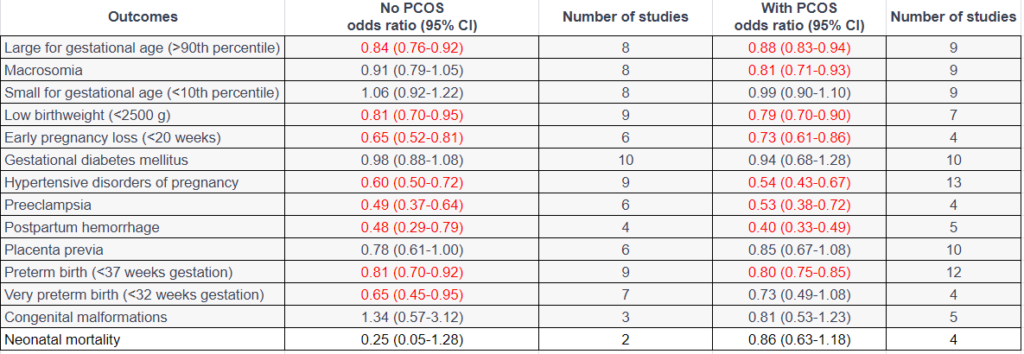
Based on this, PCOS patients who had a natural FET saw an decreased incidence of macrosomia, while the non-PCOS group saw no differences. In non-PCOS patients, there was a decrease in babies born that were very preterm when doing a natural FET, but there was no difference in the PCOS group.
Natural cycles with luteal phase support show mostly the same outcomes as without it
The researchers also did a subgroup analysis on patients that had luteal phase support (LPS) during their natural FET. Since the corpus luteum is produced in a natural cycle, supplementation with progesterone may not be necessary.
They report that the only difference was that natural FETs with LPS had decreased preterm birth risk that wasn’t seen without LPS.
However, they note that comparing LPS protocols across studies can be challenging due to differences in medication, start dates and treatment duration.
Conclusions
This study found that natural FETs led to a reduction in:
- Babies that were large for gestational age
- Macrosomia
- Babies with a low birthweight
- Early pregnancy loss
- Hypertensive disorders of pregnancy
- Preeclampsia
- Postpartum hemorrhage
- Preterm births
- Very preterm births
The authors explain that these outcomes may be due to atypical hormone levels provided in a medicated FET, or the absence of factors from the corpus luteum, that results in abnormal invasion of the embryo, placentation and placental function.
This data mostly agreed with other meta-analyses on the subject (Busnelli et al. 2022 and Moreno-Sepulveda et al. 2021), while adding new information.
The researchers estimate that for each adverse outcome examined, the use of a natural FET may prevent 4 to 22 cases per 1,000 women.
Reference

About Embryoman
Embryoman (Sean Lauber) is a former embryologist and the founder of Remembryo, an IVF research and fertility education website. After working in an IVF lab in the US, he returned to Canada and now focuses on making fertility research more accessible. He holds a Master’s in Immunology and launched Remembryo in 2018 to help patients and professionals make sense of IVF research. Sean shares weekly study updates on Facebook, Instagram, and Reddit regularly. He also answers questions on Reddit or in his private Facebook group.
Related posts:
 Natural FETs outperform medicated FETs in donor egg cycles
 Comparing frozen embryo transfer/FET protocols
 Same live birth rate, fewer complications with natural frozen embryo transfer
 Optimizing natural FET protocols: key results from a meta-analysis
 Natural FETs linked to lower pregnancy loss after euploid transfer
 Progesterone supplementation in true natural cycle FETs improves outcomes
 Pregnancy outcomes and complications with medicated, natural and mild stimulated FETs
 Live birth rates higher with natural cycle FETs vs medicated FETs