
The follicle contains follicular support cells that help the egg grow and mature, including granulosa cells, cumulus cells, and theca cells.
Granulosa cells respond to hormones like FSH and are the main producers of estrogen during the menstrual cycle, releasing growth factors that support egg development. A subtype called cumulus cells forms a cluster directly around the egg, providing it with nutrients and signaling molecules needed for maturation.
Theca cells form the outer layer of the follicle and produce androgens like testosterone, which granulosa cells convert into estrogens like estradiol using the aromatase enzyme, making them essential partners in hormone production.
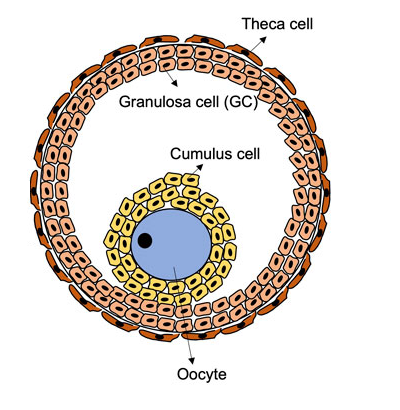
These cumulus cells remain attached to the egg at the time of egg retrieval, and you can often see them as a cloud-like layer around the egg. When these cells are attached, this structure is often called a cumulus-oocyte complex (or COC). However, when performing ICSI, these cells need to be removed so the egg can be properly assessed and fertilized, a process called denudation or “stripping.”
To denude the egg, an enzyme called hyaluronidase is used to break down the sticky bonds that hold the cumulus cells in place. Once the egg is stripped of its cumulus cells, it becomes easier to evaluate its maturity and prepare it for ICSI. The smooth, denuded egg is more stable and easier to handle during the sperm injection procedure.
