
Researchers in a 2021 review examined how sperm and eggs can sometimes be genetically incompatible, based on a group of proteins called human leukocyte antigens (HLA), which may lead to implantation failure or embryo arrest when they’re mismatched.
Fertilization involves the egg and sperm – is there any evidence that sometimes this pairing is incompatible? What determines this?
For many people going through IVF, their diagnosis is “unexplained”. And what this means is that our current understanding of the biology of infertility (and the tests we use to diagnose it) is lacking.
Story time! I first started writing as Embryoman in the Summer of 2018 and that Fall I started my Facebook support group. During this time I remember someone asking if it was possible if a particular male and female, genetically, just couldn’t produce a viable embryo. At the time I didn’t know and searched for it online. I found nothing! And so I didn’t have a good answer.
Now it’s 2022 and I found something! Kekalainen (2021) has finally provided some answers to this question. It’s a bit theoretical, and pulls some evidence from animals, but it’s a really interesting topic that I think deserves some attention. So let’s explore this idea together and hopefully that person who asked me back in 2018 is still reading!
🔗 Original studies are referenced in this post or within the linked Remembryo posts.
💡 Reminder: Terms underlined with a dotted black line are linked to glossary entries. Clicking these does not count toward your paywall limit.
Female induced sperm selection
In order for a sperm cell to fertilize an egg cell, it first needs to be activated in a process called capacitation. Capacitated sperm can move their tail (flagellum) very quickly to move toward the egg cell. They can also perform the acrosome reaction, where enzymes in the tip of the sperm head begin digesting the zona (shell) of the egg cell so it can penetrate for fertilization. You can see an outline of the acrosome reaction below:

Capacitation of sperm is necessary for fertilization, so what triggers it? It turns out, among other factors, that secretions of the female reproductive tract are needed. And these secretions can be very specific in what sperm are activated! So this can create an environment in a female where only certain sperm can be activated.
This kind of “cryptic female choice” is pretty common in other animals. In marine mussels, chemicals released by the female can change the swimming patterns of specific sperm. This way, only genetically compatible sperm will migrate to and end up fertilizing the mussel eggs.
And it turns out we’re not so different from mussels! Fitzpatrick et al. (2020) showed that follicular fluid from a (human) female can selectively attract sperm from specific males over others. Furthermore, Jokiniemi et al. (2020) found that the cervical mucus from a female can alter sperm performance (swimming speed, activation and viability) but only from certain males.
Evidently, there are some factors that are present in these fluids that can activate sperm. We’ll talk about what that is in a moment, but first, what’s so special about all of this? Why would some combinations be better than others? It turns out that in some cases sperm performs better the more dissimilar the male and female HLA genes are.
HLA genes and mating preference
HLA (human leukocyte antigen, aka MHC proteins) are a group of proteins that play a big role in the immune system. There’s different groups of HLA and each group has different genetic varieties (alleles) to give tens of thousands of possible combinations when a male and female reproduce. Having a diverse set of HLA genes is important because it helps to defend against a wider range of infections – thank you evolution!
This might be confusing so consider this analogy. Imagine that whenever humans produced a child, that child inherits a collection of books owned by the two parents. The more diverse the set of books inherited, the smarter the child becomes. If the parents share a similar collection of books then the child won’t inherit a diverse set of books and won’t be as smart.
Evolution has set up mechanisms to promote reproduction between parents who carry dissimilar HLA gene sets. Many animals, including humans, can select mates based on body odors. Kromer et al. (2016) found that their partner’s “body odor attractiveness” and corresponding partnership and sexual satisfaction was higher between men and women with dissimilar HLA sets.
There’s also some evidence in my post on why embryos fail to implant or miscarry that suggests similar HLA combinations can lead to the embryo failing to implant and may be more common in cases of RIF. NK cells might also be involved in a similar process.
So in terms of sperm and egg, the female reproductive system might be more selective in what sperm fertilizes the egg based on how dissimilar the HLA groups are.
It doesn’t all have to be about HLA, there could be other features that evolution has deemed important to match (or mismatch!), but HLA provides a good example.
How is genetic compatibility recognized by the sperm and egg?
The answer has to do with different cells surface protein receptors, or even carbohydrates, on the surface of the sperm and egg cell.
All cells have “stuff” on their surface to communicate with other cells, or to respond to certain events. These are usually large molecules made up of amino acids called proteins. A great example is insulin, which is a protein that tells cells to start taking up sugar to use it for energy after a meal. There are receptors for insulin on the surface of cells so this can all be communicated.
You can see a 3D representation of a generic (not an egg) cell surface and its different receptors below:

There’s about 10k receptors above, but not all cells have this many. Every type of cell will have a unique set of cell surface proteins that are needed for that cell to communicate. The number and types of receptors on a cell can change pretty rapidly depending on what’s going on.
The sperm and egg cell may have compatible surface proteins that can associate with each other like a lock and key. This can inform the egg cell that the sperm cell is appropriate and compatible. You can see a diagram representing this below. Notice how the top sperm cell has a triangle shaped cell surface protein that would fit with the egg cell’s receptor, while the bottom sperm cell has a different shaped protein that won’t fit (not compatible!).
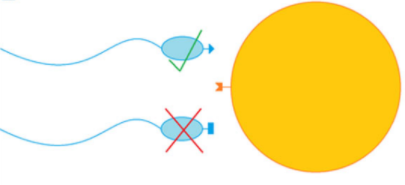
It’s not so much that the egg and sperm have a different set of receptors/cell surface proteins (although they could), but these proteins might fit together better in partners that are more compatible.
Let’s look at an example.
Two important proteins that are involved in fertilization are Juno (expressed on the egg) and Izumo (expressed on the sperm). These proteins associate with each other just like the lock and key mechanism described above, and this binding is essential for fertilization to occur (Bianchi et al. 2014).
Grayson (2015) showed that some pairs of Juno and Izumo fit better than other pairs. So some pairs are more compatible and fit like a lock and key better. Why this happens is because they’re believe to have co-evolved together. This means that they both gradually changed their structures over millions of years to eventually fit together.
This co-evolution of proteins in the sperm and egg/female reproductive tract might be driven by something like HLA. Offspring that are produced by different HLA matching will be more likely to survive and reproduce (because they have a stronger immune system). So evolution favors fertilization of eggs and sperm with dissimilar HLA sets, and one way to ensure that these two dissimilar sets pair together is by having proteins like Juno and Izumo fit together just right (but only in compatible partners!).
There are lots of different proteins that associate with each other on the sperm and egg. Here are some examples of a few we’ve discovered (from Kekalainen 2021):
| Oocyte | Function | Location |
|---|---|---|
| CD9 | Sperm–oocyte fusion | Oocyte surface |
| CD81 | Sperm–oocyte fusion | Oocyte surface |
| Juno | Sperm–oocyte membrane adhesion | Oocyte surface |
| ZP1-ZP3 | Sperm–oocyte binding/coevolution | Zona pellucida |
| Sperm | Function | Location |
| Izumo1 | Sperm–oocyte membrane adhesion | Sperm surface after acrosome reaction |
| FIMP | Sperm–oocyte fusion | Sperm equatorial segment |
| THEM95 | Sperm–oocyte fusion | Sperm plasma membrane |
| SOF1 | Sperm–oocyte fusion | Sperm plasma membrane |
| SPACA6 | Sperm–oocyte fusion | Sperm plasma membrane |
| DCST1/DCST2 | Sperm–oocyte fusion | Sperm plasma membrane |
| C4BPA (ZP3R) | Sperm–oocyte binding/coevolution | Sperm plasma membrane |
| PKDREJ | Zona pellucida (ZP) binding | Sperm acrosome |
| CRISP1/CRISP2 | Sperm–oocyte interaction | Sperm plasma membrane |
| PH-20 | Cumulus penetration + ZP binding | Sperm plasma membrane |
| Zonadhesin | ZP binding | Sperm acrosome |
Some of these proteins have been shown to co-evolve with each other, possibly driven by HLA or other mechanisms. This suggests that a number of proteins create a type of “signature” on the sperm that collectively pair with a compatible signature on the egg. Or the sperm might only be activated in certain female’s reproductive tracts.
What about conventional IVF or ICSI?
Alright, so we talked a lot about what would happen when sperm travels through the reproductive tract, but this isn’t what happens in IVF.
Sperm capacitation normally occurs inside the female reproductive tract. In IVF, capacitation is accomplished by using specialized media that resembles the fluid in the fallopian tube called “human tubal fluid medium” or HTF (Ikawa et al. 2010). Sperm can be processed after ejaculation using HTF.
The capacitated sperm can now be used for conventional IVF, where sperm is mixed in with the eggs, or by injecting it using ICSI.
As described above, in conventional IVF, compatible sperm and eggs might have a more compatible signature on their cell surfaces which allows them to associate with each other. So a more compatible match of sperm and egg would be more likely to undergo fertilization.
With ICSI, the sperm is injected directly into the egg and there is no opportunity for the surface of the egg and sperm cells to interact. But there may be other compatibility mechanisms in place once the sperm is inside the egg, or even as the embryo develops. A number of studies listed by Kekalainen (2021) have shown that compatibility of egg and sperm are associated with embryo survival in different (non-human) animal species. So it’s possible that similar HLA sets, or other genes involved in compatibility, can lead to embryo arrest.
Conclusions
An issue is that infertility is seen as a disease of the reproductive system, but as Kekalainen (2021) argues, it may just be that some male and female combinations “match” better. So some cases of fertilization failure, or even embryo arrest, may be the result of genetic incompatibility and might have nothing to do with egg or sperm quality.
Changing the way we look at infertility to include this phenomenon is important to understand it better and to improve outcomes. One way we could do this, for example, is by developing compatibility tests to measure sperm responses to female reproductive tract secretions. How we handle a “genetic incompatibility” diagnosis is another story, but at least it will provide an explanation to some cases of unexplained infertility and can help in moving toward the next line of treatment.
Reference

About Embryoman
Embryoman (Sean Lauber) is a former embryologist and the founder of Remembryo, an IVF research and fertility education website. After working in an IVF lab in the US, he returned to Canada and now focuses on making fertility research more accessible. He holds a Master’s in Immunology and launched Remembryo in 2018 to help patients and professionals make sense of IVF research. Sean shares weekly study updates on Facebook, Instagram, and Reddit regularly. He also answers questions on Reddit or in his private Facebook group.
Related posts:
 Artificial oocyte activation improves IVF outcomes in clinical trial
 Predicting how many day 3 embryos make it to blastocyst
 Sleep quality and its impact on IVF outcomes
 An Italian consensus on key performance indicators for assessing IVF clinics
 Abnormal embryo cleavage
 ESHRE 2023 guidelines on managing unexplained infertility
 Researchers develop tool to help predict fertilization failure
 Nearly half of unexplained infertility patients have endometriosis