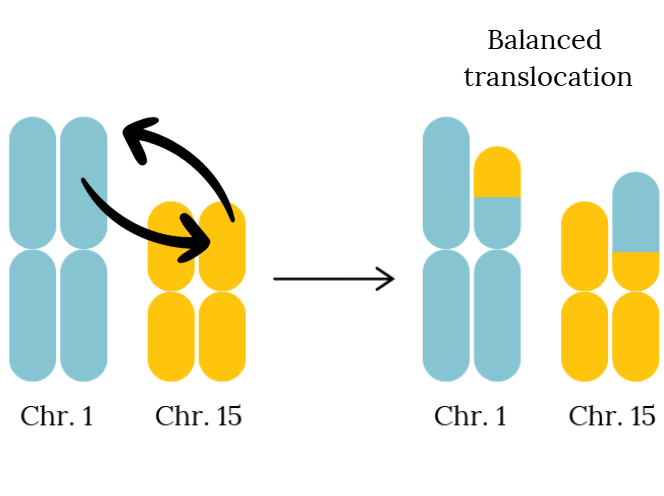
A translocation is a chromosomal abnormality where a segment of one chromosome breaks off and attaches to another chromosome or a different region within the same chromosome. If no genetic material is lost or gained, it is called a balanced translocation, and the carrier is typically healthy. You can see a balanced translocation below. Notice how, all together, there is no gain or loss of any chromosomal sections — there’s the same amount of green and yellow, because all that happened was the segments were swapped between chromosomes.
However, during the formation of egg or sperm cells, the rearranged chromosomes may separate unevenly, leading to unbalanced gametes. When an unbalanced gamete combines with a normal egg or sperm, the resulting embryo may have missing or extra genetic material, increasing the risk of implantation failure, miscarriage, or congenital disorders. Translocations are diagnosed through karyotyping, which analyzes the chromosomes of the parents. If a translocation is detected, PGT-SR can be used to identify embryos that are chromosomally balanced, improving the chances of a successful pregnancy.
For those who want more detail — let’s look at how this balanced translocation can lead to an unbalanced embryo with missing or extra genetic material!
During the formation of egg or sperm cells (gametes), the two copies of each chromosome will separate so only a single copy of each chromosome goes into a gamete. Some gametes will get the normal (untranslocated) chromosome, while others will receive the translocated copy. I’ve shown this below during sperm formation as an example, and marked each chromosome copy with an A, B, C and D so you can more clearly see how this is happening. The A or B chromosome will pair with either C or D, so the possible combinations are AC, AD, BC and BD sperm.
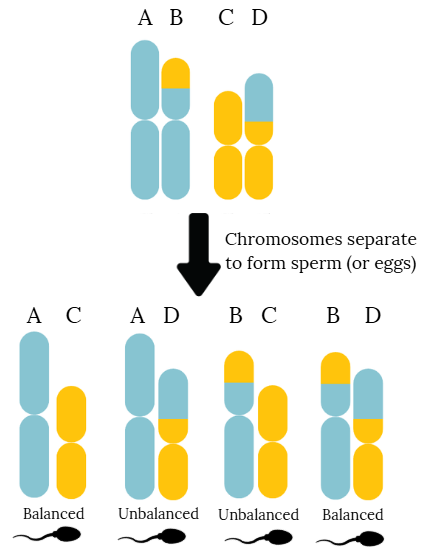
The AD and BC pairs are unbalanced because they don’t have the right amount of genetic material (ie. the AD pair has the extra green chromosome segment and is missing a yellow chromosome segment). Now let’s look at what happens when a balanced and unbalanced gamete combines with an egg that doesn’t have any translocations:
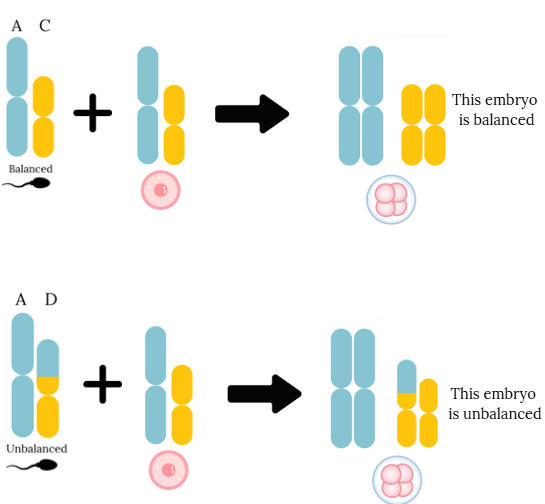
The balanced sperm with the normal egg makes an embryo that doesn’t have any translocations — there are 2 copies of the green and yellow chromosomes and none of its parts are missing or duplicated. However, when an unbalanced sperm combines with the normal egg, the embryo inherits that translocation and is unbalanced — the green chromosome pairs are normal but the yellow chromosome pair missing/additional genetic material. This embryo might not implant, or might miscarry.
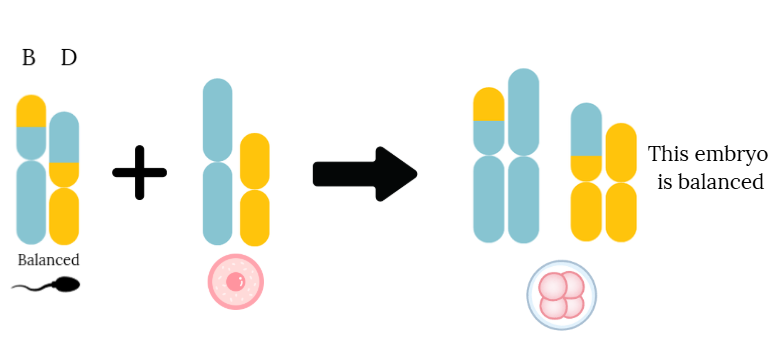
In some cases, an embryo with a balanced translocation can be produced, as shown below with the BD sperm and normal egg. The child from this embryo would have a balanced translocation and may also have fertility problems.