
Researchers in a 2021 study followed 1,825 women with poor ovarian response for 7 complete cycles and found that there was no further increase in live births after the 4th cycle.
Women with poor ovarian response (POR) often retrieve 3 or fewer eggs in a cycle and are typically diagnosed using the Bologna criteria.
Wang et al. (2021), in their retrospective cohort study between 2014 and 2018 in a single IVF center in China, compared cumulative live births among 1,825 POR women. They had upwards of 7 ovarian stimulation cycles that included 2,773 ovarian stimulation cycles (with fresh transfers) and 1,702 frozen embryo transfer (FET) cycles. Women were grouped according to their age at the time of their first egg retrieval and both day 3 and day 5/6 embryos were transferred.
These 2,773 ovarian stimulation cycles were complete cycles, meaning that all embryos from an ovarian stimulation cycle were transferred. You can see the flow of patients in each complete cycle below:

To calculate cumulative rates, the total number of pregnancies (or live births) after all the cycles is added up and then divided by the initial number of patients. If patients drop out in subsequent cycles then we need to find a way to include them somehow because they’re being represented in this calculation. So the researchers presented their cumulative rates as conservative and optimistic:
- Conservative estimate: assume that women who drop out have a 0% chance of pregnancy/live birth.
- Optimistic estimate: assume that women who drop out have the same chance of pregnancy/live birth as those who didn’t drop out.
The true cumulative rate lies somewhere in between these conservative and optimistic estimates.
🔗 Original studies are referenced in this post or within the linked Remembryo posts.
💡 Reminder: Terms underlined with a dotted black line are linked to glossary entries. Clicking these does not count toward your paywall limit.
Cumulative live birth rates in women with POR
There were 1,825 POR women that initiated an IVF cycle, with many of them going on to do another cycle after they had used up all their embryos. In total there were 7 cycles, and the live birth rates for each individual cycle are shown below (not cumulative):

The conservative and optimistic cumulative rates were calculated after each cycle for different age groups. The conservative data for cumulative live birth rate is shown below, with the optimistic data just below it:
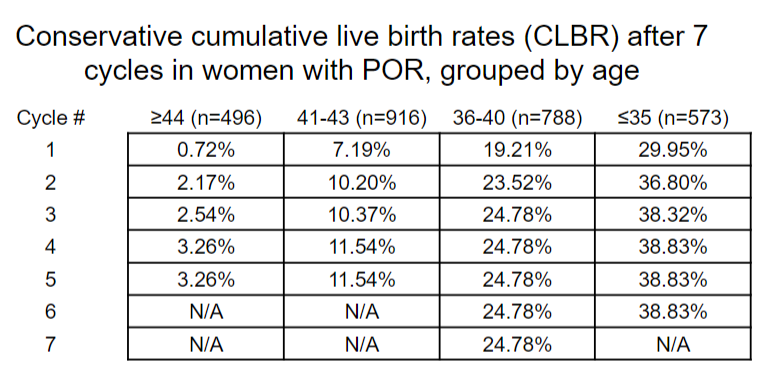
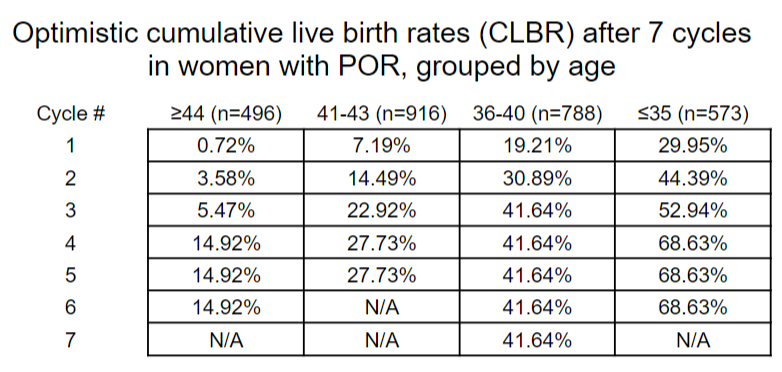
Note that this can be interpreted by looking at the conservative and optimal estimates. So in this study 44 year old women had a chance of live birth between 2.54% (conservative) and 5.47% (optimistic) after finishing 3 complete cycles where all embryos were transferred.
In these graphs, we can see that the values peak and stabilize at some point. This is because no further live births occurred in those particular ages and cycles, so the total number of live births isn’t changing and the cumulative rates stabilize.
We can see this when we look at the individual birth rates across each age group:
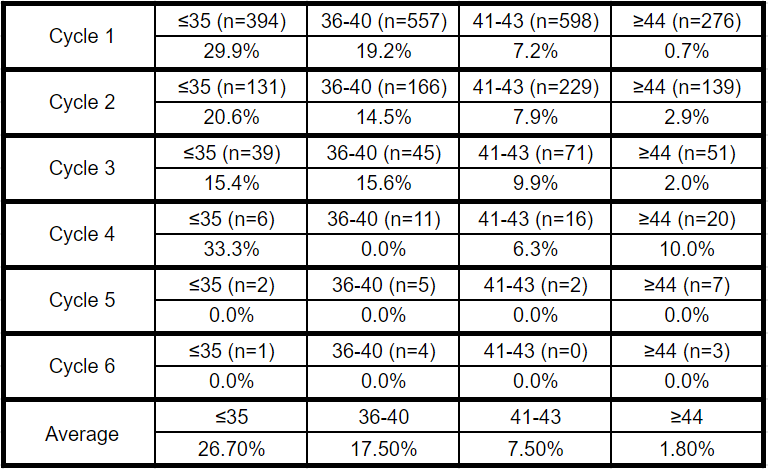
Notice that there are no live births after cycle 4 (mainly because there aren’t many women left at this point). There were 8 women who went on to have 6 complete cycles and didn’t have a live birth, and 2 of them went on to try a 7th cycle (not shown).
Conclusions
This study found that the cumulative live birth rate varied by age, and stabilized after 4 cycles as there were no further live births. This was mainly due to the decreasing number of women after each cycle, from 1,825 in cycle 1 to 53 in cycle 4. By the 5th cycle there were 16 women without a live birth, followed by 8 in cycle 6 and 2 in cycle 7. This led the authors to conclude that women with POR should not undergo more than 4 complete cycles.
This study would likely have had different results with a larger number of women to go beyond a 4th cycle, because there would likely have been more live births. However this seems to be rare, as demonstrated by the 16 women with POR out of 1,825 who went beyond a 4th cycle without a live birth, so investigating this kind of population would be difficult.
Reference

About Embryoman
Embryoman (Sean Lauber) is a former embryologist and the founder of Remembryo, an IVF research and fertility education website. After working in an IVF lab in the US, he returned to Canada and now focuses on making fertility research more accessible. He holds a Master’s in Immunology and launched Remembryo in 2018 to help patients and professionals make sense of IVF research. Sean shares weekly study updates on Facebook, Instagram, and Reddit regularly. He also answers questions on Reddit or in his private Facebook group.
Related posts:
 Impact of delayed treatment on IVF outcomes
 IVF and pregnancy outcomes in women with low AMH (≤0.3 ng/ml), by age
 An Italian consensus on key performance indicators for assessing IVF clinics
 Risk of poor ovarian response with repeat IVF cycles
 Sleep quality and its impact on IVF outcomes
 IVF and pregnancy outcomes for women 45+
 Comparing IVF outcomes from cycles with low AMH
 Examining live birth rates in IVF cycles with 5 or less follicles