

Researchers in a 2022 study found variable embryo transfer success rates that were unrelated to experience after tracking 28 embryologists and 32 physicians for nearly 20 years.
Physicians can vary in their individual embryo transfer success rates (reviewed here), but these studies have been smaller and haven’t included the embryologist who often chooses the best embryo and must prepare it for transfer.
Cirillo et al. (2022) compared ongoing pregnancy rates (pregnancies that went beyond 12 weeks) for 24,992 fresh transfers performed by 28 embryologists and 32 physicians between 2000 and 2019 at a single center in Italy.
Before inclusion in the study they needed to complete training, with the embryologists having done at least 100 embryo transfers and the physicians 50. The majority of transfers were cleavage stage (92.79%), with an average of 2.14 ± 0.71 embryos transferred per cycle. The average female age was 36.6 ± 4.0.
For embryologists, prior experience was accounted for upon entry into the study. It’s assumed the same was done for physicians, although this was not stated.
🔗 Original studies are referenced in this post or within the linked Remembryo posts.
💡 Reminder: Terms underlined with a dotted black line are linked to glossary entries. Clicking these does not count toward your paywall limit.
The ongoing pregnancy rate varies by embryologist
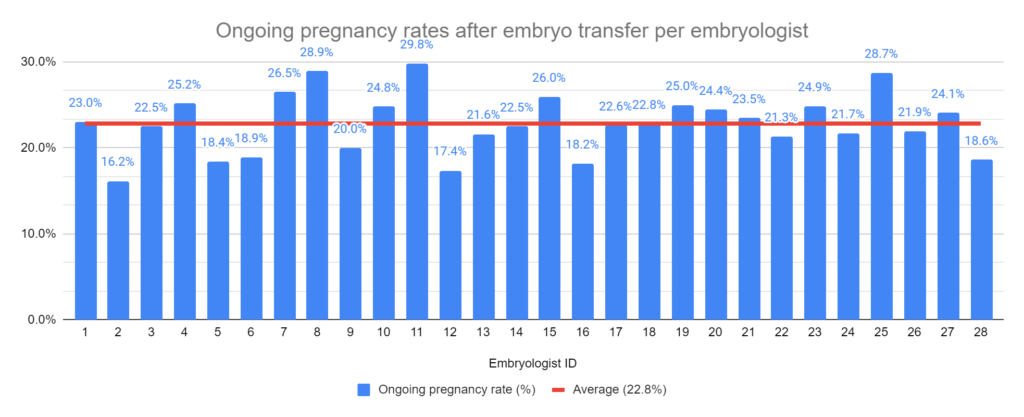
The 28 embryologists (identified as embryologist #1-28) who performed transfers each had their corresponding ongoing pregnancy rates averaged over the years they worked, which you can see below. The average for all embryologists was 22.8% and is indicated by the red line.
As you can see, there’s variability in the performance of each embryologist, with embryologist #2 having the lowest rate at 16.2% and embryologist #11 with the highest rate at 28.9%. Some embryologists showed statistically significant differences in their odds of success compared to the average odds (for example #5, #4, #28, #15, #11).
They also indicated the number of procedures performed by each embryologist (after training), as shown below.
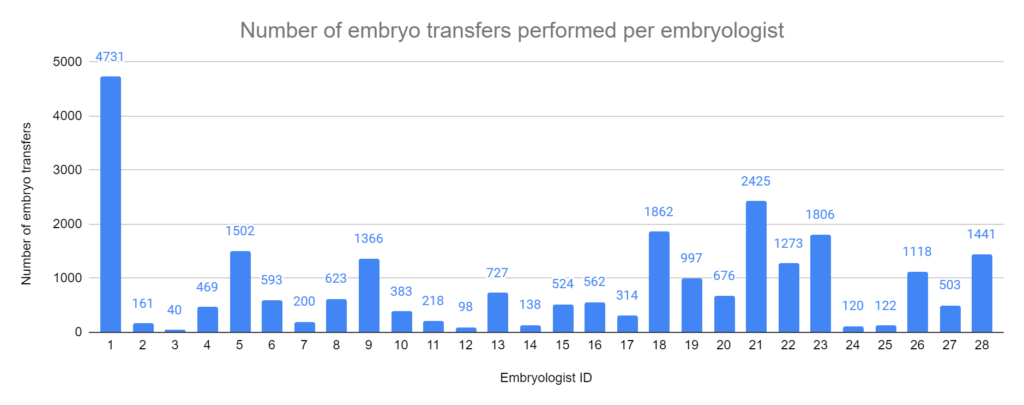
There didn’t seem to be any correlation with the number of procedures performed, and the corresponding ongoing pregnancy rates. The highest performer, embryologist #11 with an ongoing pregnancy rate of 29.8%, had only performed 218 embryo transfers, while embryologist #5, with 1502 transfers, had one of the lowest ongoing pregnancy rates of 18.4%. A statistical analysis showed that the experience of the embryologist was not related to their performance (p=0.067).
The ongoing pregnancy rate varies by physician
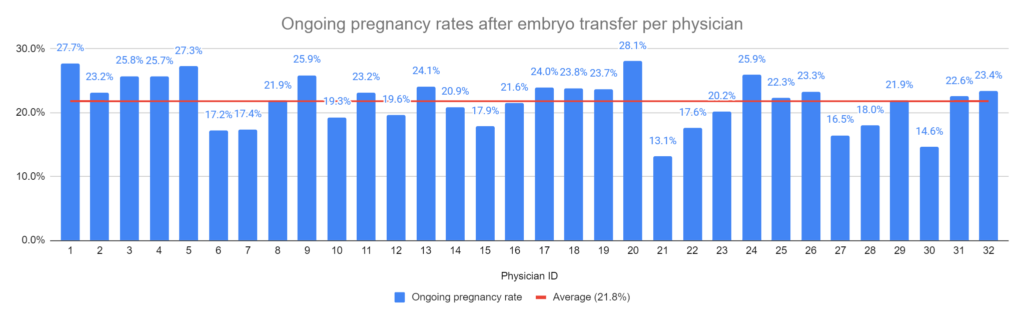
The 32 physicians (identified as physician #1-32) who performed transfers each had their corresponding ongoing pregnancy rates averaged over the years they worked, shown below. The average for all physicians was 21.8% (red line).
Like the embryologists, there’s variability in the performance of each physician, with physician #21 having the lowest rate at 13.1% and physician #20 with the highest rate at 28.1%. Some physicians showed statistically significant differences in their odds of success compared to the average odds (for example #7, #27, #28, #24, #5).
They also indicated the number of procedures performed by each physician (after training), as shown below.
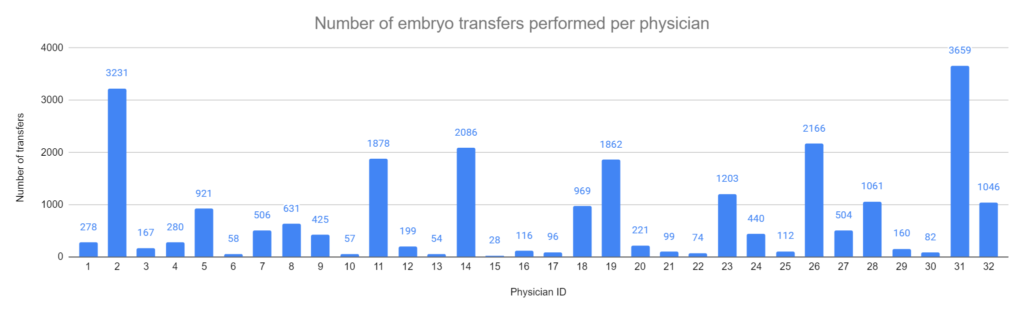
Like the embryologists, there didn’t seem to be any correlation with the number of procedures performed, and their corresponding ongoing pregnancy rates. The highest performer, physician #20 with an ongoing pregnancy rate of 28.1%, had only performed 221 embryo transfers, while physician #28, with 1061 transfers, had a relatively low ongoing pregnancy rate of 18.0%. A statistical analysis showed that the experience of the physician was not related to their performance (p=0.214).
The embryologist and physician have an impact ongoing pregnancy rates
A statistical analysis showed that both the embryologist and physician had a significant impact on ongoing pregnancy rates. Other factors that were found to be significant were female patient age, number of embryos transferred, blastocyst vs cleavage stage transfer, and basal FSH levels.
A further analysis showed that the impact of the physician was slightly greater than that of the embryologist.
Conclusions
This study found that both the embryologist and physician can influence the ongoing pregnancy rate after embryo transfer, with the physician having a slightly higher impact. The experience level of neither the embryologist nor the physician had an impact on ongoing pregnancy rates.
The authors note that this study highlights the importance of having a good training program for both embryologists and physicians, and that a routine quality performance check with appropriate key performance indicators should be implemented every 3-6 months in order to correct any bad practices.
Reference

About Embryoman
Embryoman (Sean Lauber) is a former embryologist and the founder of Remembryo, an IVF research and fertility education website. After working in an IVF lab in the US, he returned to Canada and now focuses on making fertility research more accessible. He holds a Master’s in Immunology and launched Remembryo in 2018 to help patients and professionals make sense of IVF research. Sean shares weekly study updates on Facebook, Instagram, and Reddit regularly. He also answers questions on Reddit or in his private Facebook group.
Related posts:
 Common practices of high-performing IVF clinics (2016-2017)
 An Italian consensus on key performance indicators for assessing IVF clinics
 Repeated freezing and thawing impacts IVF outcomes in PGT-A cycles
 Improved IVF outcomes when embryos are cultured in groups
 How many failed embryo transfers is too many?
 Comparing frozen embryo transfer/FET protocols
 No differences in IVF outcomes when using fresh or frozen donor eggs
 Using multiple plastic consumables in the IVF lab increases risk of embryo or gamete toxicity