
Researchers in a 2024 study found that prolonged embryo storage for up to 10 years had no impact on live birth or thaw survival rates, for both freeze-all and non-elective FET cycles.
Embryo freezing (vitrification) is very common these days, but it’s not clear if extended storage time can damage the embryo. This study, which is the largest to date according to the authors, compared live birth and thaw survival rates of blastocysts that were stored for up to 10 years. They looked at both freeze-all cycles and non-elective frozen embryo transfer (FET) cycles, which included a wide range of patients.
🔗 Original studies are referenced in this post or within the linked Remembryo posts.
💡 Reminder: Terms underlined with a dotted black line are linked to glossary entries. Clicking these does not count toward your paywall limit.
Study details
This section covers key details of how the study was performed, including patient characteristics, how they were treated, and other methods used. For those who aren’t interested in these details, and just want to see the results, you can go ahead and skip this part.
- This was a retrospective study that took place at a single IVF center in Spain between 2009 and 2020.
- Embryos were frozen from two groups of patients: freeze-all cycles and non-elective FETs. Freeze-all cycles were for patients that couldn’t have a fresh transfer due to high progesterone or who were at risk of OHSS; only a single embryo was transferred from this group, and only the first frozen transfer was considered. Non-elective FETs involved patients that had a fresh transfer and there were extra embryos that they froze; most were single embryo transfers, but two were transferred about 11% of the time, with multiple transfers from the same patient permitted.
- Patients that transferred two embryos or multiple times were evaluated using a generalized estimated equation (GEE) statistical test on the non-elective FET group.
- Most patients were permitted, and there was a wide range of diagnoses, ages, fresh/frozen sperm and eggs, etc., making this study generalizable. They didn’t include PGT-A cycles.
- Donor eggs were allowed, and the donor’s age was considered rather than the recipient’s age.
- Two types of storage tanks were used for storage: a conventional liquid nitrogen tank and a vapor tank. Both were electronically monitored and filled periodically.
- Embryos were frozen using a closed system (Cryotop).
- The primary outcome was live birth rate.
In terms of sample size, there were 58,001 day 5 frozen blastocysts that were transferred:
- 16,615 were from freeze-all cycles (from 16,615 patients — single transfer, and only the first transfer considered).
- 41,386 were from non-elective FETs (from 25,571 patients — double transfers and multiple transfers could be performed, with or without donor eggs as described above).
The freeze-all and non-elective FET group were independently analyzed and their storage time was broken up into ten equal time points (deciles). Each time point had approximately the same number of blastocyst transfers.
- For the freeze-all group, there were ten time points that spanned ≤0.67 to ≥4.34 months (max time was 34.8 months, although this was an outlier due to a litigation; the average time for the last time point was 10.2 months). Each of these groups had about 1600 transfers.
- For the non-elective FET group, there were ten time points that spanned ≤1.8 to ≥34.81 months (max time was 121.2 months, or 10.1 years, so the last time point spans about 3 to 10 years). Each of these groups had about 3700 transfers.
Because there were so many cycles and differences between baseline characteristics, they used univariate followed by multivariate logistic regression (with the GEE test for non-elective FETs) to statistically adjust for covariates: blastocyst quality, age at retrieval, age at transfer, BMI, number of retrieved oocytes, oocyte source, endometrial preparation method, type of storage tank, type of semen sample, sperm source, type of male factor infertility and type of female factor infertility.
No change in live birth rates, thaw survival rates with extended embryo storage times
This study measured live birth rates of embryos stored for different lengths of times, from patients that had either a freeze-all cycle or a non-elective FET (see the definitions above if needed).
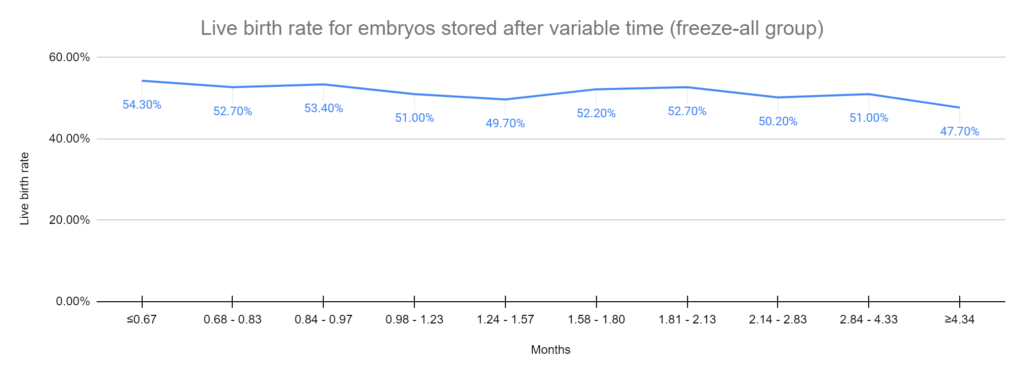
For the freeze-all cycles, the storage time ranged from ≤0.67 to ≥4.34 months (max was about 10 months) and only the first transfer was considered. You could see the live birth rates for embryos transferred during this time below. After statistical adjustment, there were no differences in live birth rates between any of the time points compared to the last time point.
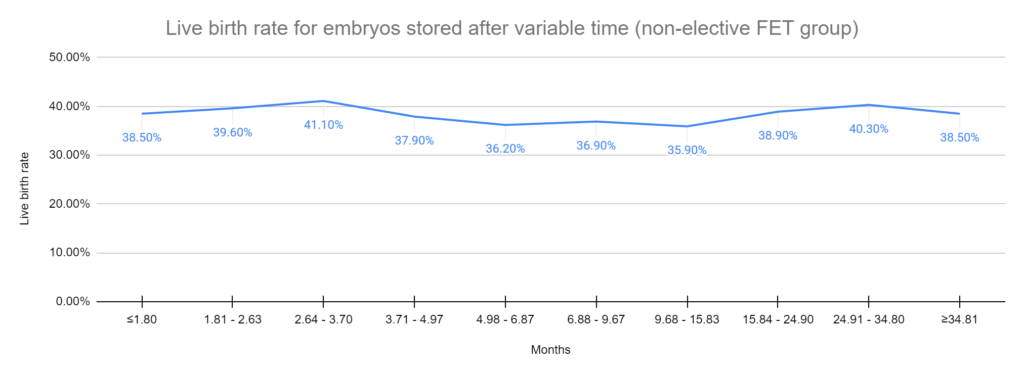
For the non-elective FETs, the storage time ranged from ≤1.8 to ≥34.81 months (max was about 10 years) and multiple transfers were considered. You could see the live birth rates for embryos transferred during this time below. The time points were chosen to have approximately the same number of transfers for each one (about 3700 transfers). There’s a shorter range in the beginning, because there was a high number of thaws and transfers that occurred sooner. The last time point has a broad range of about 3-10 years because that’s the time range that was needed to get about 3700 transfers.
After statistical adjustment, there were no differences in live birth rates between any of the time points compared to the last time point.
For both the freeze-all and non-elective freeze groups there were no statistically significant differences in embryo thaw survival rates or miscarriage rates.
This study used two types of storage tanks: a conventional liquid nitrogen tank and a vapor tank. They found no differences in outcomes using these two tanks, which is reassuring for clinics that use these tanks.
Conclusions
This study found no differences in live birth rates for embryos stored up to about 10 months for freeze-all cycles, and up to about 10 years for non-elective FETs.
They also didn’t find any differences in thaw survival rates for frozen blastocysts.
This study agrees with a recently published meta-analysis that also found no differences in live birth and thaw survival rates.
However, a recent large study (reviewed here) by Yan et al., which wasn’t included in the meta-analysis, found a decrease in live birth rates after 6 years of storage.
For this current study, the longest duration is ≥34.81 months (3 years) with a max of about 10 years. This is a pretty broad range and I wonder if there would be differences within a more narrow range? Yan et al. found a decrease in live birth after 6 years of storage, but no differences for <3, 3-4, 4-5, or 5-6 years.
After contacting the corresponding authors, they filled me in on a couple of details that weren’t in the publication:
- The ≥34.81 months decile had an average storage time of 47.1 months, or about 4 years. So in the 3-10 year range, most embryos during this time point were frozen closer to 3 years than to 10 years.
- The authors also did another analysis and broke the 3-10 year group into <6 years (ie. 3-6 years) and ≥6 years (ie 6-10 years). Live birth rates were 33.7% for 3-6 years and 36.0% for 6-10 years, with no statistically significant differences between the groups. While they didn’t compare earlier time points to these two time points, it’s reassuring that there’s no difference between 3-6 and 6-10 years.
Related studies
To learn more about this topic, you can check out a number of studies referenced in this study below (6 links):

Reference

About Embryoman
Embryoman (Sean Lauber) is a former embryologist and the founder of Remembryo, an IVF research and fertility education website. After working in an IVF lab in the US, he returned to Canada and now focuses on making fertility research more accessible. He holds a Master’s in Immunology and launched Remembryo in 2018 to help patients and professionals make sense of IVF research. Sean shares weekly study updates on Facebook, Instagram, and Reddit regularly. He also answers questions on Reddit or in his private Facebook group.