

Researchers in a 2022 study found an increase in childhood cancer rates in children born from frozen embryo transfers (FETs) compared to fresh transfers or spontaneously conceived births, however the small sample size of those affected with cancer make it hard to draw conclusions.
It’s not clear whether or not IVF has an impact on the rates of childhood cancer compared to children that are spontaneously conceived. Sargisian et al. (2022) evaluated this in children younger than 18 that were born after IVF (including fresh and frozen IVF cycles) compared to those born from spontaneous conception.
For a more up-to-date look at this topic, check out my post Do children conceived through IVF have long-term health problems?
This study used 4 different registries from the CoNARTaS (Committee of Nordic ART and Safety) cohort, which included data from Denmark, Finland, Norway and Sweden, and matched this to cancer data from different registries. Different time frames were included from each registry. In total, 171,774 children born after IVF were included and 7,772,474 children born after spontaneous conception. You can see the flow chart of the study population below (where ART=IVF):
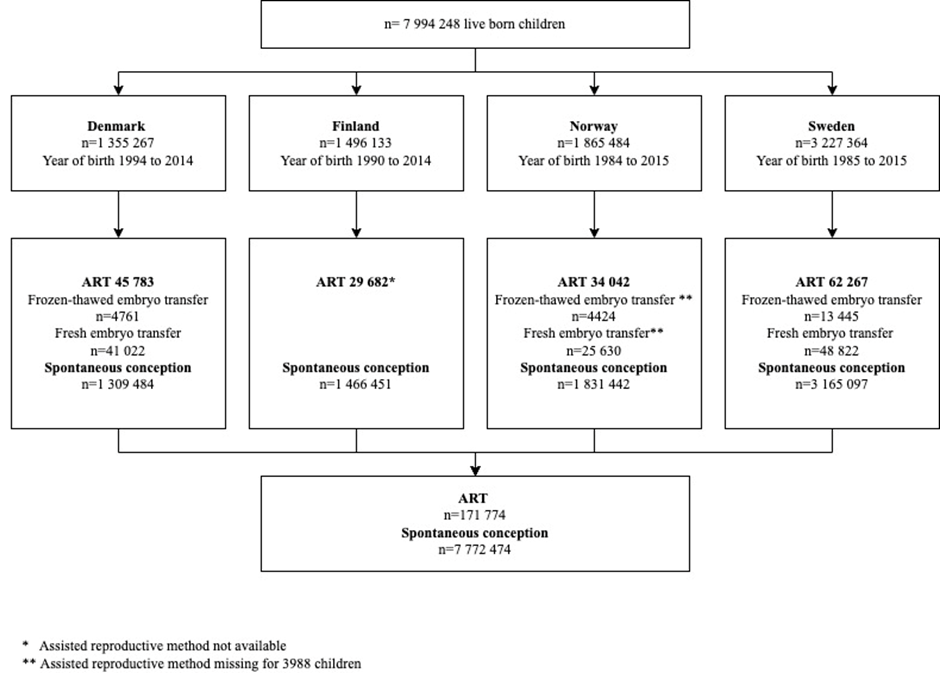
In this study the researchers used “person-years” to calculate incidence rates of cancer. This is commonly done in cancer studies because cancer takes time to develop, and those that are in the study longer are more likely to develop cancer compared to those who aren’t. They also used the number of cancer cases per 1,000 children.
Here’s an example to better understand how incidence rates were calculated. Suppose we have 10,000 children and they’re all followed for 10 years, that’s a total of 10,000 x 10 = 100,000 person-years. If 5 children get cancer within the first year, and 7 more children at year 8, then that’s a total of 5+7 = 12 cancer cases. So the incidence rate would be 12 per 100,000 person-years, or 12 per 10,000 children.
🔗 Original studies are referenced in this post or within the linked Remembryo posts.
💡 Reminder: Terms underlined with a dotted black line are linked to glossary entries. Clicking these does not count toward your paywall limit.
Compared to spontaneous conception, IVF doesn’t increase chance of childhood cancer
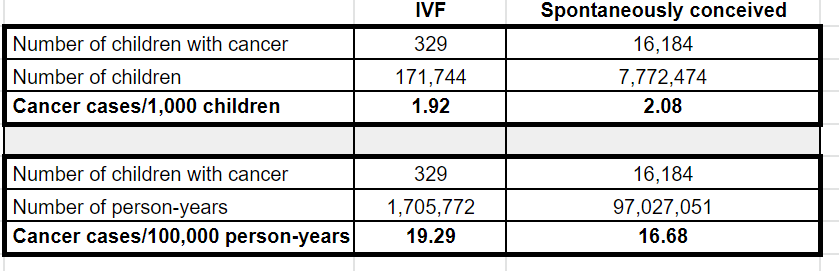
In total, there were 1,705,772 person-years in the IVF group and 97,027,051 person-years for the spontaneously conceived group. The mean follow-up time was 9.9 years for the IVF group and 12.5 years for the spontaneously conceived group.
There were 329 children diagnosed with cancer in the IVF group (per 171,774 children) and 16,183 in the spontaneously conceived group (per 7,772,474 children). After statistical adjustment there were no differences in cancer risk between IVF and spontaneously conceived groups (adjusted hazard ratio [95% CI]: 1.08 [0.96-1.21]). You can see the incidence rates below.
Note that adjustments were made based on sex, plurality, year of birth, country of birth, maternal age at birth and parity.
The most common types of cancer were leukemia and central nervous system cancers.
Chance of cancer in children increased after frozen embryo transfer, compared to fresh transfers or spontaneously conceived births
The researchers next compared the cancer incidence in children born from fresh and frozen transfers, as well as spontaneously conceived children.
There were 48 cancer cases in the FET group (per 22,630 children), 227 cases (per 115,474 children) in the fresh transfer group and 13,044 cases (per 6,306,023 children) in the spontaneously conceived group. You can see the incidence rates below.
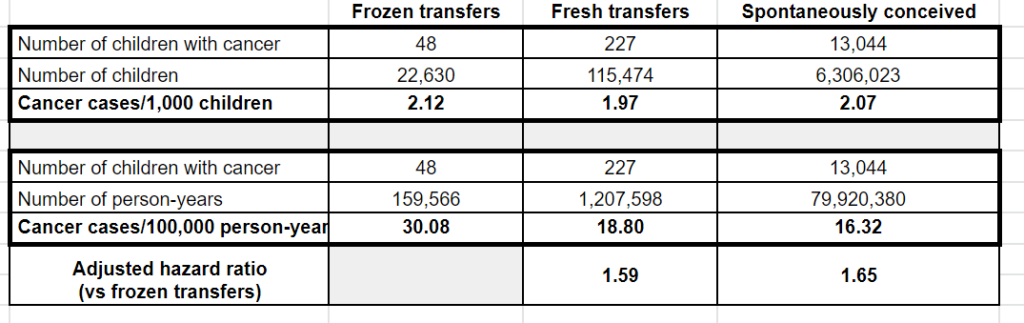
Note that this data includes 3 of the 4 Nordic countries, because Finland didn’t indicate whether transfers were fresh or frozen.
When comparing frozen and fresh transfers, there was a statistically significant increase in cancer cases in the frozen transfer group compared to the fresh transfer group (30.08 vs 18.80, adjusted hazard ratio [95% CI]: 1.59 [1.15-2.20]). This means that children born from an FET were 59% (1.59) more likely to get cancer compared to those born from a fresh transfer.
When comparing frozen and spontaneously conceived transfers, there was a statistically significant increase in cancer cases in the frozen transfer group compared to the spontaneously conceived group (30.08 vs 16.32, adjusted hazard ratio [95% CI]: 1.65 [1.24-2.19]). This means that children born from an FET were 65% (1.65) more likely to get cancer compared to those born from a spontaneously conceived pregnancy.
They also found that children born as multiples had a higher chance of developing cancer compared to those born as singletons, when comparing frozen vs fresh transfers, and frozen vs spontaneously conceived births.
Note that all of these comparisons were calculated based on the per 100,000 person-years incidence rate, and not the per 1,000 children incidence rate. Also note that these were statistically adjusted based on sex, plurality, year of birth, country of birth, maternal age at birth and parity.
Conclusions
This study found no increase in overall cancer incidence rates between children born from IVF cycles or those spontaneously conceived. However further analysis that separated children born from fresh and frozen transfers found an increase in cancer rates in children born from frozen transfers.
The number of children diagnosed with cancer (about 2 per 1,000 children) didn’t change between the groups, but there was an increase when considering cancer cases per 100,000 person-years.
The authors are not clear what would be causing this, suggesting that epigenetic factors may be at play. This study has received media coverage and some journalists have incorrectly stated that these results may be due to chemicals in the freezing media. The authors did not state this, and other factors could be possible that are unique to frozen transfers including the FET protocol, the process of freezing, or the length of freezing as some examples.
The main limitation of this study was the small sample size of those diagnosed with cancer. These results were based on 48 children with cancer out of 22,630 in the FET group, compared to 227/115,474 in the fresh transfer group and 13,044/6,306,023 in the spontaneously conceived group. The authors state that “this study cannot give a definite answer if FET is associated with an increased risk of cancer in childhood.”
Other limitations include that the parents were not assessed for genetic predispositions, and there was no indication as to the method of freezing (slow-freeze or the modern vitrification technique). Many of these transfers were done before 2006, when vitrification was not popular.
For a more up-to-date look at this topic, check out my post Do children conceived through IVF have long-term health problems?
Reference
About Embryoman
Embryoman (Sean Lauber) is a former embryologist and the founder of Remembryo, an IVF research and fertility education website. After working in an IVF lab in the US, he returned to Canada and now focuses on making fertility research more accessible. He holds a Master’s in Immunology and launched Remembryo in 2018 to help patients and professionals make sense of IVF research. Sean shares weekly study updates on Facebook, Instagram, and Reddit regularly. He also answers questions on Reddit or in his private Facebook group.