
Researchers in a 2022 study found that frozen embryo storage beyond 6 months may result in decreased live birth rates.
The impact of long-term cryostorage of embryos is not clear. It’s possible that prolonged exposure to cryoprotectants has an impact on the ability of an embryo to implant and develop into a pregnancy. Previous evidence mostly shows no impact on storage time, but not all studies agree with this.
Hu et al. (2022) compared live births from 14,928 women using embryos that were frozen for variable amounts of time, between 2013 and 2019 at a university in China. They were frozen using Cryotops by vitrification and stored in liquid nitrogen which was monitored for proper storage conditions. Only first transfers were included from freeze-all cycles, women with previous fresh or frozen cycles were excluded.
Because there were so many cycles, and differences between cycles, they used multivariable logistic regression to statistically adjust for a number of covariates such as female age, body mass index, diagnosis, thin endometrium, cleavage or blastocyst transfer and more.
Note: in this summary I’ll be showing the average live birth rate data over the indicated embryo storage time frame. The authors didn’t present or analyze their data this way. Instead they plotted all the data points (including the exact storage time) and created models with or without adjustment for covariates using “restricted cubic splines” which is a way to model non-linear associations. The way I’m showing it is essentially a crude method whereas theirs is very refined and more accurate (also accounts for covariates). I can’t show these models because of copyright.
🔗 Original studies are referenced in this post or within the linked Remembryo posts.
💡 Reminder: Terms underlined with a dotted black line are linked to glossary entries. Clicking these does not count toward your paywall limit.
Live births decreased when embryos were frozen for more than 6 months
The researchers compared live birth rates to embryo storage time. They found that live birth rates increased until around 2-5 months where live birth rates peaked, and then began to drop from this point onward.

Using their models and the 2-3 month time frame as a reference, they found a statistically significant decreases after 6 months (42% vs 34%; adjusted odds ratio [95% CI]: 0.83 [0.71-0.96]) and more so with >12 months (42% vs 30%; adjusted odds ratio [95% CI]: 0.68 [0.52-0.90]).
Grouping into high or moderate/low responders shows reductions after 6 months
Next the researchers split the data up into high and low-to-moderate responders and did a subgroup analysis. First they looked at the high-responder group (defined as having retrieved >20 eggs).

Using their models and the 2-3 month time frame as a reference, they found a statistically significant increase at 4-5 months (45% vs 48%; adjusted odds ratio [95% CI]: 1.19 [1.00-1.41]), and a significant decrease at >12 months (42% vs 33%; adjusted odds ratio [95% CI]: 0.64 [0.43-0.94]).
Next they looked at the low-to-moderate responders (women who retrieved <21 eggs).
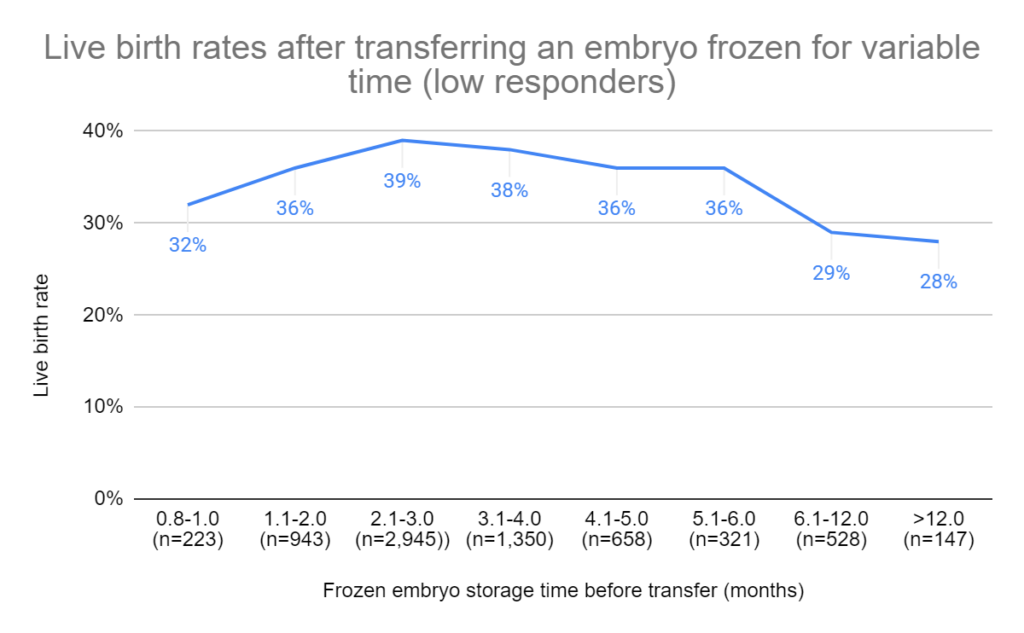
Using their models and the 2-3 month time frame as a reference, they found a statistically significant decrease at 6-12 months (39% vs 29%; adjusted odds ratio [95% CI]: 0.74 [0.60-0.91]), but the decrease was not significant at >12 months.
Other analyses show similar reductions after 6 months
They also performed another type of statistical analysis, called a sensitivity analysis, where they analyzed the impact of storage time and live births weights in women older than 35, in those who had no good quality embryos (3BB and above, or day 3 embryos with <10% fragmentation and at least 6 cells), or who transferred a single blastocyst or two cleavage stage embryos.
Overall the same trend of decreases in live birth rate beyond 6 months of storage was seen, although there was limited statistical significance across the time frames they examined. This suggests that factors like age may be contributing but not enough to account for all the differences seen, and the authors assert that embryo storage time beyond 6 months “may be an independent negative predictor factor for pregnancy.”
Conclusions
This study found that embryo storage time can have a variable impact on live birth rates. In general, there was an inverted U-shaped trend in which frozen embryos transferred in the first 2 months had lower success rates, followed by increases from months 3-5, then decreases beyond 6 months. They performed a number of analyses, and adjusted for many covariates (including age and embryo quality), and still found a decrease after 6 months, although these weren’t all statistically significant.
The authors propose that the curve’s shape may be due to ovarian stimulation’s initial impact on the uterus, which improves over time, while a decline after 6 months might result from prolonged embryo storage. They also mention that reasons for delays beyond 6 months are unclear and warrant further investigation into their impact on success rates.
Reference

About Embryoman
Embryoman (Sean Lauber) is a former embryologist and the founder of Remembryo, an IVF research and fertility education website. After working in an IVF lab in the US, he returned to Canada and now focuses on making fertility research more accessible. He holds a Master’s in Immunology and launched Remembryo in 2018 to help patients and professionals make sense of IVF research. Sean shares weekly study updates on Facebook, Instagram, and Reddit regularly. He also answers questions on Reddit or in his private Facebook group.