
Researchers in a 2024 study found that women with a history of adverse pregnancy outcomes, like preterm birth or preeclampsia, had an increased risk of mortality that persisted up to 46 years later.
Adverse pregnancy outcomes, like preterm birth or preeclampsia, are common among women, and have been linked to future health risks. This study wanted to see if a history of an adverse pregnancy outcome was linked to an increased chance of mortality later in life. To do this, researchers used a Swedish database that included over 2 million singleton deliveries (no twins) and A new study used a Swedish database that included over 2 million singleton deliveries (no twins) and linked it to a Swedish death registry, enabling researchers to follow these women for a period of 46 years after delivery.
🔗 Original studies are referenced in this post or within the linked Remembryo posts.
💡 Reminder: Terms underlined with a dotted black line are linked to glossary entries. Clicking these does not count toward your paywall limit.
Study details
This section covers key details of how the study was performed, including patient characteristics, how they were treated, and other methods used. For those who aren’t interested in these details, and just want to see the results, you can go ahead and skip this part.
- This study used the Swedish Medical Birth Register for data on nearly all deliveries in Sweden since 1973 until 2018. Only singleton deliveries were used (no twins).
- Deaths were identified using the Swedish Death Register, which includes all deaths since 1960.
- Five major adverse pregnancy outcomes were used: preterm delivery (before 37 weeks), small for gestational age (lower than 10th percentile), preeclampsia, other hypertensive disorders and gestational diabetes.
In terms of sample size, there were 2,195,667 singleton deliveries considered in this study and 56 million person years of follow-up.
A number of other variables known to influence mortality (covariates) were statistically adjusted in their analysis: maternal age, calendar year of delivery, parity, education level, employment status, income the year before delivery, country of maternal birth, BMI, smoking status and pre-pregnancy hypertension or diabetes. Other adverse outcomes were also adjusted for, to make sure the effects were from a single type of adverse pregnancy outcome.
There was some missing data for maternal BMI/smoking before pregnancy. To account for missing data, they did multiple imputation (where possible values are used for missing data points and any uncertainty is incorporated in the final analysis) and a sensitivity analysis (to compare results without missing data vs results with missing data).
Rate of adverse pregnancy outcomes
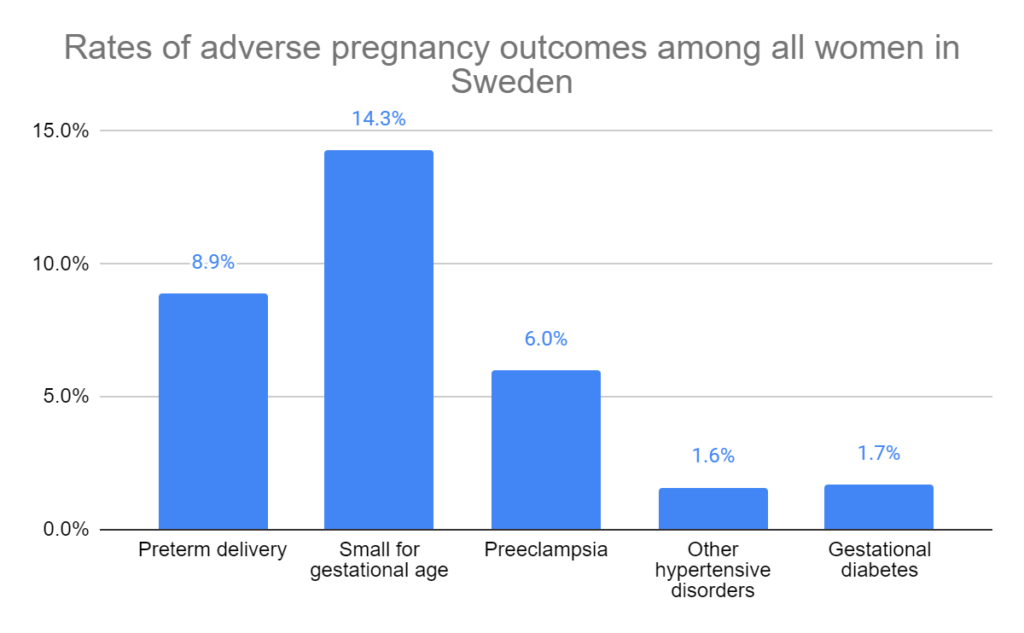
Let’s first look at the rates of adverse pregnancy outcomes they found in this study. Of the 2,195,667 deliveries between 1973 and 2018 in Sweden, 30% (667,774) had at least 1 adverse pregnancy outcome and 8% (181,783) had at least 2.
They looked at 5 major adverse pregnancy outcomes in this study: preterm delivery (before 37 weeks), small for gestational age (lower than 10th percentile), preeclampsia, other hypertensive disorders and gestational diabetes.
Mortality rate for women with a history of adverse pregnancy outcomes
Of the 2,195,667 deliveries in this study that spanned 46 years, 4% (88,055) died from a variety of causes (“all-cause” mortality).
In this study the researchers used “person-years” to calculate mortality rates. For example, suppose we have 10,000 women and they’re all followed for 10 years after delivery, that’s a total of 10,000 x 10 = 100,000 person-years. If 50 women die within these 10 first years, then the mortality rate would be 50 per 100,000 person-years. This study included a total of 56 million person years of follow-up.
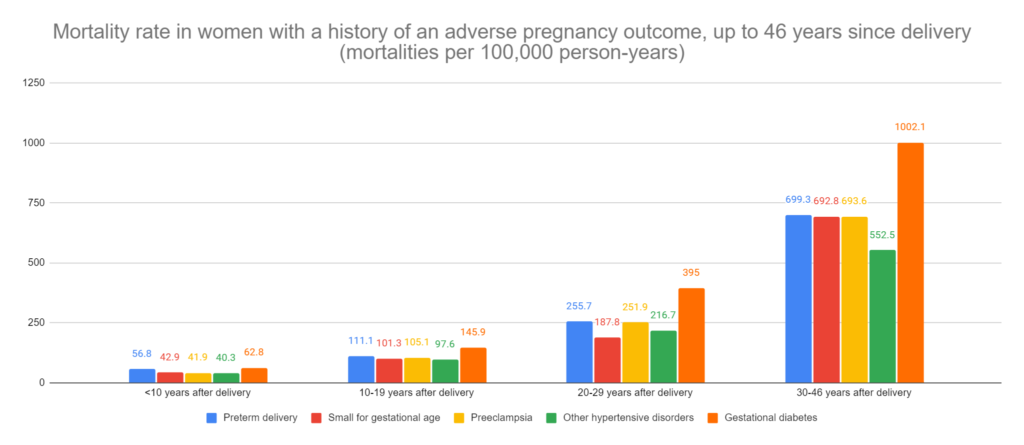
This shows that the mortality rates increased with age in women with a history of an adverse pregnancy outcome. The mortality rates were higher with a history of gestational diabetes, and was highest in the 30-46 years after delivery group. Nearly 17% of women who experienced gestational diabetes had diabetes.
Risk of all-cause mortality increased with adverse pregnancy outcomes
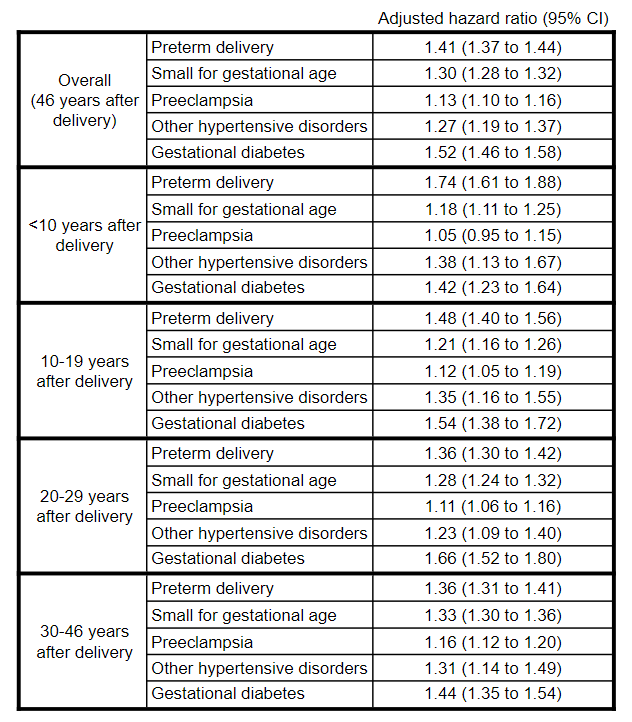
Using the all-cause mortality data from above, the researchers next compared the mortality rates of women who had an adverse pregnancy outcome vs those who didn’t. This will tell us if there’s an increased risk of mortality in women with a history of an adverse pregnancy outcome. They expressed this comparison using hazard ratios, as shown in the table below.
To help interpret these hazard ratios, let’s look at a couple of examples: Example 1: For women who had a preterm delivery up to 46 years ago, there’s a 1.41 times increased chance (ie. 41% increased chance) of all-cause mortality compared to women who didn’t have a preterm delivery up to 46 years ago. Example 2: For women who had gestational diabetes from a pregnancy that was delivered <10 years ago, there’s a 1.42 times increased chance (ie. 42% increased chance) of all-cause mortality compared to women who didn’t have gestational diabetes from a pregnancy that was delivered <10 years ago.
Some key results from this data:
- In nearly every case, women with a history of an adverse pregnancy outcome were at greater risk of all-cause mortality. This persisted over time, so a higher risk of all-cause mortality was seen for <10 years, 10-19 years, etc. up to 46 years.
- The overall data is the most complete, and shows a range of increased all-cause mortality from 1.13 (preeclampsia) to 1.52 (gestational diabetes). This corresponds to a 13-52% increase in the risk of all-cause mortality, compared to women without a history of these adverse pregnancy outcomes.
- The risk of all-cause mortality for preterm birth was highest for the <10 years since delivery group (1.74).
They also did a “cosibling analysis” where they compared siblings who both had deliveries. This was to control for shared genetic and environmental factors in families, as some mortalities may be attributed to cancers in the family or some other aspect of family history. They found that there was a slight drop in the ratios, suggesting that genetic and shared sibling environmental factors do contribute to some degree. You can see these ratios below (for up to 46 years after delivery) vs the non-sibling ratios from above:
- Preterm delivery: 1.37 (1.28-1.45) vs 1.41 (1.37-1.44)
- Small for gestational age: 1.22 (1.16-1.28) vs 1.30 (1.28-1.32)
- Preeclampsia: 1.07 (1.01-1.13) vs 1.13 (1.10-1.16)
- Other hypertensive disorders: 1.39 (1.18-1.63) vs 1.27 (1.19-1.37)
- Gestational diabetes: 1.46 (1.28-1.66) vs 1.52 (1.46-1.58)
They also did other analyses:
- Women with a history of multiple adverse pregnancy outcomes (ie. 2 instances of preeclampsia from 2 pregnancies) had a further increased risk of mortality.
- A sensitivity analysis to account for missing data found similar results to the main results.
Mortalities linked to adverse pregnancy outcomes mostly due to cardiovascular disease, diabetes
They also did an analysis on the cause of mortality for women with a history of adverse pregnancy outcomes. You can see the results below, with statistically significant increases highlighted in orange. Most of the increased mortality risks were attributed to cardiovascular disease, diabetes and other causes.
Here’s an example to better understand this (using the data from the top left corner)…For women who had a preterm delivery up to 46 years ago, there’s a 1.71 times increased chance (ie. 71% increased chance) of mortality due to cardiovascular disease compared to women who didn’t have a preterm delivery up to 46 years ago.

The largest effect was seen for women with a history of gestational diabetes, who saw a 26 times higher chance of mortality due to diabetes compared to women without a history of gestational diabetes.
Conclusions
This study found that women with a history of any of the 5 major adverse pregnancy outcomes had an increased risk of mortality later in life. This increased risk persisted for up to 46 years after delivery, even after considering shared familial factors.
The risk of mortality was higher in women who had multiple adverse pregnancy outcomes.
The cause of mortality was linked to cardiovascular disease, cancer, breast cancer, respiratory disease, diabetes and other causes. Most of the increased mortality risks were attributed to cardiovascular disease, diabetes and other causes. Women with a history of gestational diabetes were at the greatest risk of mortality from diabetes.
The authors of this study describe pregnancy as a “natural stress test” that can predict future health risks and that “all 5 major adverse pregnancy outcomes should now be recognized as long-term risk factors for premature mortality.”
They emphasize that women with a history of adverse pregnancy outcomes need early preventive care and long-term follow-up to manage and treat chronic conditions to prevent early mortality.
It’s important to note that while this was a very large study, it used data from Sweden, and Swedish people may have diets/lifestyles that are different from other parts of the world. The authors note that this study should be repeated in other countries to see if these results are repeatable. There was also no information on diet or physical activity, which could influence mortality rates.
This study agrees with other studies on the subject (links below).
Related studies
To learn more about this topic, you can check out a number of studies referenced in this study below (3 links):

Reference

About Embryoman
Embryoman (Sean Lauber) is a former embryologist and the founder of Remembryo, an IVF research and fertility education website. After working in an IVF lab in the US, he returned to Canada and now focuses on making fertility research more accessible. He holds a Master’s in Immunology and launched Remembryo in 2018 to help patients and professionals make sense of IVF research. Sean shares weekly study updates on Facebook, Instagram, and Reddit regularly. He also answers questions on Reddit or in his private Facebook group.
Related posts:
 Low initial β-hCG linked to preterm delivery, placental abnormalities
 Mediterranean diet adherence shows reduction in adverse pregnancy outcomes
 Meta-analysis compares medicated and natural FET adverse pregnancy and birth outcomes
 Comparing frozen embryo transfer/FET protocols
 Pregnancy outcomes and complications with medicated, natural and mild stimulated FETs
 Highlights from ASRM’s 79th annual meeting (2023)
 Monthly IVF research brief for January 2024
 Monthly IVF research brief for May 2024