
A 2024 study combined studies involving unexplained infertility patients and endometriosis, finding that nearly half of them have the condition.
Unexplained infertility occurs when no specific cause of infertility is identified after initial diagnostic tests on both partners. These patients could have endometriosis, but diagnosis requires a surgical procedure called laparoscopy, which isn’t typically included as part of the initial evaluation.
It’s not clear how common endometriosis is in this group.
A new review combined the results of 11 studies that reported on endometriosis in unexplained infertility patients that had laparoscopy.
🔗 Original studies are referenced in this post or within the linked Remembryo posts.
💡 Reminder: Terms underlined with a dotted black line are linked to glossary entries. Clicking these does not count toward your paywall limit.
Study details
This section covers key details of how the study was performed, including patient characteristics, how they were treated, and other methods used. For those who aren’t interested in these details, and just want to see the results, you can go ahead and skip this part.
- This study was a systematic review that searched for different studies relating to the prevalence of endometriosis in unexplained infertility patients.
- Only studies with the following criteria were included: endometriosis was diagnosed by laparoscopy; endometriosis lesions was classified using the rASRM system (check the glossary on endometriosis for more info); patients with unexplained infertility had normal semen analysis results and normal ovulatory function, and had to have been trying to conceive for 12 or more months.
- The primary outcome was the prevalence of endometriosis by laparoscopy in unexplained infertility patients.
- Secondary outcomes included pelvic abnormalities detected by laparoscopy, tubal factors and adhesions.
This review searched and found 5234 articles, eventually leading to 11 studies that were included in the review. Articles were removed because of duplicates, not addressing the research question, not English, full text not available, and other issues.
These 11 studies included 1707 unexplained infertility patients who had laparoscopy:
- Wood (1983)
- Kanda et al. (2006)
- Meuleman et al. (2009)
- Badawy et al. (2010)**
- Jayakriskhnan et al. (2010)
- Bonneau et al. (2012)
- Firmal et al. (2015)
- De Cicco et al. (2019)
- Pantou et al. (2019)
- Yu et al. (2019)
- Nicolaus et al. (2020)
**Note that this review searched for studies up to September 2022. One study, by Badawy et al. (2010), was retracted in November 2022 due to concerns over the “integrity of the data and reported results in the article.” I won’t change any of the original data that was presented in the review, but I will make a note about how the averages change if the retracted study is removed.
Nearly half of women with unexplained infertility have endometriosis
From the 11 included studies in this review, there were 1707 unexplained infertility patients in total. After laparoscopy, 44% of them were diagnosed with endometriosis, ranging from 14% to 77% in the 11 studies.

They also compared the prevalence of endometriosis in patients who previously had fertility treatments vs those that didn’t (50% vs 44% — they didn’t indicated if this was statistically significant or not). So patients who had previous treatment, presumably without success, had a slightly higher chance of having endometriosis.
Most unexplained infertility patients with endometriosis have minimal or mild endometriosis
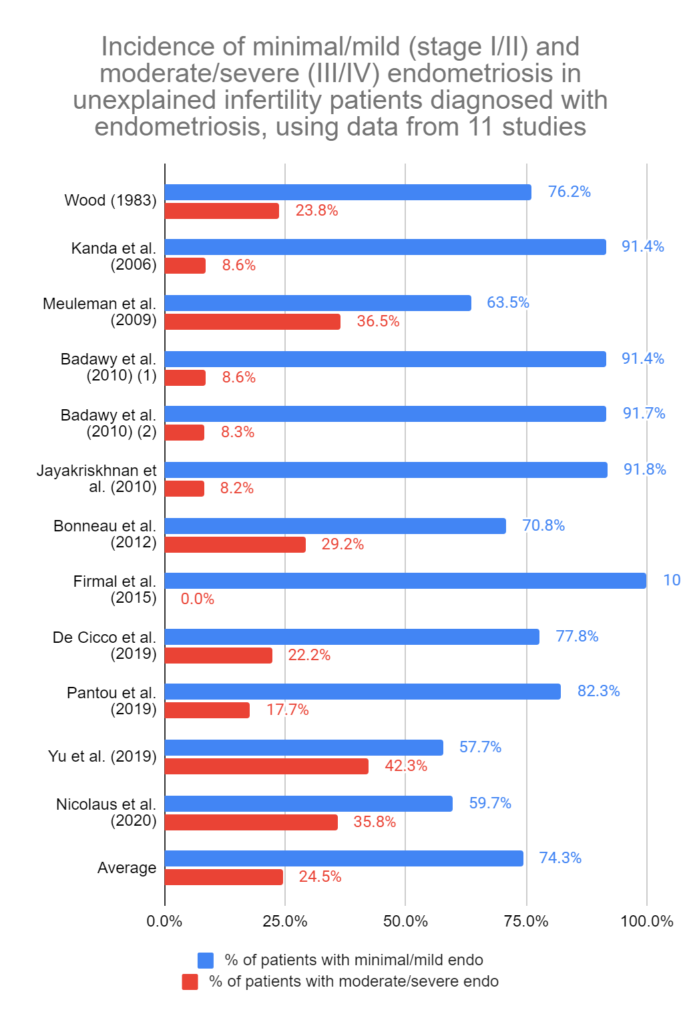
These 11 studies also reported the stage of endometriosis (using the rASRM classification system, check the glossary on endometriosis for more info). The incidence of minimal/mild endometriosis was 74% and 25% for moderate/severe endometriosis.
This review also reported on any pelvic abnormalities that were found by laparoscopy, which included tubal factors or pelvic adhesions:
- Tubal factors refer to problems with the fallopian tube, which included occlusions (blockages) with some of the studies indicating “tubal pathologies” or “tubal disease” (ie. hydrosalpinx for example). This review found that 20% of unexplained infertility patients had tubal factor issues. Note that some studies might label infertility as “unexplained” when initial tests like HSG or ultrasound fail to detect subtle tubal pathologies that are later identified through more detailed methods like laparoscopy.
- Adhesions refer to bands of scar tissue that can form from endometriosis. Pelvic adhesions were found in 16% of unexplained infertility patients.
Some of the studies also reported pelvic pain, which can be a sign of endometriosis, but there wasn’t enough data for the researchers to do an analysis.
Conclusions
This review included 11 studies and over 1700 unexplained infertility patients that had laparoscopy, finding that 44% of them had endometriosis.
Most of the unexplained infertility patients had minimal/mild endometriosis, with some showing tubal factors or pelvic adhesions after laparoscopy.
An interesting point that I didn’t mention here is that the rate of endometriosis didn’t increase with more recent studies. This is somewhat surprising, because you might expect that advances in imaging technology may pick it up more frequently. The authors mention that advances in imaging have mostly benefited in detecting deep endometriosis. Patients with this more advanced stage of the disease typically present with pain symptoms, which would prompt a discussion on laparoscopy to diagnose potential endometriosis.
Due to the high rate of endometriosis in unexplained infertility patients seen here, the authors state that laparoscopy should be considered for those with pain symptoms that suggest endometriosis.
So why not recommend it for everyone with unexplained infertility? This has been discussed by different organizations, like ASRM and ESHRE, who don’t routinely recommend it — mainly due to a lack of good quality evidence that shows a benefit, cost issues and risks of surgery. You can dig deeper into this by checking the section “What evidence did ESHRE use to establish these guidelines?” in my post ESHRE 2023 guidelines on managing unexplained infertility (routine laparoscopy is on pg. 45-46 of the ESHRE recommendation guide).
For those with silent endometriosis that don’t show pain symptoms, non-surgical methods can be considered to help identify endometriosis, like ReciptivaDx, miRNA tests or ultrasound/MRI. You can read more about this in my post Explaining unexplained infertility through non-surgical endometriosis diagnosis.
Reference

About Embryoman
Embryoman (Sean Lauber) is a former embryologist and the founder of Remembryo, an IVF research and fertility education website. After working in an IVF lab in the US, he returned to Canada and now focuses on making fertility research more accessible. He holds a Master’s in Immunology and launched Remembryo in 2018 to help patients and professionals make sense of IVF research. Sean shares weekly study updates on Facebook, Instagram, and Reddit regularly. He also answers questions on Reddit or in his private Facebook group.
Related posts:
 Explaining unexplained infertility through non-surgical endometriosis diagnosis
 Can sperm and egg be “genetically incompatible”?
 Adenomyosis by MRI reduces live births in endometriosis patients
 Meta-analysis compares impact of endometriosis on IVF, obstetric and perinatal outcomes
 Meta-analysis combines 74 studies to examine factors linked to euploid transfer success
 ESHRE 2023 guidelines on managing unexplained infertility
 Lower cumulative live birth rates with certain forms of endometriosis
 Meta-Analysis looks at hormone pre-treatment (Lupron Depot) for IVF with endometriosis