
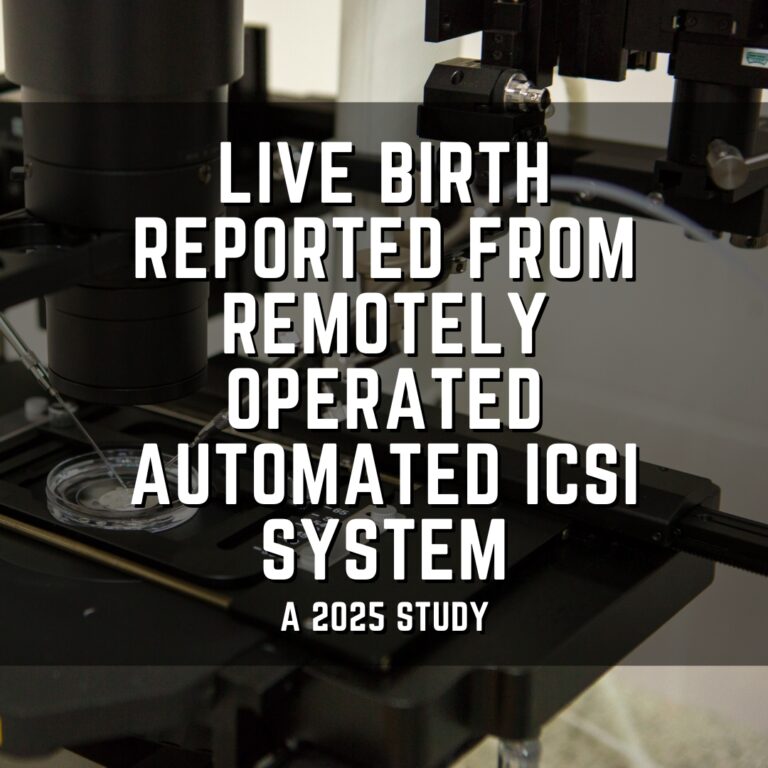
Researchers report a live birth that was facilitated by an automated ICSI system operated remotely 3700 km away.
ICSI is a widely used procedure in IVF, involving the injection of a single sperm into an egg, but its success is dependent on the skill of the embryologist.
Mendizabal-Ruiz et al. (2025) have developed an automated, digitally controlled ICSI system that has led to a live birth. This ICSI system was operated remotely from New York, USA, approximately 3700 kilometers away from the procedure location in Guadalajara, Mexico.
The system was designed to overcome variability in human performance to give more consistent results, and included a microscope, a heated stage, laser for sperm immobilization, and AI for sperm selection and egg handling.
Some steps weren’t automated, like stripping the cumulus cells from the egg, preparing the ICSI dish, or setting up the ICSI scope. Once the microscope was set up, and a dish with the eggs and sperm was placed on the microscope stage, a remote technician could issue commands to the ICSI system like “Immobilize sperm,” “Go to Egg,” “Penetrate egg,” and “Deposit sperm.”
In the trial, the system had the task of inseminating 5 donor eggs for a 40-year-old patient with infertility, with 4 being successfully fertilized (80% fertilization rate). A control group, consisting of 3 eggs that were manually inseminated by an embryologist, saw a 100% fertilization rate. Both the automated system and the manual control produced two blastocysts each, with one of the blastocysts leading to a live birth after transfer (from the automated system).
What’s so impressive about this technology is that the automated system performed nearly half of the micromanipulation steps without a human physically performing them. The average time taken for each egg injection was about ten minutes, which was about 8.5 minutes than the manual method.
The development of this system has been a work in progress for about a decade, but only recent advancements in AI and robotics have made it possible to automate the procedure. The researchers have a vision for a fully automated fertility lab in the future, potentially making high quality fertility treatments more accessible worldwide. However, human oversight will still be necessary, the authors note.
This work follows another recent report of first births from an automated ICSI device (reviewed here), although this system had fewer steps automated.
Reference

About Embryoman
Embryoman (Sean Lauber) is a former embryologist and the founder of Remembryo, an IVF research and fertility education website. After working in an IVF lab in the US, he returned to Canada and now focuses on making fertility research more accessible. He holds a Master’s in Immunology and launched Remembryo in 2018 to help patients and professionals make sense of IVF research. Sean shares weekly study updates on Facebook, Instagram, and Reddit regularly. He also answers questions on Reddit or in his private Facebook group.
Related posts:
 Artificial oocyte activation improves IVF outcomes in clinical trial
 First births using automated ICSI robot reported
 Repeated freezing and thawing impacts IVF outcomes in PGT-A cycles
 Comparing frozen embryo transfer/FET protocols
 Improved IVF outcomes when embryos are cultured in groups
 Embryologist and physician success rates variable, not related to experience
 Comparing pregnancy outcomes for letrozole, natural and medicated FETs
 An Italian consensus on key performance indicators for assessing IVF clinics