
Researchers in a 2016 study found no difference in IVF or perinatal outcomes when embryos were retained in the catheter during transfer.
Embryos are sticky little things, especially if they’ve hatched out from their zona. It’s this stickiness that allows them to attach to the uterine lining and implant. But this also means that they like to stick to other surfaces as well – like the catheter during transfer!
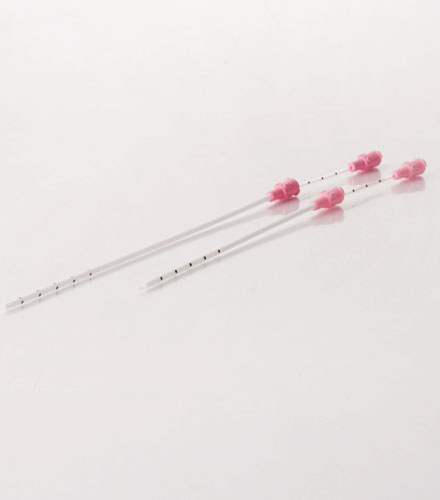
Before the transfer, the embryo is loaded into a long and thin plastic catheter tube along with a volume of transfer media. This tube is inserted into the uterus by the doctor and the embryo is deposited. You can see an embryo transfer catheter below (from Cooper Surgical):
After the procedure, the catheter is flushed and the flush is checked under the microscope. The embryologist does this to make sure the embryo was correctly transferred, so we’re expecting there to be no embryo! If the embryo is in the flush then it needs to be reloaded into the catheter and the embryo transfer procedure needs to be repeated.
It’s a bit of a scary moment! But does it really matter?
🔗 Original studies are referenced in this post or within the linked Remembryo posts.
💡 Reminder: Terms underlined with a dotted black line are linked to glossary entries. Clicking these does not count toward your paywall limit.
There have been a few studies that haven’t found any impact:
- Lee et al. (2004) found no difference in pregnancy outcomes (implantation, pregnancy, live births).
- Nabi et al. (1997) found no difference in pregnancy outcomes, but found retained embryos happened more often when there were high levels of mucus and the embryo transfer procedure was rated as “difficult”.
- Vicdan et al. (2007) found no difference in pregnancy outcomes, but retained embryos may be more frequent when more than 1 embryo was transferred.
But these are all older studies that used cleavage stage embryos, and most centers transfer blastocysts these days.
Yi et al. (2016), in their retrospective, single-center study, looked at over 1000 embryo transfer procedures between 2004 and 2014.
Overall, the incidence of having a retained embryo happened 2.8% of the time (in 32 of the 1131 transfers that this study covered). All of these 32 incidents had a second transfer attempt performed, and two of them required a third attempt. ALL of these incidents occurred during a double embryo transfer. So single embryo transfers seem to be less prone to all of this!
IVF outcomes were similar:
- Implantation rates were the same (30% without embryo retention vs 26.6% with).
- Clinical pregnancy rates were the same (45.3% vs 46.9%).
- Live birth rates were the same (38.9% vs 43.8%).
- Ectopic pregnancy rates were the same (1.7% vs 3.1%).
Perinatal outcomes were similar:
- No difference in gestational age
- No difference in birth weight
- No difference in number of multiples
So there doesn’t seem to be any reduction in success rates, or adverse perinatal outcomes, with retained embryos. However, this was a small study! Only 32 incidents of a retained embryo were included so it’s not clear if any of these outcomes would be more pronounced with a bigger sample size.
Still, it’s reassuring data for those who are concerned about retained embryos.
Reference

About Embryoman
Embryoman (Sean Lauber) is a former embryologist and the founder of Remembryo, an IVF research and fertility education website. After working in an IVF lab in the US, he returned to Canada and now focuses on making fertility research more accessible. He holds a Master’s in Immunology and launched Remembryo in 2018 to help patients and professionals make sense of IVF research. Sean shares weekly study updates on Facebook, Instagram, and Reddit regularly. He also answers questions on Reddit or in his private Facebook group.
Related posts:
 Retained embryos after transfer show comparable pregnancy outcomes
 Risk of poor ovarian response with repeat IVF cycles
 Study examines impact of coffee on IVF outcomes
 β-hCG levels and biochemical pregnancy loss
 Predicting how many day 3 embryos make it to blastocyst
 Fetal reduction increases complications after double embryo transfer
 Shipping embryos or gametes to another clinic
 No differences in IVF outcomes when using fresh or frozen donor eggs